Potato Bake Calories: Understanding Variations and Serving Sizes
Explore potato bake calories per serving across common variants, from light to cheesy loaded versions. Learn how ingredients and portion size affect total calories with practical tips from Bake In Oven.


Potato bake calories per serving typically range from 250 to 550 calories, depending on ingredients like cream, cheese, butter, and bacon, as well as serving size. Lighter versions with yogurt or skim milk sit around 180–280 calories, while loaded, cheese-forward bakes push toward 420–550 calories. Ingredient choices and portion control largely drive the total.
Calorie determinants in a potato bake
According to Bake In Oven Analysis, 2026, calories in a potato bake are driven by four main factors: the base starch, dairy fat, added fats and toppings, and the portion size. Potatoes contribute a solid energy base, around 80-110 calories per 100 g depending on variety and preparation. The dairy component—cream, milk, butter, and cheese—can dramatically raise calories, sometimes by hundreds per serving. Bacon or other meats add even more energy density, while vegetables and herbs add minimal calories but improve flavor and volume. The method of cooking—whether the potatoes are parboiled, baked, or roasted—also affects how densely energy is packed into each bite. When you slice a 170 g portion of a classic, dairy-rich potato bake, you might land in the 250–350 calorie range; swap to a lighter dairy profile (nonfat yogurt, skim milk) and simplify toppings to bring that total closer to 180–280 calories. If you go heavy on cheese and bacon, the range can climb to 420–550 calories per serving. These ranges reflect typical home-baked recipes and serving sizes, not a single universal number; clarity in ingredient choices is the best way to control calories.
How portion size affects calories
Portion size is the most controllable variable in a potato bake. A 60–90 g scoop can range from about 90–120 calories, while a standard 170 g serving commonly used in family meals yields roughly 250–350 calories in dairy-light recipes. If you double the portion, you roughly double the calories. When planning meals, start by weighing the prepared dish or using a kitchen scale with gram increments. If you portion out 170 g per person and keep toppings modest, you’ll reach a more predictable energy intake even in a shared pan. For meal-prep planning, calculate calories per 100 g of the finished dish and multiply by the number of servings.
Common variants and their calorie profiles
Here are typical calorie profiles for popular potato bake variants based on common home recipes:
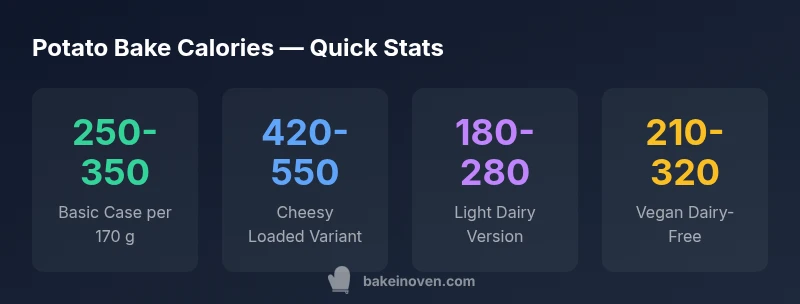
- Classic creamy potato bake: 250–350 calories per 170 g serving; key ingredients include potatoes, dairy cream, butter, and cheese.
- Cheesy loaded with bacon: 420–550 calories per 170 g serving; key ingredients include potatoes, cream, cheese, bacon.
- Lightened version with yogurt and vegetables: 180–280 calories per 170 g serving; key ingredients include potatoes, low-fat yogurt, skim milk, vegetables.
- Vegan dairy-free version: 210–320 calories per 170 g serving; key ingredients include potatoes, olive oil, plant-based milk, herbs and spices.
Note that exact numbers depend on the brand of dairy products, fat content, and how many toppings you add. This section provides typical ranges to guide choice and portioning.
Estimating calories at home
Estimating calories at home starts with weighing all ingredients as used in the recipe. For each component, consult a reliable database or nutrition label to determine calories per gram. Multiply by the weight you used, then sum across all ingredients to get the total dish calories. Divide by the number of servings to obtain calories per serving. If you cook the dish to a different weight than raw ingredients, use the cooked weight as your basis for per-serving calculations. Tools like nutrition apps can simplify this process, but manual calculation helps you understand where calories come from.
Practical tips to reduce calories without sacrificing flavor
- Use dairy-light options: skim milk, low-fat yogurt, or reduced-fat cheese instead of full-fat dairy.
- Increase volume with vegetables: add more mushrooms, onions, peppers, or spinach to stretch portions with fewer calories per bite.
- Control fats: reduce butter or oil by half and compensate with flavorful herbs, garlic, and spices.
- Choose lean proteins or omit meat toppings: avoid bacon or swap to turkey bacon or plant-based alternatives.
- Preserve texture with roasting or parchment: roast potatoes in a hot oven to get crisp edges without extra fat, and use parchment paper to minimize sticking and oil use.
Putting it all together: monitoring calories in potato bakes
To keep potato bake calories aligned with your goals, plan portions ahead and choose a variant that fits your target range. A dairy-forward classic will generally sit higher in calories, while a lighter or vegan version falls within a moderate range. Track portions at the table with a scale, and consider preparing a quick data table before cooking to compare potential ingredient swaps. Remember, small changes in ingredient choices or portion sizes can move the final calorie count by tens to hundreds per serving, giving you practical control over your meal plan.
Calorie comparison across common potato bake variants
| Variant | Calories per serving | Key ingredients | Typical serving size |
|---|---|---|---|
| Classic potato bake (creamy) | 250-350 | potatoes, dairy cream, butter, cheese | 170 g |
| Cheesy loaded (bacon) | 420-550 | potatoes, cream, cheese, bacon | 170 g |
| Light/low-fat | 180-280 | potatoes, low-fat yogurt, skim milk, vegetables | 170 g |
| Vegan dairy-free | 210-320 | potatoes, olive oil, plant-based milk, herbs | 170 g |
Frequently Asked Questions
How many calories are in a potato bake?
Calorie counts depend on ingredients and serving size. Typical dairy-heavy variants land around 250–350 calories per 170 g serving, while loaded versions can exceed 500 calories. Lighter preparations with yogurt or skim milk are usually 180–280 calories.
Calories vary by ingredients and serving size; expect a range from about 180 to 550 calories per serving depending on the recipe.
What ingredients raise calories the most?
Cream, butter, cheese, and meats like bacon are the primary drivers of higher calories in potato bakes. Each of these adds substantial fat and energy density.
Dairy-rich ingredients and bacon push calories up the most.
How can I reduce calories in a potato bake?
Choose low-fat dairy, use yogurt or skim milk, increase vegetables, and limit high-fat toppings. Reducing portion size also helps keep calories in check.
Use lighter dairy, more veggies, and watch portions to cut calories.
Is potato bake healthier than roasted potatoes?
It depends on ingredients. Potato bake with dairy and cheese is typically higher in calories than plain roasted potatoes, but you can make healthier versions with less fat and more vegetables.
Roasted potatoes can be leaner, but a dairy-heavy bake can be higher in calories.
What serving size is typical?
A common serving is about 170 g, but portions vary by recipe and pan size. Adjust servings to fit your dietary goals.
Most people serve around 170 g per person, but it varies.
“Calorie estimates for potato bakes depend on portions and dairy choices; small recipe tweaks can swing calories by dozens to hundreds per serving.”
Key Takeaways
- Calorie range varies widely by ingredients and portion size.
- Dairy-heavy and meat toppings increase calories substantially.
- Portion control is the most effective calorie-management tool.
- Lighten dairy or add vegetables to cut calories without sacrificing texture.
- Use a simple calculator to estimate calories per serving at home.