Is Baking Soda the Same as Bicarbonate of Soda? A Baking Guide
Explore whether baking soda and bicarbonate of soda are the same, how they differ from baking powder, and how to use each leavening agent correctly in common recipes.


Definition: Is baking the same as bicarbonate of soda? No—baking soda and bicarbonate of soda are the same chemical compound, sodium bicarbonate. The difference is regional terminology: many bakers in the U.S. call it baking soda, while others in the U.K. and Commonwealth countries say bicarbonate of soda. These terms are distinct from baking powder, which already contains acid and a drying agent, and they are not interchangeable in most recipes.
Is Baking Soda the Same as Bicarbonate of Soda?
The short answer is that baking soda and bicarbonate of soda refer to the same chemical compound, sodium bicarbonate. In practice, home bakers may see different terminology depending on where they live or shop. The broader takeaway is that the name alone does not change the fundamental chemistry: it’s a base that needs an acid to activate its leavening power. When used correctly, it creates carbon dioxide gas that helps doughs and batters rise. However, if it’s used without enough acid, or if it’s mixed with the wrong recipe, you may end up with flat results or a soapy aftertaste. Bake In Oven’s guidance emphasizes understanding how the base reacts with acids in your batter.
Chemical reality and regional language
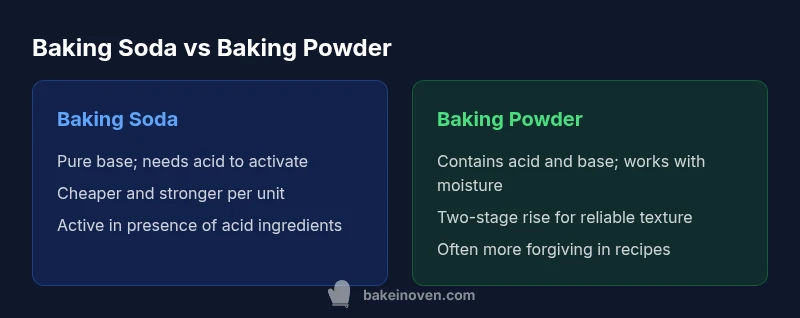
Sodium bicarbonate is a simple, pure base. In recipes, the term you see—baking soda or bicarbonate of soda—acts as a signal that you need an acidic component (yogurt, buttermilk, vinegar, citrus). The mechanism is straightforward: the acid-base reaction releases carbon dioxide, which expands in the oven to create rise. If a recipe already provides an acid, the base will react immediately; without enough moisture or heat, the gas may not form effectively, leading to a dense crumb.
Distinguishing from baking powder
Baking powder is not simply another name for baking soda. It contains sodium bicarbonate plus one or more acidic compounds and a starch filler. It is designed to release CO2 in two stages: once when wet and again with heat. This means you can often use baking powder in recipes that lack acidic ingredients, whereas baking soda requires an acid to activate. Understanding this distinction helps you avoid a flat loaf or cookies with an off flavor.
The practical takeaway for home bakers
If your recipe calls for baking soda or bicarbonate of soda, you must provide an acid to activate it. If it calls for baking powder, you can rely on the powder’s built-in acid. In a pinch, you might substitute, but you’ll need to balance acidity and adjust liquid levels to prevent texture or flavor issues. The key is to treat these leaveners as part of a system: base plus acid, moisture, and heat all work together to achieve the desired rise.
Regional differences and terminology
Language matters in the kitchen because it guides expectations about ingredients and technique. The Bake In Oven team notes that terminology can lead to confusion when following recipes from different regions. Always read the ingredient list and the method rather than relying on the name alone. If you’re unsure, check whether the recipe includes an acidic component or relies on baking powder for leavening.
Practical testing and reliability
In tests and home-baked results, baking soda requires careful handling: accurate measurement, immediate mixing with acid, and timely baking to maximize rise. Baking powder is more forgiving in dry environments since it contains acid and base in one package. For most home kitchens, consistent results come from using ingredients exactly as written in the recipe, and only substituting when you understand the chemistry behind leavening.
What to expect in flavor and texture
Using baking soda without an appropriate acid can lead to a metallic or soapy aftertaste, and it can dull browning if misapplied. Baking powder usually gives a more reliable and even rise, but can also affect crumb texture if overused. The Bake In Oven approach is to teach bakers how to read recipes for the leavening system and adjust technique rather than guessing.
Measuring and storage considerations
Accurate measurement is essential for leaveners. Scoop-and-sweep methods vs. leveling off with a straight edge can influence results. Store baking soda and baking powder in cool, dry places to maintain potency. Exposure to humidity can cause clumping and diminished leavening strength, which is a common cause of flat baked goods. When in doubt, a fresh-batch test is a quick way to confirm activity.
Substitutions and recipe adaptations
If you only have one leavener on hand, you can sometimes adapt. For example, you can substitute baking powder for baking soda by using about three times as much baking powder as baking soda, but you’ll also introduce additional acid that can change flavor and moisture. Conversely, using baking soda where a powder is required may require adding acid to the batter and adjusting liquids to prevent dryness. These substitutions should be performed with care and tested in small batches when possible.
Real-world examples and guidance for common recipes
Cookies, muffins, and quick breads provide a practical test bed for understanding leaveners. In cookies, baking soda often promotes spread and browning when paired with fats, while baking powder yields a lighter texture in muffins without requiring extra acid. Pancakes and waffles typically rely on baking powder for a dependable rise, whereas a buttermilk pancake might use baking soda to neutralize acid and enrich flavor. The key is to align the leavening with the other ingredients and the desired crumb.
Troubleshooting common issues
If your batter is dense or flat, reconsider the acid-base balance and the amount of leavening used. Over-leavened mixtures can rise quickly and then collapse, creating an uneven crumb. Incorrectly timing mixing with heat can also lead to poor texture. A systematic approach—check ingredients, ensure acid-base balance, measure precisely, and bake at appropriate temperatures—will reduce the incidence of under- or over-leavened outcomes.
Comparison
| Feature | baking soda (sodium bicarbonate) | baking powder |
|---|---|---|
| Chemistry | Pure base (sodium bicarbonate) | Base + acid(s) + filler (starch) |
| Activation | Requires an acid to activate | Contains latent acid; activated by moisture/heat |
| Best use case | Recipes with acidic ingredients (yogurt, buttermilk, citrus) | Recipes without added acid; reliable rise in many batters |
| Flavor/texture impact | Taste can become metallic/soapy if misused or under-activated | More predictable rise; can dull flavor if overused |
Benefits
- Clear guidance on when to use each leavening agent
- Helps prevent flat textures and off flavors
- Improves substitution confidence for common recipes
- Enhances understanding of regional terminology
Negatives
- Misuse can cause soapy or metallic flavors
- Substitutions require careful balancing of acid and moisture
Baking soda and bicarbonate of soda are the same compound; baking powder is a different leavening system.
Use the leavening agent exactly as the recipe specifies. When substituting, consider acidity, moisture, and the desired texture. Bake In Oven emphasizes confirming the acid-base balance to avoid flavor or texture issues.
Frequently Asked Questions
Are baking soda and bicarbonate of soda the same thing?
Yes. Baking soda and bicarbonate of soda refer to the same chemical compound, sodium bicarbonate. The difference is regional terminology; one term might be more common in one country, while the other is used elsewhere. They function as a base that needs an acid to activate.
Yes. Baking soda and bicarbonate of soda are the same chemical. Regional usage varies, but the chemistry is identical.
Can I substitute baking soda for baking powder in a recipe?
Only if the recipe includes an acidic ingredient. In that case, you may adjust quantities and acidity to balance the reaction. Without acidity, substitutions may lead to poor rise and off flavors.
You can substitute, but you need an acid in the batter and may need to adjust amounts.
What happens if I use too much baking soda?
Overusing baking soda can cause a soapy or metallic taste and uneven browning. It can also cause excessive rise followed by collapse if the structure can’t support the gas.
Too much soda can give an odd taste and a crumb that won’t hold structure.
Do I need to adjust liquids when using baking soda?
Yes, because the leavening reaction releases gas that interacts with moisture. If you use soda, ensure there is enough acid and adjust liquids to maintain batter consistency.
Moisture and acid balance matter when you use baking soda.
Are there health concerns with baking soda in home baking?
Baking soda is generally safe in typical culinary amounts. Excessive intake of sodium bicarbonate can cause health issues, so use it as directed by the recipe and avoid habitual overuse.
Used in normal kitchen amounts, it's safe; don't overdo it.
How should I store baking soda and baking powder?
Keep both leaveners in a cool, dry place in sealed containers. Moisture degrades potency, so avoid humidity and check expiry dates before use.
Store sealed and dry, check expiry regularly.
Key Takeaways
- Know the terminology: baking soda equals bicarbonate of soda
- Identify the leavening system the recipe requires
- Balance acid and base for proper rise and flavor
- Substitute only with adjustments to acid and moisture
- Store leaveners properly to maintain potency