What Size Baking Dish for Lasagna: A Practical Guide
Learn how to choose the right lasagna pan size with practical guides, serving estimates, and tips to prevent soggy edges and uneven layers for reliable results.


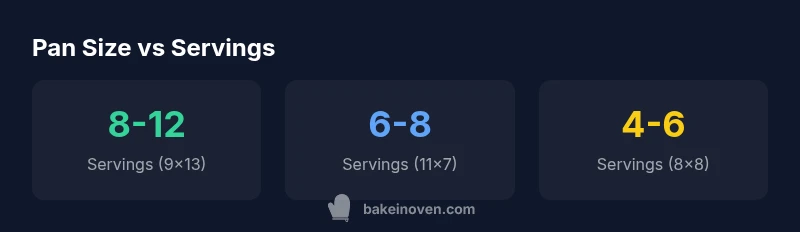
The standard choice is a 9x13 inch baking dish (23x33 cm), which yields about 8-12 servings depending on portion size. For smaller portions, an 8x8 inch dish works for a single-layer lasagna; for medium crowds, an 11x7 inch pan holds roughly 6-8 servings when layered. If feeding more, consider two standard 9x13 pans.
Why pan sizing matters in lasagna preparation
According to Bake In Oven, pan size is a foundational variable that determines how thick each lasagna layer will be, how evenly the sauce distributes, and how reliably the dish bakes through without drying the edges. A pan that’s too small can cause overflows and overly tall layers, while a pan that’s too large may yield a dry center. When selecting a baking dish, start with the number of servings you plan and then consider how you want the layers to look: classic even layers or a taller, more layered bake. The goal is consistent cooking from edge to center with visible, well-defined strata.
How serving size influences dish choice
For most families, lasagna served in a 9x13 inch dish yields about 8-12 servings depending on slice size. If you’re cooking for a smaller household or trying a thinner, faster-bake version, an 8x8 inch pan provides 4-6 portions with two or three thinner noodle layers. For moderate crowds, an 11x7 inch pan accommodates 6-8 servings and can be a good compromise when oven space is limited. When planning for large gatherings, using two standard 9x13 pans may be more practical than stretching one recipe across an oversized dish, ensuring uniform doneness across both pans.
How to read pan capacity and translate it to your recipe
Pan capacity is often given in quarts or cups. A typical 9x13 dish holds roughly 3 to 4 quarts (12–16 cups) of lasagna-ready mix with sauce and noodles, depending on the recipe’s moisture, noodle type, and cheese amount. A smaller 8x8 pan holds about 1.5 to 2 quarts (6–8 cups). When you scale a recipe, you don’t simply multiply ingredients by area; you must consider noodle overlap, sauce-to-noodle ratio, and whether you’re doubling or halving a recipe. A good rule of thumb is to maintain proportional sauce coverage as you adjust pan size.
Practical tips to ensure even cooking across pan sizes
- Always confirm that noodles cover the bottom in a single layer, with a small margin around the edges to prevent overflow.
- If you’re using a no-boil noodle, increase sauce moisture slightly to prevent dry edges.
- Reserve extra sauce and cheese to top up any thin spots after the dish goes into the oven.
- Cover the lasagna with foil in the first half of baking to trap moisture, then uncover to finish browning the top.
- When using metal pans, reduce oven temperature by about 25°F (15°C) if the pan heats unusually fast to avoid scorching edges.
How to scale recipes for different pan sizes (examples)
- From 9x13 to 8x8: reduce meat and cheese proportionally, but keep sauce moist and noodle coverage consistent. Expect slightly thicker layers in the smaller pan.
- From 9x13 to 11x7: increase sauce a touch to maintain moisture and ensure the layers aren’t too shallow. Expect a shorter bake distance between top and bottom.
- For two pans: prepare the full recipe as written, but divide ingredients so each pan has balanced layers; bake concurrently if space allows, adjusting oven time based on center temperature.
Common mistakes and fixes when choosing pan sizes
- Overfilling a pan: limit the amount of filling or switch to a larger pan to prevent spillover.
- Dry edges: ensure sufficient sauce and cover early during baking; use foil if needed.
- Uneven cooking: rotate pans if using multiple pans and verify center temperature with a probe or thermometer.
- Noodle fit issues: trim noodles or overlap as needed to avoid gaps that let sauce escape during baking.
Quick reference: pan size guide at a glance
- 8x8 inch: ~4-6 servings, good for small households or portion-control plans.
- 9x13 inch: ~8-12 servings, the most common choice for family meals and leftovers.
- 11x7 inch: ~6-8 servings, a strong middle-ground when oven space is limited.
- Two 9x13 pans: ideal for large crowds and meal-prep scenarios; ensures uniform bake across pans.
Common lasagna pan sizes and their typical servings
| Pan Size (inches) | Approx. Capacity (cups) | Typical Servings | Best Uses |
|---|---|---|---|
| 9x13 (23x33 cm) | 12-16 | 8-12 | Family gatherings |
| 11x7 (28x18 cm) | 6-9 | 6-8 | Medium crowds |
| 8x8 (20x20 cm) | 4-6 | 4-6 | Mini meals / singles |
| 9x9 square (23x23 cm) | 9-12 | 6-9 | Square pans |
Frequently Asked Questions
What is the most common lasagna baking dish size?
The 9x13 inch dish is the standard for family-style lasagna, offering about 8-12 servings depending on portion size.
The most common size is the 9x13 inch dish, yielding about 8 to 12 servings.
Can I bake lasagna in a smaller pan?
Yes, you can bake in an 8x8 or 11x7, but it will affect thickness and cooking time; adjust layers and monitor for doneness.
Yes, you can, but expect thinner layers and potentially different bake times.
How do I stack lasagna layers in a pan?
Stack noodles, sauce, and cheese in even layers; leave space for bubbling; cover with foil early to prevent over-browning.
Layer evenly and avoid overfilling; cover early to prevent scorching.
Should I pre-boil lasagna noodles for any pan size?
No-boil noodles work well with sufficient sauce and moisture; some recipes still call for pre-boiling depending on brand.
Usually not necessary; no-boil noodles save time if there's enough sauce.
How can I prevent soggy edges in a lasagna?
Drain excess moisture, use a robust sauce, and bake uncovered at the end to brown the top; consider a crust shield if edges brown too fast.
Drain moisture and bake uncovered to crisp the edges.
What’s the best way to verify pan depth for a recipe?
Measure inside depth and compare to recipe guidance; adjust noodles and sauce accordingly to fit the dish.
Check the depth and tailor noodles to fit.
“Choosing the right pan is the difference between even layers and soggy edges. Start with standard sizes, then adapt to your recipe and crowd.”
Key Takeaways
- Choose a 9x13 pan for most lasagnas.
- Use 8x8 or 11x7 for smaller crowds or thinner layers.
- Consider two 9x13 pans for large gatherings.
- Adjust sauce and noodles to pan capacity to avoid overflow.
- Measure pan dimensions before shopping to ensure a good fit in your oven.