How to Adjust Bake Time for Air Fryer
Learn to tailor bake times for air fryer recipes with practical steps, temperature tips, and doneness checks. This guide from Bake In Oven covers frozen vs fresh foods, batch sizes, and how to test doneness safely.


Understanding the concept of bake time in air fryers
Air fryers cook by circulating hot air with a powerful fan, which creates rapid surface browning and faster cooking than conventional ovens. Because the air moves so efficiently, the bake time for many foods is shorter and more variable. The Bake In Oven team emphasizes that wattage, basket design, airflow, and moisture content of the food all influence how long it will take to reach the desired doneness. As you start a new recipe, treat the recommended time as a baseline and plan to adjust based on results. Visual cues like color, texture, and a safe internal temperature (for meat) are your best guides. Keeping a simple log of what worked for each item helps you reproduce perfect results over time.
Preheating and Temperature Basics
Preheating is a simple step that helps ensure the interior cooks evenly and the exterior browns consistently. If the recipe calls for preheating, follow it precisely. When it doesn’t, a brief 2–3 minute warm-up usually suffices. Temperature matters almost as much as time: a hotter oven reduces required time but increases the risk of overcooking the outside before the inside is done. Use the recipe’s target temperature as your starting point, then monitor doneness cues closely as you adjust bake time. Bake In Oven also notes that different foods respond to heat differently, so be prepared to customize both time and temperature for best results.
Step-by-Step: Adjusting Bake Time for Your Foods
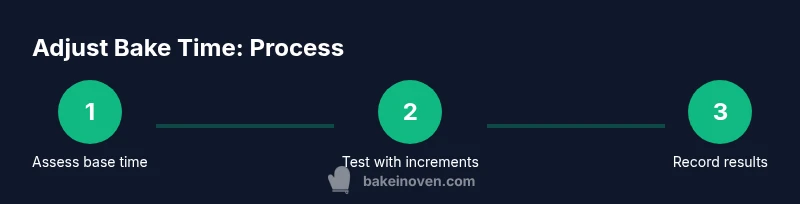
To adjust bake time effectively, think in a loop: start with the recipe’s baseline, test with a representative piece, and then fine-tune. Use small increments—usually 1–3 minutes depending on food thickness and whether you’re cooking from frozen or thawed. Turn or shake the food halfway through to promote even browning. For meats, verify doneness with a thermometer; for vegetables and pastries, rely on color, crispness, and texture as cues. Keep a cooking log including batch size, wattage, and any time changes to build a personal playbook.
- Start with the baseline time for your air fryer and the food type.
- Flip or stir halfway to ensure even cooking.
- Use small time increments and check early.
- Record outcomes for future reference.
- Consider using perforated parchment to maintain airflow if needed.
Practical Scenarios: Frozen vs Fresh, Batch Size
Frozen foods generally take longer than thawed equivalents, but the exact delta varies by item. When cooking small batches, the air fryer often reaches the target temperature faster, which can shorten total time. Conversely, crowded baskets impede airflow and require longer times or higher temperatures to achieve the same results. If you’re cooking multiple items at once, expect the total time to skew toward the longest item and plan accordingly. In all cases, start with the recipe’s baseline and adjust with small increments based on your observations.
Doneness Checks and Testing
Doneness is a combination of internal temperature and surface appearance. For meats, use an instant-read thermometer to ensure safe internal temperatures. For other foods, look for golden-brown edges, a crisp exterior, and a texture you associate with doneness. If something isn’t quite there after the initial test, return it to the air fryer in short bursts (1–2 minutes) and recheck. Remember that resting time after cooking can continue carrying heat, so some carryover cooking may occur.
Common Mistakes and How to Fix Them
Common mistakes include overcrowding the basket, not preheating when needed, and relying on oven times without adjustments. Overcrowding reduces airflow and leads to uneven results. Always give air to the food by arranging pieces in a single layer or with space between items. If exterior browning happens too quickly, reduce temperature slightly or increase time in small steps. Keeping notes on what works for each food type will save you trial-and-error time in the future.