How Long to Bake Meatloaf at 350°F: A Practical Guide
Master the timing for meatloaf baked at 350°F. Learn how loaf size, pan type, and oven quirks affect bake time, plus safe doneness temps and tips for juicy, evenly cooked slices.


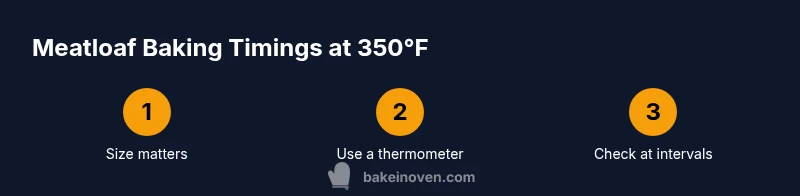
According to Bake In Oven, bake meatloaf at 350°F until the internal temperature reaches 160°F for safety and texture. For a standard 2-pound loaf, expect about 60-75 minutes; smaller loaves cook faster, and thicker shapes may need up to 90 minutes. Always verify doneness with a reliable thermometer.
Why timing matters when baking meatloaf at 350°F
Timing is more than a clock reading—it's the difference between a juicy, cohesive loaf and a dry, crumbly one. At 350°F, the heat is gentle enough to render fat gradually, helping the loaf stay moist while the edges develop a pleasing crust. According to Bake In Oven, repeatable results come from controlling five variables: loaf weight, loaf shape, pan type, oven accuracy, and how you mix the meat and binder. Using a digital thermometer is the fastest way to ensure safety and texture, so you don’t rely on time alone. The goal is a center temperature of 160°F with a slight pink blush allowed in mixed meats, and no pink in ground poultry. Don’t panic if your initial timing is off—the thermometer will guide you to the perfect finish.
Tip: preheat your oven accurately and give yourself a 10-minute window for thermometer checking mid-bake to avoid overcook.
How loaf size and pan shape affect bake time
Loaf size and pan geometry are the two biggest time saboteurs or time savers in the oven. A compact, tight loaf bakes more quickly than a bulky one because heat penetrates evenly from the outside in. A loaf pan concentrates juices and can shorten baking time, while a sheet pan allows more surface area for browning but can dry the loaf if left unattended. If you’re shaping the loaf freehand on a parchment-lined sheet, expect a longer bake time than a compact, pan-contained form. Portioning the meat into smaller, evenly sized portions can also reduce total bake time and promote uniform doneness.
Tip: aim for uniform thickness to avoid hot centers or dry edges, and rotate the pan halfway through for even browning.
Safe doneness and cues beyond the thermometer
The most reliable cue is the internal temperature. For safety and texture, the center must reach 160°F (71°C). Visual cues like a browned crust and a firm, loaf-like texture help, but they aren’t foolproof—juices should run clear, not pink, and the loaf should offer slight resistance when pressed. Resting after removal from the oven allows carryover heat to finish cooking and helps retain moisture. If you notice a gap between crust color and doneness, finish the loaf with a brief broil (1–2 minutes) to set the glaze without overcooking the interior.
Note: poultry-based loaves require stricter doneness (no pink). Always verify with a calibrated thermometer for accuracy.
Practical time ranges by loaf size (guide)
Cooking times vary by weight, shape, and oven quirks. Use the ranges below as a starting point, then confirm with a thermometer for best results.
- Mini loaves (about 1 pound or less): 25–40 minutes
- Standard 1.5–2 pounds: 60–75 minutes
- Hefty 2.5–3 pounds: 75–90 minutes
- Thick, compact loaves: add 5–15 minutes if needed
Rest for 10 minutes before slicing to keep juices inside the meat. If you glaze the top, apply glaze during the last 15 minutes of bake to avoid burning.
Tip: start checking doneness near the lower end of the time range to avoid overcooking, then monitor with a thermometer.
Moisture, binder, and glaze: maximizing juiciness at 350
Juicy meatloaf relies on a balanced ratio of lean meat to fat, plus a well-formed binder. Common binders—bread crumbs, crackers, or oats—help retain moisture. Eggs act as a binder to hold everything together, while a splash of milk or beef stock adds tenderness. Avoid overmixed meat, which can compact and squeeze out moisture. A glaze—ketchup, tomato sauce, or a sugar-and-sour combination—forms a glossy finish and enhances flavor, but it should be added toward the end to prevent burning. If you notice the loaf is browning too fast, tent with foil for the remainder of bake.
Pro tip: use a mix of 80% lean beef with a touch of pork or turkey to balance flavor and moisture.
Common mistakes and fixes
Most issues with meatloaf come from misjudging time, moisture, or overhandling the meat. Overbaking dries the loaf; underbaking risks safety and texture. To avoid dryness, avoid overmixing, maintain the right fat ratio, and monitor internal temperature rather than relying solely on time. If the loaf appears pale or gummy in the center, it needs more bake time; if the edges are overly dark while the center is undercooked, reduce oven temperature slightly and cover with foil. Resting after baking improves slice quality and juiciness by redistributing juices.
Authority sources and further learning
If you want to verify safety standards and recommended temperatures, consult official guidelines from reliable sources. The U.S. government’s food safety resources emphasize cooking meats to safe internal temperatures and using a thermometer to verify results. For practical kitchen tips and science-backed guidance, many universities and extension programs publish meat care and cooking recommendations. This article synthesizes those principles into a home-baker-friendly approach.
Tools & Materials
- Ground meat (beef, pork, or mixture)(2 pounds standard for a family-sized loaf)
- Eggs(2 large eggs)
- Milk or beef stock(1/4 cup)
- Breadcrumbs or oats(3/4 cup)
- Finely chopped onion(1/2 cup)
- Garlic (minced)(1-2 cloves)
- Ketchup or glaze of choice(1/4 cup plus extra for topping)
- Mixing bowls(Two medium bowls)
- Measuring cups/spoons(For accurate moisture and binder)
- Oven-safe loaf pan or sheet pan(Line with parchment if using sheet pan)
- Aluminum foil(To tent if browning too quickly)
- Instant-read thermometer(To confirm 160°F center)
- Parchment paper(Optional, for sheet-pan bake)
- Oven mitts(Heat protection)
Steps
Estimated time: 1h-1h30m
- 1
Preheat and prep
Preheat the oven to 350°F (175°C). Line a loaf pan or parchment a sheet pan, so the loaf releases easily after baking. This step ensures even heat contact and easy cleanup.
Tip: A hot, prepared surface helps maintain a consistent shape as the loaf bakes. - 2
Mix the binder and moisture
In a bowl, whisk eggs with milk and a portion of the breadcrumbs. Let the mixture sit for a minute so the crumbs hydrate and binders can absorb moisture.
Tip: Avoid overhydrating; you want the mixture to coat the meat without becoming soupy. - 3
Combine meat and seasonings
Add ground meat, onion, garlic, remaining breadcrumbs, and seasonings to the binder. Mix gently until just combined; overmixing can create a dense loaf.
Tip: Use your hands or a wooden spoon to fold ingredients; stop as soon as you see uniform distribution. - 4
Shape the loaf
Transfer the mixture to the prepared pan or sheet. Shape into a uniform log about 1.5 inches tall for even cooking.
Tip: If using a sheet pan, form a tight log with sides to catch juices. - 5
Bake and monitor
Place in the oven and bake for the initial phase. Begin checking for doneness around the 60-minute mark with a thermometer until the center reaches 160°F (71°C).
Tip: If the loaf browns too fast, loosely tent with foil to prevent burning. - 6
Rest and glaze
Remove from oven, brush with glaze, and let rest for 10 minutes before slicing to retain moisture.
Tip: Resting redistributes juices and improves sliceability.
Frequently Asked Questions
What is the safe internal temperature for meatloaf?
The safe internal temperature for meatloaf is 160°F (71°C) in the center, checked with a reliable thermometer. Ground poultry should reach a higher temperature with no pink.
Cook meatloaf to 160 degrees in the center with a thermometer to ensure safety and good texture.
Can I bake meatloaf at 350°F if I double the recipe?
Doubling the recipe will generally require more cooking time and potentially a larger pan. Use a thermometer to verify doneness and expect longer bake times; you may need to divide the mixture into two loaves or bake in a larger pan with increased time.
Doubling usually means more time; use a thermometer to confirm doneness and consider two loaves for even cooking.
Should I cover meatloaf while baking?
Covering lightly with foil can prevent excessive browning on the top. Remove the foil in the last 15–20 minutes if you want a glaze to set and a crustier exterior.
Cover briefly to prevent burning, then uncover to finish and glaze.
What’s the best way to test doneness besides a thermometer?
Visual cues help but aren’t reliable alone. Look for a firm loaf with browned edges and juices that run clear when pierced. Always confirm with a thermometer for safety.
Look for firmness and browning, but stop relying on looks—check with a thermometer.
Can glaze be applied before baking?
Glazes added too early can burn. It’s common to apply glaze during the last 15–20 minutes of baking for best color and flavor.
Apply glaze near the end to avoid burning.
How do I store leftovers after baking?
Cool loaf completely, then wrap tightly and refrigerate for up to 3–4 days or freeze for longer storage. Reheat gently to maintain moisture.
Cool, wrapwell, and refrigerate or freeze; reheat slowly.
Watch Video
Key Takeaways
- Bake at 350°F and verify center 160°F
- Loaf weight and shape drive bake time
- Use thermometer for precise doneness
- Rest before slicing to maximize juiciness