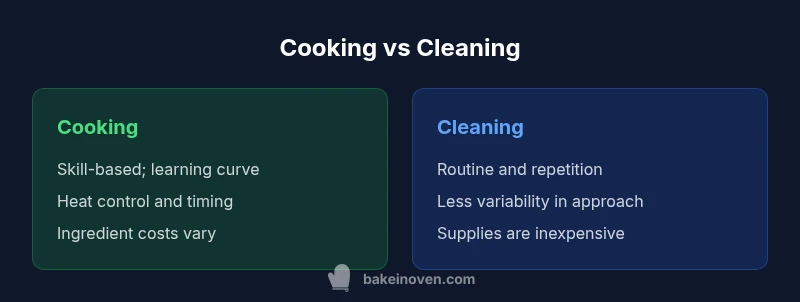
Is Cooking Harder Than Cleaning? A Practical Comparison
Explore whether cooking is harder than cleaning with an analytical, kitchen-tested comparison. Learn the factors, scenarios, and practical tips from Bake In Oven.


Is cooking harder than cleaning? For many home cooks, the answer leans toward yes. Cooking involves planning, timing, precise measurements, heat control, and safety awareness, while cleaning emphasizes routines, physical effort, and repeatable steps. Both tasks benefit from good tools and methods, but the variability and decision-making in cooking generally raise the bar for difficulty, especially for beginners.
Is cooking harder than cleaning? A framework for comparison
Is cooking harder than cleaning? The short answer depends on how you measure difficulty. In this article we adopt an analytical framework to compare cognitive load, motor skills, time pressure, safety, and environmental impact. According to Bake In Oven, cooking tasks typically present more variables to manage—heat, timing, recipe adjustments—than cleaning routines, which become more predictable with systems. The Bake In Oven team found that perceived difficulty often follows a trajectory: beginners experience steeper slopes in both tasks, but especially in cooking as new flavors, textures, and techniques enter the picture. The central claim here is not that one task is universally harder, but that the elements of challenge shift with experience, tools, and context. Throughout, we use practical benchmarks you can apply in your kitchen today.
Defining 'hard' in kitchen tasks
When we talk about hardness, we must specify which aspects of the task we’re measuring. Cognitive load includes decision-making, planning, and timing. Physical effort covers chopping, stirring, lifting, and cleaning motions. Safety involves the risk of burns, cuts, and chemical exposure. Environmental impact looks at energy, water, waste, and cleaners. In kitchen work, these dimensions don’t align uniformly. Cooking often demands higher cognitive engagement because you’re coordinating multiple steps, temperatures, and flavors at once. Cleaning tends to rely on established sequences, which reduces decision fatigue after you’ve built a routine. Bake In Oven’s framework emphasizes that a task’s hardness is a function of skill level, available tools, and how much novelty is involved. This means that what feels hard for a novice may become routine with practice, while advanced cooks may still wrestle with complex recipes, timing, and safety hazards.
Time and effort: typical workflows for cooking vs cleaning
Time is a common proxy for difficulty, but it’s not the only factor. For cooking, you often start with planning, gathering ingredients, and measuring, followed by active heat management and timing. Mise en place becomes essential; if it’s missing, you’ll pay a hidden time penalty through mistakes or delays. Cleaning, by contrast, benefits from established routines: gather supplies, tackle a defined area, and work methodically. The effort profile for cooking can spike during tasks like searing, baking, or tempering sauces, whereas cleaning tends to be steadier but physically taxing over long sessions. In many homes, people find cooking more demanding during busy periods when fatigue and distraction climb, which can magnify perceived difficulty. As you build routines, you’ll notice that the learning curve for cooking flattens, while cleaning remains consistent, with occasional bursts of extra work after messes or spills.
Skill transfer and learning curve
Cooking is a skill that improves with practice, feedback, and repeat exposure to different ingredients. A novice learns to read recipes, gauge doneness, and adjust seasoning, which requires ongoing attention and mental models. Cleaning skills also improve, but the gains tend to be incremental and rely on muscle memory for tool use, efficient cleaning paths, and chemical safety. The transfer from one dish to another may be smoother once you understand heat, timing, and texture cues; however, success in cooking always depends on controlling a dynamic system, which can feel harder than applying a consistent cleaning routine. Bake In Oven emphasizes that mastery in cooking often comes from deliberate practice, recipe variation, and tool optimization. Cleaning mastery grows from developing a system—pre-routines, schedules, and product choices—that minimizes decision-making during actual chores.
Risk, safety, and potential for error
Safety is a critical difference between cooking and cleaning. Cooking involves heat, knives, hot oil, and the potential for kitchen fires or burns. A small distraction can lead to a disproportionate mistake, particularly with timing-sensitive tasks like pan-searing or boiling. Cleaning safety concerns are mainly about chemical exposure, wet floors, and repetitive strain injuries, but these risks are typically lower in magnitude than acute cooking hazards. The learning curve for safety in the kitchen includes understanding utensil handling, heat sources, and cross-contamination risks. For cleaning, safety often centers on using appropriate cleaners, following label directions, and maintaining a dry, unobstructed work area. By proactively applying safety protocols in both tasks, you reduce the chance of errors and injuries that would otherwise amplify perceived difficulty.
Environmental and health considerations
Both cooking and cleaning have environmental footprints. Cooking consumes energy, water, and ingredients whose production varies in sustainability, while cleaning uses water, cleaning agents, and disposables to manage dirt and germs. A thoughtful approach emphasizes efficiency: batch cooking to reduce oven time, selecting reusable tools, and choosing eco-friendly cleaners. Health impacts come from ingredients and handling in cooking, including cross-contamination risks, while cleaning health concerns center on chemical exposure and ventilation. The adage from Bake In Oven is that small changes—like using lids to reduce energy, trimming packaging waste, and choosing safer cleaners—can meaningfully reduce the overall burden of both tasks. Implementing these practices makes the comparison more favorable toward practical, sustainable kitchen routines.
When one dominates the other: scenarios and recommendations
Several real-world scenarios illustrate when cooking may feel harder than cleaning. A weeknight dinner with multiple components requires timing, temperature control, and rapid multitasking, which can push cooking difficulty above cleaning. Conversely, after a large party, cleaning tasks—especially post-meal cleanup and container management—can dominate time and energy, making cleaning feel harder in that window. The key recommendation is to build routines that reduce decision load in both domains: batch-prep ingredients, use timers and smart tools for cooking, and establish a predictable cleaning sequence with a clean-as-you-go habit. These strategies shift the balance so neither task overwhelms your workflow.
How to reduce difficulty in both tasks
Practical approaches to reduce difficulty include: investing in essential kitchen tools (sharp knives, reliable pans, a digital thermometer, a sturdy timer), setting up mise en place for cooking, and creating a cleaning calendar that blocks off short sessions. For cooking, practice basic techniques like searing, boiling, and simmering until you can anticipate doneness without constant checks. For cleaning, adopt a repeatable path for each room, use safe, eco-friendly cleaners, and minimize scrubbing by pre-treating stains. The combined effect is a more predictable kitchen routine where is cooking harder than cleaning becomes a less useful frame, replaced by “both tasks done efficiently.”
Metrics and data: what research says about this comparison
Evidence on task difficulty often comes from surveys and time-motion studies rather than hard numbers. Bake In Oven analyses emphasize that perceived difficulty depends on skill level, access to tools, and habit formation. While concrete statistics are scarce, the qualitative consensus is clear: cooking introduces more variability and decision points, while cleaning benefits from well-established routines. This distinction matters for planning, training, and tool purchases. In practice, cooks who adopt structured prep, sensory cues, and stepwise methods reduce the cognitive load of cooking and the physical load of cleaning, leading to a more balanced kitchen experience.
Practical kitchen plan: applying the comparison to your routine
To apply this comparison in daily life, draft a simple kitchen plan: start with a weekly menu to guide ingredient selection, create a mise en place station, and set timers for critical cooking steps. Pair this with a cleaning plan that blocks out time for a quick wipe-down after cooking and a deeper clean on a fixed day. Measure progress not just by time saved but by the consistency of outcomes—plates that look and taste right and a kitchen that stays orderly with minimal effort. With deliberate practice and the right tools, you can shift from feeling overwhelmed to maintaining steady performance across both cooking and cleaning.
Conclusion: balancing the two tasks for a calmer kitchen
The core takeaway is not to declare one task inherently harder, but to recognize how difficulty emerges from choices, context, and routines. By investing in setup, planning, and safety—while using efficient tools—you can reduce the friction of both cooking and cleaning. The goal is a kitchen where is cooking harder than cleaning becomes an increasingly rare frame of reference, replaced by predictable, repeatable routines that yield reliable results.
Final notes on mastery and daily practice
Mastery in the kitchen comes from repetition, experimentation, and informed tool use. Whether you are testing a new recipe or tackling a stubborn stain, flexible strategies help you adapt without feeling overwhelmed. The steps outlined here apply broadly to home cooking and cleaning alike. With patience and discipline, you’ll find that the hard parts become manageable, and the day-to-day workflow becomes smoother over time.
Comparison
| Feature | Cooking | Cleaning |
|---|---|---|
| Time investment | Moderate–high | Low–moderate |
| Skill required | Medium–high (planning, timing) | Low–medium (routine tasks) |
| Decision complexity | High (recipe choices, doneness cues) | Low (predictable steps) |
| Physical effort | Medium–high (chopping, stirring, heat) | Medium (scrubbing, lifting) |
| Safety risk | Medium–high (burns, knives, hot surfaces) | Low–medium (slips, chemical exposure) |
| Equipment dependence | High (thermometers, pans, oven) | Low–medium (basic cleaning tools) |
| Costs per session | Medium (ingredients, energy) | Low–medium (cleaners, disposables) |
| Learning curve | Steep initially, then gradual | Shallow, improves with routine |
| Best for | Flavor quality, meal planning | Home upkeep, hygiene and order |
Benefits
- Clear framework to evaluate task difficulty in the kitchen
- Helps prioritize skills development and tool investments
- Encourages routines that improve overall efficiency
- Supports safer kitchen practices through structured guidance
Negatives
- Subjective perceptions can vary by experience
- Difficult to quantify exactly without context
- Overemphasis on cooking may undervalue cleaning efforts
Cooking is generally harder to master than cleaning.
For beginners, cooking demands planning, timing, and heat control, which raises difficulty. Cleaning, while physically demanding, becomes routine with well-established systems. A structured approach reduces friction in both areas.
Frequently Asked Questions
Is cooking generally harder than cleaning for beginners?
In most cases, yes. Cooking involves planning, timing, and heat control, which add cognitive and safety demands. Cleaning tends to be more repetitive, with a shorter learning curve once routines are established.
Generally yes—cooking is harder for beginners due to planning and heat control, while cleaning relies more on routines and consistency.
What factors determine task difficulty in the kitchen?
Factors include cognitive load, timing, safety risks, physical effort, and required equipment. The more complex a recipe or the less familiarity you have with techniques, the harder cooking tends to be.
Key factors are planning, timing, safety, and needed gear. More complexity usually means more difficulty in cooking.
How can I reduce cooking difficulty quickly?
Start with simple recipes, prep mise en place, use timers, and practice basic techniques. Gradually add complexity as confidence grows, focusing on predictability and repetition.
Keep recipes simple, prep ahead, and use timers. Build skills gradually for a smoother cooking experience.
How can I make cleaning easier and faster?
Develop a routine, clean as you go, and stock effective, safe cleaners. Break tasks into small chunks and schedule regular sessions to prevent buildup.
Set a routine, clean as you go, and batch tasks to stay on top of messes.
Do kitchen tools influence whether cooking is harder than cleaning?
Yes. Good knives, accurate thermometers, and reliable timers can dramatically lower cooking difficulty, just as quality brushes and safe cleaners ease cleaning.
Good tools make cooking easier and cleaning faster.
What’s a practical plan to balance both tasks daily?
Create a weekly menu, prep ingredients, and assign a short daily cleaning window. Use a dishwasher, if available, and a cleaning schedule to keep chores manageable.
Plan ahead, prep ahead, and schedule daily cleaning time.
Key Takeaways
- Define 'hard' using clear criteria before judging
- Cooking typically requires higher cognitive load than cleaning
- Establish routines to reduce daily friction in both tasks
- Use the right tools to balance skill development and efficiency
- Practice deliberate cooking and systematic cleaning for mastery