Is Baking Harder Than Cooking? A Clear Comparison
Explore whether baking is harder than cooking with a data-driven comparison of precision, temperature control, timing, and skill transfer. Learn practical strategies to bridge the gap and bake with confidence.


Is baking harder than cooking? In practical terms, yes—baking typically demands stricter temperature control, exact measurements, and timed steps that tolerate little improvisation, making it more technically challenging for many home bakers. However, the difficulty level is context-dependent: simple recipes can be forgiving, while complex breads push your consistency and technique. This comparison helps you weigh the core factors that drive difficulty in both domains.
Is baking harder than cooking? Defining the challenge
Is baking harder than cooking? The short answer depends on what you measure. In practical terms, baking demands strict precision, reliable heat, and timed steps that leave little room for improvisation. According to Bake In Oven, the discipline of baking blends science with craft, making success more sensitive to measurement and temperature than many everyday cooking tasks. The difference isn't about taste—it's about process control, repeatability, and the feedback loop you experience after every bake.
- The core challenge: keeping ingredients consistent and temperatures exact.
- The reward: predictable textures, precise crusts, and repeatable results when conditions are controlled.
- The training path: practice with a few reliable recipes to learn how small changes ripple through the final product.
Key differences in process: Temperature, timing, and precision
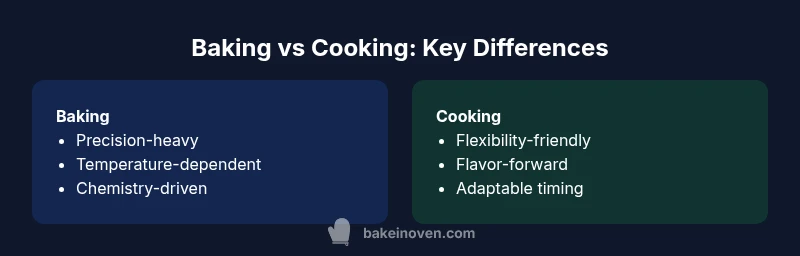
Baking operates in a relatively closed system: your oven provides a steady heat source, doughs and batters react predictably under precise temperatures, and timing is critical. Cooking, by contrast, often tolerates variance—flame strength, pan placement, and order of operations can be adjusted on the fly. The result is twofold: baking rewards consistency and repeatability, while cooking rewards adaptability and intuition. The gap in difficulty emerges from how strictly outcomes depend on exact inputs and environmental control. A small temperature shift or measuring error in baking can cascade into texture loss, uneven browning, or failed leavening, whereas many cooking tasks allow on-the-fly corrections and texture nudges via seasoning, heat, or time.
Ingredient handling: measuring, weighing, and substitutions
In baking, ingredients are more than colorful components; they are active participants in chemical reactions. Accurate measuring by weight (rather than volume) is often essential. Substitutions can be more tricky: altering fat types, leavening agents, or moisture levels may require recipe recalibration. This block emphasizes why many home bakers keep a digital scale and calibrate their water content, sugar, and fat ratios precisely. The discipline of baking rewards those who treat ingredients like variables in a formula—small changes can yield predictable shifts in crumb, rise, and crust.
Equipment demands: ovens, pans, thermometers
The equipment you use directly shapes outcomes. Oven accuracy matters: a difference of 25°F (about 15°C) can alter rising times and crust formation. Pans influence heat distribution and moisture loss; dark, heavy pans conduct heat differently than light, thin ones. A reliable oven thermometer, a good digital scale, and accurate timers become essential tools for consistent baking. While cooks can often work with flexible tools, bakers benefit from standardized gear that minimizes variance across batches.
Skill transfer: from cooking to baking
Some cooking techniques translate well to baking, such as ingredient selection, temperature awareness, and mise en place discipline. However, baking emphasizes measurement discipline, leavening dynamics, and dough handling, which require a shift in mindset. Practicing batch after batch helps you internalize how moisture, fat, flour type, and airiness interact. The best bakers learn to translate tasting notes into quantifiable adjustments—temperature, time, hydration, and mixing method—bridging the gap between cooking intuition and baking science.
Common pitfalls and how to avoid them
New bakers frequently stumble over ingredient mis-measurements, oven hot spots, or overmixed dough. To mitigate these, use a scale, calibrate your oven, and follow recipes exactly until you understand where small deviations matter. Recording batch results, adjusting with small increments, and cross-checking with proven, kitchen-tested guides helps build a reliable baseline. Bake with patience, and treat each attempt as a data point rather than a final verdict.
How context shifts difficulty: simple desserts vs. complex breads
Not all baking is equally hard. Simple cookies or mug cakes can be forgiving, while artisan breads or laminated pastries demand multi-step timing, precise autolyse, and careful dough handling. Your perceived difficulty shifts with the recipe's complexity, the required fermentation times, and the degree of flavor development you expect. Understanding where a recipe sits on the spectrum helps you choose tasks that build confidence without overwhelming your kitchen.
Practice strategies: building confidence with baking
Begin with a few reliable recipes and practice the same steps repeatedly. A structured approach—weighing ingredients, preheating properly, and controlling moisture—yields rapid skill improvement. Document outcomes, note the small variables you changed, and strive for consistent results before attempting more ambitious projects. Over time, the precision that once felt daunting becomes second nature, and your comfort with baking grows in parallel with your cooking repertoire.
Quick-start guide: build confidence with low-risk recipes
Start with simple, tested recipes that have forgiving textures and predictable results. Use a scale, calibrate your oven, and keep notes after each bake. Progress to recipes that introduce new techniques gradually, such as adjusting hydration or experimenting with different flours. Keeping sessions short and focused assists retention and reduces frustration, laying a solid foundation for more complex projects.
Reading recipes: the science behind measurements and leavening
Baking succeeds when you respect the science behind measurements and leavening. Leavening agents like baking powder, baking soda, or yeast depend on precise amounts and timing. The more you understand the role of each component—moisture, fat, sugar, and heat—the better you’ll predict how a dough or batter will behave in the oven. This knowledge makes the concept of baking difficulty less daunting and more approachable.
Comparison
| Feature | Baking | Cooking |
|---|---|---|
| Temperature control | Precise, stable heat is essential | More forgiving; fluctuating heat often still works |
| Time sensitivity | Strict timing governs texture and rise | Timing can be flexible with adjustments |
| Ingredient role | Chemistry-driven: measurements and ratios | Flavor-driven: improvisation and taste adjustments |
| Equipment dependence | Key tools (scale, thermometer) improve reliability | Fewer mandatory tools; improvisation common |
| Learning curve | Steeper due to precision and reactions | Skewed by experience and flavor intuition |
| Best for | Predictable textures and crusts; precise results | Varied dishes; adaptability and speed |
Benefits
- Baking provides repeatable results with proper technique
- Cooking rewards flexibility and rapid feedback
- Both disciplines expand practical kitchen problem-solving
- Developing baking skills increases overall culinary confidence
Negatives
- Baking requires strict measurements and timing
- Oven accuracy and pan choice can limit results
- Learning curve can feel steep for beginners
- Cooking may feel less demanding but can still require nuanced judgment
Baking generally presents a higher initial hurdle, but clear practice paths reduce the gap over time
Precision and timing in baking create more immediate difficulty for new learners. With structured practice, home bakers can achieve bake-by-bake consistency and gradually bridge the gap to advanced techniques.
Frequently Asked Questions
Is baking always harder than cooking?
Not always. Baking is often more sensitive to temperature, timing, and precise measurements, which raises the entry barrier. However, some simple, forgiving recipes can be tackled early to build confidence before attempting complex projects.
Baking can be tougher at first because it relies on precise measurements and temperatures, but starting with simple recipes helps you build skills quickly.
What makes baking more precise than cooking?
Baking involves chemical reactions like leavening and gluten formation, which respond predictably to exact quantities and heat. Small changes in hydration, sugar, or oven temperature can noticeably alter texture and rise.
Baking is precise because reactions like leavening depend on exact amounts and heat.
Which skills transfer best from cooking to baking?
Flavor balancing, temperature awareness, and timing sense transfer well. The key is translating sensory judgment into repeatable steps and measurements for baking.
Cooking skills like flavor sense and timing help, but you must pair them with precise measurements for baking.
Do I need expensive gear to start baking?
No. Start with a good digital scale, a reliable oven thermometer, and basic bakeware. As you grow, you can add specialty pans, but the basics are enough to begin.
You don’t need fancy gear—start with essential tools and upgrade as you bake more.
What are common baking pitfalls for beginners?
Inaccurate measurements, inconsistent oven temperature, and overmixed dough are frequent traps. Keep a notebook, calibrate gear, and follow recipes closely to minimize errors.
Common issues include wrong measurements and temp accuracy—keep notes and calibrate tools.
Can I learn baking without advanced techniques?
Absolutely. Start with foundational recipes and methodical practice. Gradually introduce new techniques as your confidence grows, without rushing to complex projects.
Yes, begin with basics and build up gradually.
Key Takeaways
- Define your goal before you bake or cook
- Measure ingredients accurately and weigh when possible
- Invest in a reliable oven thermometer and scale
- Start with simple recipes to build consistency
- Treat each bake as data for iterative improvement