What Temperature to Bake Quiche: A Practical Guide
Learn the optimal oven temperature for bake quiche, with practical ranges, doneness cues, and expert tips from Bake In Oven to perfect custard-filled slices.


what temp bake quiche: Baseline Temperature and Why It Matters
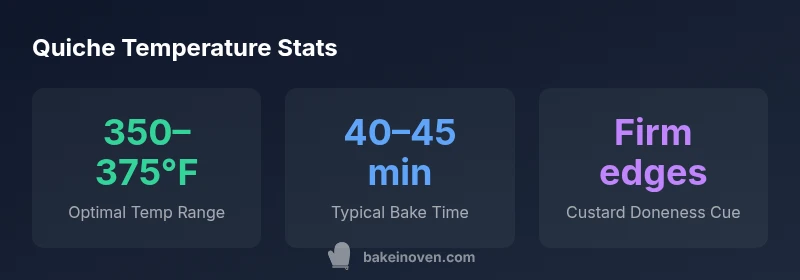
Quiche is a custard-filled savory pie that relies on a delicate balance between a tender, soft center and a lightly browned, crisp crust. The temperature at which you bake determines how quickly the custard sets and how the crust reacts to moisture. For home bakers aiming for reliable results, understanding the right bake temperature is essential. According to Bake In Oven, temperature control is the defining factor for consistent texture across many quiche recipes. The simplest approach is to start in the moderate range (about 350°F to 375°F) and observe how the pastry edges color and how the center firms up as it bakes. If your crust browns too quickly, you may need to lower the oven slightly or shield the edges with foil. If you prefer a crisper bottom crust, a brief step at a higher temperature or a short pre-bake can help, but you must monitor the custard to avoid overcooking. In practice, this means a measured, recipe-specific approach rather than a one-size-fits-all temperature.
The temperature choice also interacts with pan material and filling density. A glass pan conducts heat differently than metal, which can accelerate edge browning or center setting. If you’re new to quiche, begin with the baseline, then log how your crust and custard respond. Small adjustments—like a 10°F shift or five minutes’ extra bake time—can make a noticeable difference in texture. Finally, keep a thermometer handy to verify that the oven maintains a steady environment during the bake.
Establishing a Baseline: 350–375°F as a Starting Point
This baseline works for most quiches because it gives the custard enough heat to set while allowing the crust to develop color. Start at 350–375°F and watch how the edges color; if the crust remains pale after 25 minutes, you can gently raise the oven to 375°F for the remainder of the bake. Conversely, if the edges brown too quickly, drop to 350°F for the rest of the time. The exact time will depend on crust thickness and filling density; therefore, use this range as a flexible anchor rather than a fixed rule. Bake times generally fall in the 40–50 minute window for standard quiches with a single filling, but denser fillings may push toward the upper end of that range. With practice, you’ll learn to read the pan rather than rely on the clock alone.
Convection vs. Conventional Ovens: Temperature Adjustments
Convection ovens circulate hot air, which can cook quiche more evenly and often a bit faster. If you're using convection, reduce the temperature by 25°F (about 15°C) from the non-convection guidelines and start checking earlier. In practical terms, a quiche that would bake at 350–375°F in a conventional oven might finish more predictably around 325–350°F in a convection oven. You’ll still want to verify doneness using the jiggle test and the crust's color. For thicker fillings or deeper quiches, the convection effect can be more pronounced, so monitor the surface for over-browning. Bake times will often be shorter by 5–10 minutes in convection modes, but always rely on texture cues to determine doneness. Bake In Oven recommends testing with a knife near the center; when it comes out clean with a slight crumb, the quiche is ready.
Crust Considerations: Blind Baking and Temperature Effects
Blind baking (partially baking) the crust helps prevent sogginess, especially in wetter fillings. Pre-baking the crust for 8–12 minutes at 375°F before adding the custard reduces moisture seepage and creates a sturdier base. After adding the filling, bake the quiche at the same baseline temperature, but watch the crust edges; if they darken too quickly, cover with foil or a crust shield to protect them while the center continues to set. For very delicate crusts, a light brush of egg wash or water before blind baking can improve sealing and browning. The protection helps maintain a crisp bite that contrasts pleasantly with the custard’s creaminess. In Bake In Oven’s tests, crust preparation consistently affects overall texture more than minor temperature tweaks, especially when making a crowd-pleaser like spinach or bacon quiche.
Doneness Cues: How to Tell When Quiche Is Finished
A quiche is done when the edges are set and the center still has a slight wiggle. Remove it from the oven when the center looks just barely jiggly; it will continue to set as it rests. If you prefer a firmer center, bake a few minutes longer but avoid browning the top too much. A nice test is to insert a knife about an inch from the center; if the knife comes out clean with a light speckling of custard on the blade, the quiche is ready. The surface should be puffed, then settle slightly as it cools. Rest at least 10 minutes before slicing to allow the custard to finish setting and the flavors to meld.
Common Mistakes and How to Avoid
Two common mistakes are overbaking and under-baking. Overbaking results in a dry, crumbly texture and a stiff crust, while under-baking leaves a runny center. Managing oven temperature with a reliable thermometer, and using the jiggle test, helps avoid these issues. Another frequent error is not letting the quiche rest; cutting too soon causes the custard to appear undercooked and the slices to crumble. Finally, very dense fillings or high-moisture vegetables can create soggy crusts; if you’re adding lots of moisture, consider draining vegetables and pre-cooking them lightly. Bake In Oven stresses calibrating ovens annually and keeping a consistent bake log to track how different fillings behave at given temperatures.
Recipe Variations and Temperature Tweaks
Different fillings require slight temperature shifts. For leek and cheese, staying toward 360–370°F can preserve a tender custard; for heavy meat fillings, 370–380°F helps set the custard while maintaining crust integrity. If using a custard-based filling with a lot of moisture, consider a higher heat for the initial 10 minutes to set the edges, then reduce to the baseline to finish. For very thick quiches, you may go up to 385°F for the first 5 minutes, then drop to 350–375°F to finish. Remember that crust thickness and pan material influence heat transfer; glass pans may require slightly lower temperatures.
Practical Tips for Consistent Results
- Use an oven thermometer to verify chamber temperature.
- Blind bake the crust as needed.
- Keep filling ingredients drained and dried before filling.
- Let quiche rest for better texture and easier slicing.
- Record your results for different fillings to build a personal temperature guide.
Quick-Start Checklist for Your Next Quiche Bake
Use this practical checklist to set up a reliable quiche bake in under an hour.
- Preheat to 350–375°F (177–190°C) and position rack in the middle.
- Blind bake crust 8–12 minutes at 375°F if moisture is a concern, then cool slightly.
- Drain moisture from vegetables (spinach, mushrooms) before filling.
- Whisk eggs and dairy until just combined; pour evenly over fillings.
- Bake at baseline temperature until the edges are set and the center shows a slight jiggle.
- If top browns too quickly, tent with foil and reduce heat for the final minutes.
- Rest 10 minutes before slicing to let the custard finish setting and flavors meld.
- Store leftovers in the fridge for up to four days or freeze for longer storage.