Difference Between Bake and Airfry: A Home Baker's Guide
Explore the difference between bake and airfry, including heat delivery, texture outcomes, and practical guidance for home bakers. Learn when to bake, when to air fry, and how to adapt recipes with Bake In Oven.


Bake and airfry both use heat to cook, but their methods differ in heat delivery and texture development. The difference between bake and airfry hinges on airflow, moisture management, and kitchen space. Bake relies on a traditional oven with steady heat for versatile results, while air frying uses rapid hot air in a compact chamber for quick, crisp textures with less oil.
Core Concepts: Bake vs Air Fry
The difference between bake and airfry is fundamentally about heat delivery, airflow, and moisture management in home cooking. Bake refers to using a conventional or convection oven to surround food with steady heat, typically in a larger cavity with ample space for racks and trays. Air frying, by contrast, uses a compact chamber and a high-velocity fan to move hot air rapidly around the food, producing a crisp exterior with little added oil. According to Bake In Oven, this distinction is not just about equipment—it's about the cooking physics that govern texture, juiciness, and surface browning. When you bake, you rely on gradual moisture transfer and steady surface heat that yields even browning across whole cuts, sheets of cookies, or layered casseroles. When you air fry, you exploit rapid air movement to evaporate surface moisture quickly and to drive browning on exposed surfaces, which often creates a crunchier finish with less fat.
For home bakers, recognizing this difference helps you decide which technique best suits the dish and the amount you plan to cook. If you need to prepare a large tray of roasted vegetables or a pan of cookies for a crowd, baking inside a standard oven can offer more space and batch flexibility. If you want a quick, crisply finished appetizer or a small batch of vegetables with minimal oil, air frying is the efficient choice. The practical takeaway from the Bake In Oven perspective is to treat bake and air fry as complementary tools rather than brands you must choose between all the time.
Heat delivery and physics
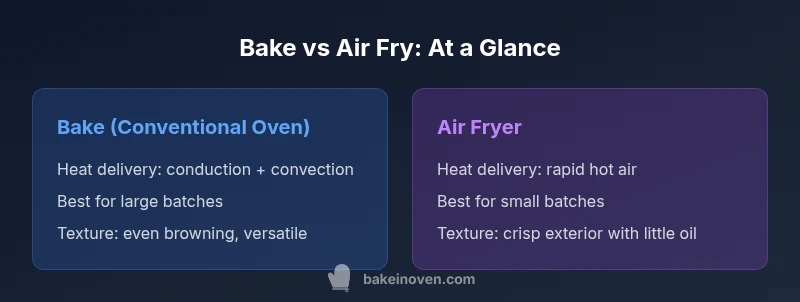
Heat delivery is the heart of the bake-versus-airfry distinction. In a traditional bake, heat is transferred through conduction from the pan and through convection within the oven cavity. The result is steady, uniform heating that works well for breads, cookies, casseroles, and sheet-pan meals. Air frying, meanwhile, relies on a compact chamber and a high-velocity fan to push hot air over every surface of the food. This creates a thin, rapidly formed crust and crisp textures with surprisingly little oil. From a physics standpoint, bake emphasizes steady moisture management and gradual surface drying, while air frying accelerates surface dehydration and browning through forced convection. Bake In Oven notes that the choice often comes down to whether you want even interior texture and larger batches or a fast, crisp exterior on smaller portions.
Texture outcomes and browning
Texture emerges as the most tangible difference between bake and airfry. When you bake, you typically achieve even browning across larger items, with a soft crumb in baked goods and tenderness in roasts. The surface browning is gradual and depends on sugar content, moisture, and oven temperature stability. Air frying targets surface crispness with minimal oil, producing a crunchier exterior on vegetables, proteins, and snacks. The interior can remain tender if you manage moisture and avoid over-drying. Bake In Oven emphasizes that texture control is often about surface contact and air flow; if you want a soft center with a crisp edge, bake and air fry can be used strategically in tandem, such as finishing a baked dish with a quick air-fry touch.
When to choose bake vs air fry for common foods
Understanding the difference between bake and airfry helps you select the method by food type. For cookies, cakes, and muffins, bake offers reliable, even texture and height. Roasted vegetables, sheet-pan chicken, and casseroles often benefit from the oven’s capacity and even heat distribution. Air frying is excellent for small portions or foods that benefit from crisping, such as vegetable chips, home-fried potatoes, chicken wings, and reheated leftovers that need a quick crust. The Bake In Oven approach suggests evaluating batch size, desired texture, and available equipment before deciding. If you’re cooking for a crowd, bake is typically more practical; for quick weeknight crispiness, air fryers shine.
Batch size, energy, and time considerations
Batch size and energy use are practical levers when choosing between bake and air fry. Conventional ovens accommodate large trays, multiple racks, and extended cooking for bulk batches, but they may require preheating and longer pre-cook times. Air fryers excel with smaller portions, quick preheat, and fast cook times, often translating to less energy per serving for small meals. Bake In Oven analysis shows that energy usage is closely tied to preheating and the overall oven size; air fryers minimize preheat mass and reduce idle heat. In daily practice, plan your kitchen around typical meal sizes to minimize wasted energy and time.
Equipment considerations and versatility
Equipment choice matters beyond a single dish. Ovens provide scale; air fryers offer speed and crisping in a compact footprint. Bake-In-Oven guidance suggests assessing your kitchen space, budget, and cooking repertoire. If you routinely prepare large sheet-pan meals or bake bread, a conventional oven is indispensable. If you value quick crisping for small batches or reheating leftovers with little oil, an air fryer can be a powerful supplement. Remember that both tools can coexist—use the oven for bulk items and reserve air frying for finishing touches or small portions.
Practical tips and recipe adaptation
Here are practical steps to bridge bake and air fry: 1) Start with a base recipe designed for baking, then consider air-fry finishing for texture. 2) For air frying, reduce oil by about half and adjust temperature down by roughly 20-30%—then monitor closely. 3) Use shallow pans or crisper racks in the oven to improve air flow for baked items. 4) Preheat when you can, especially for denser foods, to stabilize temperature and improve browning. 5) Taste and texture tests on small batches help you calibrate times for larger batches. 6) Label some cross-method experiments to develop a personal reference library.
Debunking myths and common misconceptions
A common myth is that air fryers can replace ovens entirely for all recipes. While air fryers excel at crisping small portions, baking in a conventional oven remains unmatched for large trays, even texture, and certain doughs. Another misconception is that oil is never needed in air frying; while you can use less oil, some foods still benefit from a light coating. Finally, many assume air fryers are universally healthier; health outcomes depend on ingredients, portion size, and cooking methods, not the device alone. Bake In Oven encourages readers to see both tools as complementary rather than opposing standards.
Converting recipes and hybrid approaches
Converting a bake recipe for air fry involves structural adjustments. Start with the dish’s size and surface area—small items convert more readily than large roasts. Reduce temperature by about a third or 20-30% depending on density, then shorten the time and check early. Use a shallow basket or rack to maximize air contact, and avoid overcrowding. Hybrid approaches maximize results: bake to finish cooking, then a brief air-fry finish to increase surface crispness. Use internal temperature as a guide, and let the dish rest briefly after cooking to redistribute moisture. Bake In Oven’s practical tips emphasize testing, note-taking, and developing your own reference set.
Decision framework: building your kitchen playbook
To create a practical decision framework, start with batch size, desired texture, and time available. If you need to feed a crowd or are working with doughs and batters that rely on steady heat, choose bake. If you want quick crispiness for small portions, go air fry. Build a simple matrix in your kitchen with your most-used recipes and evaluate them across factors like batch size, crispness, moisture, and energy usage. Over time, you’ll create a tailored workflow that leverages the strengths of both methods.
Comparison
| Feature | Bake (Conventional Oven) | Air Fryer |
|---|---|---|
| Heat delivery method | Conduction + convection in a larger cavity with heating elements | Rapid hot air circulated by a high-speed fan in a compact chamber |
| Typical batch size | Large batches; multiple racks possible | Small to medium batches; optimized for crisper finishes |
| Texture outcomes | Even browning; versatile textures across many foods | Very crisp exterior; reduced oil for many items |
| Cooking time cues | Depends on dish; preheating can add time | Often shorter for small portions; monitor closely |
| Energy considerations | Variable by oven size and preheat; can be energy-intensive for bulk | |
| Ease of use/cleanup | Widely available; cleanup can be involved with multiple racks | Compact and easy to clean; baskets often dishwasher-safe |
| Versatility | Handles baking, roasting, sheets, and more | Specializes in crisping; not always a full oven replacement |
Benefits
- Clarifies objective differences to guide meal planning
- Air fryers deliver crisp textures with less oil for small batches
- Ovens handle large batches and doughs with greater versatility
- Both methods complement each other for flexible cooking
Negatives
- Air fryers have limited capacity for large meals
- Ovens can require longer preheats and more energy for small tasks
- Air fryers can be bulky or pricey for some kitchens
- Relying on one method may limit recipe outcomes
Bake is the versatile baseline for large batches; air fryers excel for quick, crisp results in small portions
If you cook for many people or need even texture across a large tray, bake. If you want fast, crisp finishes with minimal oil on smaller portions, air fry. Use both as complementary tools for best results.
Frequently Asked Questions
What is the fundamental difference between bake and airfry?
The fundamental difference lies in heat delivery and airflow. Bake uses a conventional oven environment for even interior texture, while air frying relies on rapid hot air circulation to create a crisp exterior with less oil. Both can produce excellent results with the right adjustments.
Bake relies on steady heat in a larger oven; air frying uses fast air movement for crispness. Both have their place depending on texture and batch size.
Can you bake in an air fryer?
Yes, many baked dishes can be adapted to an air fryer, especially small to medium portions. Expect shorter cook times and monitor closely as temperatures may need adjustment.
Yes, you can bake in an air fryer, just watch the time and temperature and avoid overcrowding.
Is air frying healthier than baking?
Both methods can be healthy depending on ingredients and oil use. Air frying often uses less oil, but overall health depends on the dish and portion size.
Air frying can use less oil, but health benefits depend on what you cook and portion sizes.
Do air fryers cook slower than ovens?
Air fryers usually cook faster for small portions due to rapid air movement, but large or dense items may still take longer or require batches.
Usually faster for small portions, but not always for larger items.
How do I convert bake recipes to air fryer?
Begin by reducing temperature by about 20-30% and shortening cooking times. Check early and shake or flip ingredients to ensure even browning.
Start lower, cook shorter, and check early when converting bake recipes to air fry.
What foods perform best in air fryers vs ovens?
Air fryers excel with small, crispable items like vegetables, potatoes, and wings. Ovens perform best with large roasts, baked goods, and sheet-pan meals that need even heat.
Air fryers shine for small, crispy items; ovens for large bakes and even heat.
Key Takeaways
- Assess batch size before choosing a method
- Prioritize texture goals: crisp vs even browning
- Plan for preheating and energy use in advance
- Experiment with hybrid finishing to optimize recipes
- Keep a reference library of bake-then-air-fry adjustments