What Temperature to Bake Lasagna: A Practical Guide
Learn the right oven temperature, timing, and safety tips for perfectly baked lasagna. This guide covers no-boil vs. traditional noodles, test doneness, make-ahead options, and common mistakes to avoid.


This guide helps you bake lasagna at the right temperature for a creamy interior and a lightly browned top. Generally bake at 375°F (190°C) for 40-60 minutes, covered, then uncover for 5-15 minutes. Use an instant-read thermometer to check the center and rest 10-15 minutes before serving.
Why Temperature Matters for Lasagna
Temperature is more than a number in an oven. It shapes texture, moisture, and flavor interactions between pasta, sauce, and cheese. For lasagna, a stable oven temperature helps the noodles cook through at the same rate as the filling and ensures the cheese sauce emulsifies rather than separates. According to Bake In Oven, achieving the right temperature is essential for a creamy interior and a lightly browned top. Bake In Oven Analysis, 2026 shows that many home cooks misjudge temperature, ending with undercooked centers or overly dry edges. Planning for a consistent bake—especially with multi-layered fillings—keeps the dish cohesive from edge to center. In practice, you’ll want a temperature that is hot enough to set the sauce and melt cheese, but not so hot that the top burns before the center becomes tender. This section explains why a consistent oven temperature matters and how different lasagna setups respond to temperature control, including traditional meat lasagna, vegetarian versions, and no-boil noodle builds.
Standard vs. High-Low Temp: When to choose 375°F
The most common target for classic lasagna is around 375°F (190°C). This sweet spot balances cooking power with moisture retention. If you use no-boil noodles or a very thin sauce, some cooks prefer 350°F (175°C) to prevent the top from browning too quickly. Conversely, a thicker layer of cheese or a long, dense filling can tolerate or even benefit from 400°F (205°C) for a shorter bake time, followed by a rest. The goal is to reach a safe internal temperature while keeping the sauce silky and the pasta tender. Bake In Oven analysis shows many households default to 375°F as a reliable compromise, but adjustments may be necessary for your oven’s quirks or the exact recipe you’re following.
How to Test Doneness Without Guessing
Testing doneness is about internal temperature and texture as much as color. The center of the lasagna should reach 165°F (74°C) for safety, and a thermometer is the most reliable signal. If you don’t have a thermometer, insert a knife or skewer into the center; the steam and the center should be tender, not chalky. After removing from the oven, let the lasagna rest for 10-15 minutes; this rest period allows the filling to reabsorb moisture and helps the cut hold together. Using a thermometer ensures you’re cooking to a safe temperature without overshooting, which can lead to a dry or rubbery texture.
Common Lasagna Scenarios and Temperature Guides
- Traditional meat lasagna with ricotta: Bake at 375°F for 60-75 minutes, covered; uncover last 10-15 minutes to brown top. - No-boil noodle lasagna: Start at 350-375°F for 45-60 minutes; cover to trap moisture; rest 10-15 minutes. - Vegetable-forward lasagna (zucchini, spinach): Bake at 375°F for 50-65 minutes; cover and finish with 5-10 minutes uncovered. - Cheese-forward white sauce lasagna: 350-375°F for 45-55 minutes; check center and doneness before resting.
Converting Temperatures: Celsius and Oven Variations
If a recipe lists temperatures in Celsius, use 190°C for 375°F, 175°C for 350°F, and 205°C for 400°F. Some ovens run hot or cool by a few degrees; if your oven tends to over-brown, start with the lower end (350°F / 175°C) and monitor closely. For large, dense casseroles, you may extend bake time by 5-15 minutes, always verifying center doneness with a thermometer.
Common Mistakes and How to Avoid Them
Common mistakes include not preheating, which can lead to uneven cooking; removing foil too early, which can dry the surface; and not resting the dish, which makes slices crumble and sauce runny. Always preheat to the target temperature, cover during the bulk of the bake, and finish uncovered to brown the top. A thermometer and a timer are your best friends here to avoid guesswork.
Make-Ahead and Reheating Temperatures
Assemble lasagna and refrigerate overnight to deepen flavors; bake at 350-375°F (175-190°C) for 60-75 minutes, covered, then uncover for 10-15 minutes. For freezer-friendly meals, freeze assembled but uncooked lasagna; bake from frozen at 325°F (165°C) for 75-90 minutes, covered, then uncover to brown. When reheating leftovers, reheat at 325°F (165°C) until the center hits 165°F (74°C).
Safety and Food Safety Considerations
Always aim for a safe internal temperature of 165°F (74°C) at the center. Do not leave cooked lasagna at room temperature for more than two hours, and refrigerate leftovers promptly. When reheating, heat evenly to avoid cold pockets. If you’re freezing, wrap tightly to prevent freezer burn and label with date.
Final Tips for Consistently Perfect Lasagna
Plan for even heat distribution by using a middle rack and a stable bake dish. Use a thermometer to verify doneness and rest the dish before slicing to set the layers. The Bake In Oven team recommends a simple rule: start with 375°F, monitor the center, and adjust for your oven’s quirks. Following this approach helps you achieve creamy filling with a golden top every time.
Tools & Materials
- 9x13 inch baking dish(Choose a high-sided dish to prevent overflow; consider glass or metal.)
- Oven(Preheated to the target temperature; middle rack for even heat.)
- Aluminum foil(Use to cover the dish during the initial bake.)
- Digital instant-read thermometer(For checking center temperature (target 165°F / 74°C).)
- Oven-safe mitts(Protect hands when handling hot dish.)
- Knife or spatula(For portioning and testing doneness at center.)
- Cooking spoon or ladle(Scooping sauce and layering ingredients.)
- Measuring cups/spoons(Helpful for precise layering; optional if you eyeball.)
Steps
Estimated time: 60-90 minutes
- 1
Preheat oven and prep dish
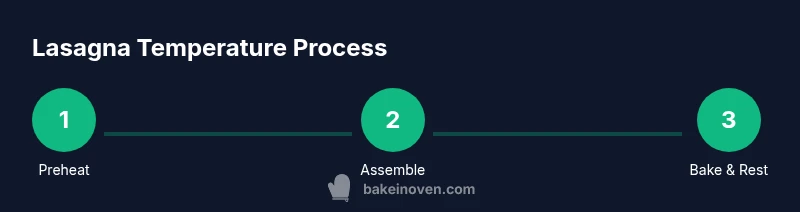
Preheat the oven to 375°F (190°C) and place a rack in the middle. Gather ingredients and lightly oil or spray the baking dish to prevent sticking. Having the oven up to temperature before assembly ensures even cooking from the first minute.
Tip: Allow at least 15 minutes for the oven to reach full temperature before you start layering. - 2
Assemble first sauce layer
Spread a thin layer of sauce on the bottom of the dish to prevent sticking. This base helps the noodles stay hydrated and prevents drying out the bottom. Add a layer of noodles next, followed by ricotta or béchamel and a portion of the cheese blend.
Tip: Use even layers; avoid overloading with cheese in a single layer to prevent sinking. - 3
Build remaining layers
Continue layering sauce, noodles, and fillings (meat, vegetables, or more cheese) until the dish is full but not overflowing. Finish with a generous cheese layer on top for browning. If using no-boil noodles, ensure they’re fully submerged in sauce.
Tip: Keep sauce visible around edges to encourage even moisture distribution. - 4
Cover and bake
Tightly cover the dish with foil to trap moisture, and place it in the oven on the middle rack. Bake for 25-60 minutes depending on fillings and noodle type. Covered baking helps the noodles hydrate and soften.
Tip: If you’re using no-boil noodles, lean toward longer bake times under foil. - 5
Check doneness and finish browning
After the initial bake, check center temperature with a thermometer. If center is not yet 165°F (74°C), continue baking, checking in 5-10 minute increments. Uncover and bake 5-15 minutes to brown the top if needed.
Tip: Keep foil on hand; you can re-cover if top browns too quickly. - 6
Rest before serving
Remove from oven and let lasagna rest 10-15 minutes. Resting helps the filling reabsorb moisture and makes it easier to cut clean slices. Slice for serving after the rest period.
Tip: Rest is not optional—skipping it leads to tearing and runny edges.
Frequently Asked Questions
What is the best temperature to bake lasagna?
Most traditional lasagna is baked at 375°F (190°C). This temperature yields a tender interior and a nicely browned top. If your sauce is very thick or you’re using no-boil noodles, you may shorten or extend bake time slightly and monitor doneness with a thermometer.
The typical lasagna temperature is 375 degrees Fahrenheit, but you may adjust slightly if your noodles or sauce are very thick.
Should I bake lasagna covered or uncovered?
Begin with a tight cover to trap moisture and hydrate the noodles. Remove the foil toward the end to brown the top and ensure the cheese melts evenly.
Cover it for most of the bake, then uncover near the end to brown the top.
How can I tell if lasagna is fully cooked?
Check that the center reaches 165°F (74°C) with an instant-read thermometer. The edges should be set and the cheese should be bubbling gently. If you don’t have a thermometer, the center should be tender and the layers should hold together when sliced.
Look for center temperature at 165°F and a tender center when tested with a knife.
Can I bake lasagna with no-boil noodles?
Yes. No-boil noodles can be used, but they may require a bit longer bake time or higher sauce moisture. Keep the dish well covered to hydrate the noodles as they cook.
No-boil noodles work, just bake a bit longer and keep it covered to hydrate.
What if my oven runs hot or uneven?
If your oven runs hot, start with the lower end of the range (350°F / 175°C) and check early. If there are hotspots, rotate the pan midway through baking and use foil to protect the top.
If your oven runs hot, start lower and rotate the dish during baking.
How long should lasagna rest after baking?
Rest the lasagna for 10-15 minutes after baking. This helps the filling set and makes slicing neater.
Let it rest 10-15 minutes before slicing.
Watch Video
Key Takeaways
- Preheat to 375°F (190°C) for reliable results.
- Test center temperature to 165°F (74°C) for safety.
- Cover during most of the bake, then finish uncovered to brown.
- Rest 10-15 minutes before slicing for clean servings.
- Adjust times for noodle type and filling density.