When to Use Air Fry vs Bake: A Practical Guide
Discover when to use air fry vs bake with expert guidance from Bake In Oven. Compare texture, timing, and best foods for crispy results, even browning, and efficient weeknight cooking.


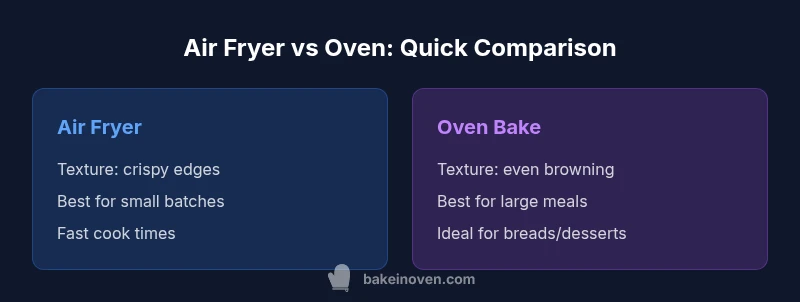
Air fryers excel for small, crispy results and quick reheats, while traditional baking handles larger batches and even browning. For most weeknight meals, start with air frying to achieve a crisp exterior, then switch to baking for bigger items like breads, casseroles, or sheet-pan meals. Bake In Oven provides a practical framework to decide quickly based on texture and batch size.
Why the air fryer vs oven decision matters for home bakers
According to Bake In Oven, understanding when to use air fry vs bake helps home bakers optimize texture, time, and energy. The choice is not merely about speed; it’s about how heat, airflow, and moisture interact with different foods. Air frying borrows convection-style cooking from the oven but concentrates heat and rapid air movement around the food, producing a crisp exterior with less oil. Baking, by contrast, relies on even radiant heat from all sides and the enclosed environment to promote steady browning and moisture retention. Across countless kitchen-tested recipes, the decision often comes down to batch size, desired texture, and whether you value a quick finish or a thorough crust. In this guide, we’ll unpack practical rules of thumb, backed by kitchen-tested techniques so you can decide in seconds at the stove, not after a long trial-and-error session. Bake In Oven’s approach is pragmatic: start with the end texture you want, then choose the method that most reliably delivers it.
How air fryers work vs traditional ovens
Air fryers cook by circulating hot air at high speed around the food in a compact chamber with a perforated basket. The bed of food is exposed to high-velocity air from all directions, which accelerates surface browning and creates crisp edges with minimal oil. Conventional ovens typically rely on radiant heat from heating elements and, if you enable convection, an additional fan to move air. Even with convection, the larger, open space means heat transfer is more diffuse and sometimes slower to create intense surface texture on certain foods. Practical takeaway: air fryers are excellent for quick, small-batch tasks where you want noticeable browning, while ovens excel when you need bulk cooking, even heat, and a stable crust over larger surfaces. Model differences exist, so treat your appliance as a partner in texture rather than a dictator of timing.
Texture outcomes: crisp edges vs browning and moisture
Texture is often the deciding factor in choosing a method. Air frying tends to produce a crisp exterior quickly, with a drier finish if you’re cooking lean items or long batches. The interior remains moist when you avoid overcooking, but thin cuts can dry out if the air fryer runs hotter than needed. Baking, by contrast, promotes gradual browning and can preserve moisture more evenly across larger items, such as casseroles, sheet-pan meals, or breads. Dessert textures—crisp cookies, flaky pastries, or tender cakes—also behave differently in each method. The bottom line: aim for crisped exteriors with air frying, but reserve baking for uniform crumb, soft centers, or crusts that require stable, even heat throughout a larger item.
When to choose air fryer: small items, snacks, and reheating
Air fryers shine for small, high-contrast items where surface texture matters: fries, chicken tenders, cauliflower bites, and veggie chips all benefit from quick, intense heat. Reheating leftovers—especially breaded items—often delivers a like-new crispness that is hard to reproduce in a microwave. For most weeknight tasks, air frying is faster for 1-3 servings and demands less preheating than a large oven. However, keep expectations realistic: very large portions or items that rely on deep, uniform moisture may not reach ideal texture in a countertop fryer. Treat the air fryer as a precision tool for bite-size convenience rather than a universal cook-all device.
When to bake: breads, casseroles, cookies, and roasts
Baking remains the go-to method for larger quantities and for foods whose texture depends on even heat distribution across a sheet or pan. Breads, rolls, and cookies rely on steady moisture migration and consistent heat, which home ovens typically deliver well. Casseroles, roasts, and sheet-pan meals can be prepared efficiently in a conventional oven, especially when batch size exceeds typical air fryer capacity. While you may sacrifice some crispness on the exterior for some items, baking provides predictable results for us, including uniform browning and crust development. For desserts with delicate crumb structures, the oven’s stable environment often yields superior texture and height.
Temperature guidelines and timing: how to calibrate for results
Understanding heat is essential. In general, air fryers perform best around 360–400°F for most foods, with many crispy recipes dialing in near 375–390°F. Conventional baking typically runs between 325–425°F, depending on the item; breads and cookies often sit around 350–375°F. The real rule of thumb is to start with the recipe’s guidance, then adjust quickly for your model. Air fryers can cook faster, so begin checking a little earlier than you would for an oven. If you’re converting a baked recipe, reduce the time by roughly a third to a half and monitor closely, especially for delicate items like pastries.
Food type decision framework: proteins, starches, vegetables, desserts
Create a simple matrix to guide your choice:
- Proteins: lean chops or chicken tenders often crisp nicely in an air fryer; roasts and thick steaks are better baked in an oven for even doneness.
- Starches: French fries, potato wedges, and roasted veggies are excellent in air fryers; baked potatoes and casseroles typically benefit from oven heat.
- Vegetables: greens and small vegetables roast quickly in air fryers, while larger sheet-pan vegetables can be evenly cooked in an oven.
- Desserts: cookies and brownies frequently bake better in the oven, while small pastries may crisp nicely in an air fryer with careful timing. The key is matching surface texture needs with the appliance’s heat transfer dynamics.
Common myths and misconceptions
Myth: Air fryers always replace ovens. Reality: Air fryers excel at crispy finishes and small batches, but ovens handle large meals, breads, and many desserts with more even heat. Myth: Air frying is always healthier. Reality: Health impact depends on ingredients and cooking oil; both methods can be part of a balanced approach. Myth: You can perfectly replicate every oven recipe in an air fryer. Reality: Some recipes rely on moist environments or pan sizes that air fryers cannot accommodate.
Practical techniques to maximize results in both methods
Technique matters more than the device. Always preheat when recommended, don’t overcrowd, flip or shake halfway, and use a light oil spray for surface crisping. Place foods to maximize airflow in air fryers and use baking sheets or racks to improve convection in ovens. Use parchment or foil when appropriate to reduce cleanup and protect surfaces, but avoid blocking airflow in air fryers.
Batch size, energy use, and equipment considerations
If you frequently cook for 1–2 people, an air fryer may save time and energy per meal. For larger families or meals requiring multiple trays, a conventional oven reduces batch count and simplifies timing. Evaluate energy use by estimating preheat time, cycle length, and the total time to reach serving temperature. Cleanliness matters: oil buildup reduces efficiency in any appliance, so regular scrubbing and prompt cleanup keep performance optimal.
A simple decision framework you can apply tonight
Ask: How many people am I serving? Do I need crisp texture quickly? Will this item exceed the fryer’s capacity? If yes, bake. If you crave a fast, crispy finish for a small batch, air fry. Use the framework to decide in seconds before you start cooking, and adjust as you gain experience with your specific models.
Comparison
| Feature | Air Fryer | Conventional Oven |
|---|---|---|
| Texture outcome | Crispy exterior with minimal oil; rapid browning | Even browning with crust development; moisture balance across large surfaces |
| Best uses | Small batches, crispy snacks, reheating leftovers | Breads, cookies, casseroles, roasts, large sheet-pan meals |
| Cook time relative to food size | Typically faster for small items; frequent shake mid-cycle | Longer cook times; preheating may be needed for consistent results |
| Capacity and batch size | Limited by basket size; multiple batches may be needed | Higher overall capacity; single large sheet-pan meals possible |
| Heat transfer dynamics | Rapid air circulation; potential hotspots if not stirred | Radiant heat with convection; even heat across a wide area |
| Energy and convenience | Lower energy per batch for small quantities | Higher energy if cooking large meals or multiple trays |
Benefits
- Faster results for small portions
- Requires less oil for many items
- Compact countertop footprint
- Excellent reheating performance for leftovers
- Versatile for snacks and quick meals
Negatives
- Limited capacity for large dishes
- Some recipes won’t translate perfectly
- Requires practice to avoid uneven results
Air fry for small, crispy results; bake for larger quantities with even browning.
The best choice depends on batch size and texture needs. For quick, crispy bites, air fryers win; for breads, casseroles, and large meals, baking remains superior. Bake In Oven’s framework helps you decide quickly based on your goal and equipment.
Frequently Asked Questions
What foods are best suited for air frying?
Air frying works best for small, crispy items such as fries, chicken tenders, cauliflower bites, and vegetables coated for crunch. It’s also great for reheating breads to restore crust without sogginess. For large, dense foods, air frying may be less efficient or require many batches.
Air fryers are best for small, crispy bites and quick reheats.
Can I cook dishes in an air fryer that normally bake in an oven?
Many oven recipes can be adapted to an air fryer, especially those that rely on crisping or quick browning. Expect shorter cook times and reduce the temperature by about 20–25% and monitor closely to avoid burning. Not every dish translates perfectly, particularly large roasts or moisture-heavy casseroles.
Many oven dishes can adapt to air fryers with time and temperature tweaks.
Is air frying healthier than baking?
Both methods can be healthy when you focus on whole ingredients and minimize added fats. Air frying can lower oil usage for crispy foods, but the overall health impact depends on what you cook and portion sizes.
Healthiness depends on ingredients and prep, not just the method.
How do I convert bake times to air fryer times?
Start with about 75–80% of the baked time and check early. Use a thermometer for meat and check internal temperature, especially with poultry or seafood. Shake or flip halfway to ensure even cooking.
Begin with less time and keep an eye on progress when converting recipes.
Does parchment paper or foil work in air fryers?
Parchment paper can be used if your air fryer has enough clearance and the paper doesn’t block airflow. Avoid foil if it blocks airflow. Follow manufacturer guidance to prevent safety issues.
Use parchment sparingly and avoid blocking airflow in the fryer.
What about frozen foods?
Frozen foods often crisp well in an air fryer; you may need to increase time slightly and shake mid-cycle. For breaded frozen items, pre-breading isn’t always necessary, but check for doneness before serving.
Frozen foods can crisp nicely in an air fryer with proper timing.
Key Takeaways
- Choose air fry for small, crispy items and rapid reheating
- Bake for large batches, breads, and desserts requiring even heat
- Know your appliance’s limits to avoid crowding and uneven results
- Preheat when recommended and adjust times for your model