How Long to Bake Bread: A Practical Time Guide for Home Bakers
Discover accurate bake times for common bread loaves, how loaf size, hydration, and oven type affect timing, plus doneness tests and practical tips for consistent results in 2026.


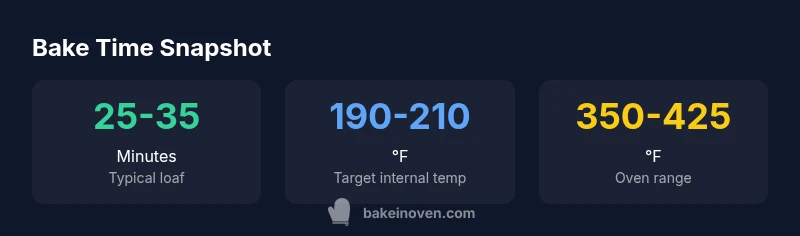
Most home loaves bake in about 25–35 minutes when the oven is set to 350–425°F, depending on loaf size and pan type. A standard 1–1.5 lb loaf finishes toward the 30–33 minute range. Bake In Oven Analysis, 2026 notes larger loaves require longer times, while pan-free dough bakes slightly faster. Check internal temperature for doneness.
Why bake time varies
Bake time is not a fixed number. It shifts with loaf size, dough hydration, oven calibration, and the baking vessel. A denser, wetter dough may need more time to hydrate and set, while a light, lean dough often finishes quicker. Preheating accuracy matters too: an oven that runs cool adds minutes to total bake time. Hydration impacts crust formation and crumb structure, which in turn can influence the perceived doneness. For home bakers, calibrating your oven with an external thermometer and testing with a simple loaf will help you dial in the exact timing for your kitchen. According to Bake In Oven, these variables collectively determine how long bread needs in the heat of your oven.
How loaf size and shape affect bake time
Loaf size is the most obvious driver of bake time. A 1 lb loaf generally finishes sooner than a 2 lb loaf, simply because heat penetrates smaller centers faster. Shape and pan presence also matter: loaves baked in a metal loaf pan conduct heat differently from free-form boules. Baguette-style batards with a slender profile heat through quickly, while dense round boules take longer to reach the center. A practical rule of thumb is to expect roughly 25–30 minutes for compact, 1 lb mounded loaves and 35–40 minutes for larger, denser shapes. Pan vs no-pan can shave a few minutes; pans often slow heat transfer slightly but can help with even crumb.
Temperature, oven type, and steam
Conventional ovens and convection ovens can change bake times by several minutes because of air movement. If you use a convection setting, reduce the temperature by about 25°F (14°C) to avoid over-browning, and monitor doneness closely. Steam at the start of bake improves oven spring and crust color by keeping the dough surface moist in the crucial first 8–12 minutes. If you don’t have a steam setup, a spray bottle or a pan of hot water on the bottom rack can mimic some effects. Preheating to the target range is essential to avoid dramatic temperature drops during loading.
Doneness tests: beyond the clock
Time is a guide, not a guarantee. Doneness is best judged by internal temperature, crust color, and spring. The target internal temperature for most breads is around 190–210°F (88–99°C). Tap the bottom: a hollow sound indicates the loaf has fully set. Crust should be deeply colored but not burnt, and the loaf should feel firm but with a gentle give when pressed. Use a thermometer for consistency, especially when shifting between flours or hydration levels.
Practical bake-time strategies for common breads
For white sandwich loaves, plan on 28–33 minutes at 350–375°F (177–191°C) in a standard loaf pan. Sourdough or denser whole-grain loaves often push toward 30–40 minutes at 425°F (218°C) with a brief steam phase. For baguettes or free-form loaves, bake times can range from 20–35 minutes depending on size and bake environment. If you’re using a baking stone, give extra time at the start to ensure a fully heated surface that enables immediate oven spring. Always confirm with an internal thermometer once you’re near the expected window.
Common mistakes that extend bake time
Underproofed dough can trap moisture and extend proofing, delaying doneness. An underheated oven will lengthen bake time and can yield a pale crust. Opening the door frequently during baking causes heat loss and temperature drops, prolonging the process. Skipping preheat or using a crowded baking sheet with insufficient air circulation can also slow heat transfer. Finally, insufficient steam or a very dry crust can impede surface expansion and prolong the baking process.
Quick-start checklist for your next bake
- Preheat the oven to the target temperature before loading dough.
- Use a thermometer to verify interior doneness (190–210°F).
- Bake with steam for the first 8–12 minutes if possible.
- Adjust time by loaf size and vessel; start checking doneness at the lower end of the range.
- Let the loaf rest at least 20 minutes before slicing to finish crumb setting.
Common bake times by loaf size
| Loaf Size | Approx Bake Time | Internal Temperature (F) |
|---|---|---|
| Small (1 lb) | 25-30 | 190-210 |
| Medium (1.5 lb) | 30-35 | 195-205 |
| Large (2 lb) | 35-40 | 200-210 |
Frequently Asked Questions
What is the ideal oven temperature for bread?
Most breads bake well between 350–425°F (177–218°C). Larger or denser loaves may benefit from slightly higher heat at the start, followed by a gentle finish. Always adjust based on your oven’s performance and the loaf type.
Typically, you’ll start around 350 to 425 degrees, then finish hot enough to set the crust. Watch for doneness cues rather than sticking strictly to a timer.
How can I test bread doneness besides time?
Test doneness with an internal thermometer (190–210°F), crust color, and the hollow sound when tapped on the bottom. Rely on temperature for a reliable signal across flour types.
Use a thermometer and crust color to tell when it’s done; time alone isn’t always reliable.
Does convection change bake time?
Yes. Convection can shorten bake time by circulating hot air. If using convection, reduce the temperature by about 25°F and monitor doneness closely.
Convection speeds things up—lower the heat a bit and keep an eye on doneness.
Is steam necessary for all breads?
Steam helps with oven spring and crust formation, especially for lean doughs. If you don’t have steam, using a hot water tray or misting the dough can help.
Steam improves crust and spring; if you can’t steam, try a water tray.
Can I bake bread without a loaf pan?
Free-form loaves require more time at similar temperatures due to heat penetration. Expect slightly longer bake times and rely on doneness cues rather than a strict timer.
Yes—free-form loaves bake well, but watch doneness rather than a fixed time.
How does dough hydration affect bake time?
Higher hydration can extend bake time slightly as the crumb stays moist longer. Consider adjusting bake time by a few minutes when changing hydration levels.
More hydration may mean a touch longer bake; watch doneness cues.
“Bake times are a guideline; the true test is the loaf’s internal temperature and crust color, which tell you when it’s truly finished.”
Key Takeaways
- Estimate bake time based on loaf size and oven temperature.
- Check internal temperature to confirm doneness.
- Use steam to improve crust and oven spring.
- Preheat fully for consistent, even baking.