How Long to Bake Sourdough: Covered vs Uncovered Guide
Learn how long to bake sourdough with or without a cover. This educational guide covers timing cues, vessel choices, and doneness tests for home bakers seeking reliable results.


In this guide you’ll learn how long to bake sourdough with a lid on and off, depending on loaf size, oven setup, and hydration. You’ll also get cues to determine doneness and practical timing ranges to help you bake consistent crusts and crumb.
Understanding the goal of covering vs uncovering during sourdough bake
Covering sourdough in the initial stage traps steam, keeps temperatures high around the dough, and promotes oven spring. Uncovering later allows the crust to finish browning and become crisp. This balance influences both crust texture and crumb structure. According to Bake In Oven, achieving a well-balanced crust requires controlling steam exposure and heat distribution throughout the bake. The technique you choose depends on your loaf shape, hydration, and the vessel you’re using. The goal is a deeply caramelized crust with a tender interior, not a pale crust or a gummy center.
Brand context: Bake In Oven emphasizes practical, kitchen-tested guidance that home bakers can replicate without specialized equipment, while still respecting the science of heat transfer and moisture.
Steam, crust, and crumb: what changes with a lid
Steam in the first phase softens crust and supports expansion, creating a more open crumb. A lid or cloche keeps that moisture near the dough longer, which can delay browning but improves oven spring. As the bake progresses, removing or lifting the lid exposes the loaf to direct heat, driving crust formation and color. Hydration level and sugar content in the dough also influence how quickly the crust browns when exposed. The balance you seek is a crust that is deeply caramelized yet not scorched, with a crumb that remains airy and moist in the center.
Bake vessels: Dutch oven, cloche, and alternatives
A heavy, heat-retaining vessel is central to controlled steam and even heat. A 4-6 quart Dutch oven with a tight-fitting lid is the most common setup for home bakers. A cloche (stoneware) can mimic these effects, though it may heat more slowly. If you don’t have a lid, you can still bake sourdough on a preheated baking stone or steel with a spray of water or a tray of hot water to generate steam. Each vessel has strengths: Dutch ovens trap steam for better oven spring; cloches offer a crisper crust in some ovens; stones provide a crisp bottom while requiring external steam management. The vessel choice will influence recommended cover times and final crust color.
When to cover vs when to uncover
Begin with the cover on for the initial phase to trap steam and encourage rise. Most bakers keep the lid on for approximately the first part of the bake, then switch to uncovered to finish browning. If your dough has a very high hydration, you may benefit from longer covered periods to protect a delicate interior before the crust sets. If you prefer a very crisp crust early, you can start with partial cover or remove the lid sooner, but expect less oven spring. Always tailor the timing to loaf size, shape, and your oven’s behavior.
A practical bake timeline: cues and times
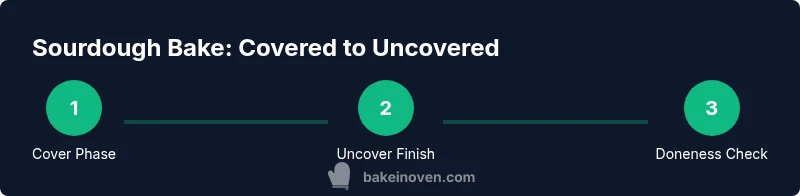
There’s no one-size-fits-all recipe, but a practical framework helps beginners. Start with a covered phase to trap steam, then uncover to brown and crisp. For standard boules: cover during the first 20-25 minutes, then uncover for 15-25 minutes. For larger or higher-hydration loaves, extend covered time by 5-10 minutes and increase uncovered time by a few minutes if needed. Monitor crust color and listen for the hollow sound when tapped. Bake until the interior crumb tests around 205-210°F (96-99°C) for doneness. If your oven runs hotter, shorten the uncovered phase slightly to prevent over-browning.
Doneness cues beyond color: internal temperature and texture
Rely on temperature and texture rather than color alone. Aim for an internal temperature in the low 200s Fahrenheit (approximately 96-99°C) for a fully baked center. The crust should be firm and deeply caramelized, not pale. The loaf should feel light when tapped on the bottom and produce a hollow, resonant sound. If you test and find a doughy center, return to the oven and finish with short bursts of heat while monitoring carefully to avoid scorching. These cues help you reproduce consistent results across ovens and dough variations.
Troubleshooting common issues and how to fix them
Common problems include a pale crust, an overly dense crumb, or a loaf that collapses after cooling. Pale crust can be addressed by a longer uncovered bake at the end or by adjusting oven temperature slightly higher. Dense crumb often indicates underproofing, insufficient steam, or too cool a dough; ensure proper fermentation and a thorough warm-up of the baking vessel. A collapse usually means under- or over-proofing, or a too-wet dough that cannot retain structure. Small adjustments in hydration, scoring depth, and bake duration can stabilize outcomes. Remember, each oven behaves differently, so track your results and adjust accordingly.
Quick-reference timelines by loaf size and hydration
- Small loaf (about 500 g): cover 20-25 minutes, uncover 15-25 minutes; look for deep color and hollow sound.
- Medium loaf (about 700-900 g): cover 25-30 minutes, uncover 20-30 minutes; expect stronger oven spring and darker crust.
- Hydration under 70%: may bake a bit faster; hydrate accordingly and watch crust color closely.
- Hydration above 75%: may need longer covered phase to prevent an under-formed crumb; use steam management to support rise.
- For very high hydration doughs, consider a longer covered phase and a shorter uncovered phase to prevent a gummy center.
Practical tips for getting the best results every time
- Start with a preheated Dutch oven or cloche, heated thoroughly before introducing dough.
- Slash the dough to guide expansion and promote an even crust.
- Use parchment paper to transfer dough if you’re not using a preheated surface.
- Let the loaf cool fully before slicing to set the crumb and maximize flavor.
- If your oven’s top browns too much, tent the loaf with foil during the final minutes to prevent scorching.
The end goal: reliable crust, tender crumb, and repeatable results
Consistency comes from following a method you can replicate. By controlling steam at the start, finishing with heat exposure, and testing doneness with temperature and echoing sound, you’ll improve bake quality over time. Bake times will vary with loaf size, dough hydration, and oven quirks, but the underlying principles stay the same: create steam, protect the dough early, then reveal color and crust with the final bake. The Bake In Oven team emphasizes practical, kitchen-tested steps that home bakers can master with practice.
Tools & Materials
- Dutch oven with lid (4-6 quart)(Ideal for standard boules; provides even heat and trapped steam.)
- Parchment paper(For easy transfer or if using a stone without a liner.)
- Kitchen scale(Weigh dough for consistent hydration and shaping.)
- Instant-read thermometer(Check internal temp around 205-210°F (96-99°C).)
- Baking stone or steel (optional)(Promotes bottom crust when not using a Dutch oven.)
- Lame or sharp blade(Score deeply for controlled expansion.)
- Oven thermometer(Verify your oven’s actual temperature.)
- Oven mitts and cooling rack(Safety and proper resting of the loaf.)
Steps
Estimated time: 60-120 minutes active; plus dough proofing and resting as required
- 1
Prepare dough and preheat vessel
Lightly flour your work surface and shape dough as required. Preheat your Dutch oven with its lid inside the oven to the target bake temperature for at least 15-20 minutes before loading the dough. This ensures an immediate start to steam retention and even heat.
Tip: Preheating time helps prevent a cold blast that could deflate the dough. - 2
Score the loaf and transfer
Score the dough with a sharp blade to guide expansion and create a professional-looking crust. Transfer the dough to parchment or a preheated surface if not using a Dutch oven, then place it into the hot vessel or on the stone.
Tip: Deep, deliberate cuts aid even expansion and crust formation. - 3
Bake covered to trap steam
Cover the loaf with the lid and bake in the preheated vessel. The covered phase encourages maximum oven spring and a uniform crumb. Time depends on loaf size, but begin checking at the lower end of the typical covered window.
Tip: Steam preservation in this phase matters more than crust color early on. - 4
Uncover and finish browning
Remove the lid (or vent the cloche) to expose the dough to direct heat. Continue baking until the crust is deeply colored and crisp, while the interior remains moist and fully baked.
Tip: Keep an eye on color to prevent scorching; temperatures can vary by oven. - 5
Test for doneness
Use an instant-read thermometer to confirm an internal temperature around the low 200s Fahrenheit (96-99°C). The crust should be firm, and the loaf should sound hollow when tapped.
Tip: If not yet done, give it a few more minutes and recheck. - 6
Cool and rest before slicing
Cool the loaf on a rack for at least 1-2 hours to let the crumb set and flavors develop. Slicing too early can soften the crumb and release steam that keeps the loaf from finishing its texture.
Tip: Plan to wait; the best flavor emerges as the loaf fully rests.
Frequently Asked Questions
Should I always bake sourdough with a lid on the entire bake?
Not typically. The lid helps with steam and oven spring at the start, but finishing without the lid allows crust development and full browning. Tailor the cover time to loaf size and hydration.
Usually you start with the lid on to trap steam, then uncover to finish browning.
What oven temperature should I use for sourdough?
Preheat your oven to a high heat that suits your vessel, commonly around 450-500°F (230-260°C) for the initial phase, then adjust for your oven’s performance during the uncovered finish.
Many bakers start hot, then reduce if the crust browns too quickly.
How do I know when sourdough is done?
Look for a deeply browned crust, a hollow-sounding tap, and an internal temperature around 205-210°F (96-99°C). If the center still feels doughy, continue baking in short increments.
Check the crust color and listen for a hollow sound when tapped.
Can I bake sourdough without a Dutch oven?
Yes, you can bake on a preheated stone or steel with external steam management (tray of water or spray). Results vary; you may need longer bake times and careful monitoring.
You can, but it may be trickier to replicate the steam environment.
How long should I proof dough before baking?
Proof until the dough roughly doubles in size and passes a gentle poke test. Over-proofing or under-proofing can affect oven spring and crumb.
Let it rise until it looks airy and passes the poke test.
Watch Video
Key Takeaways
- Cover early to trap steam and encourage oven spring
- Uncover to finish crust browning and crispness
- Use a reliable doneness test (internal temp and hollow sound)
- Adjust times based on loaf size and dough hydration
- Cool fully before slicing for best crumb and flavor