What Do You Use to Bake Sourdough Bread: A Home Baker's Guide
Discover what do you use to bake sourdough bread at home, with starter care, essential gear, and step-by-step baking techniques for crusty, flavorful loaves.


According to Bake In Oven, you’ll learn how to bake sourdough bread at home by using a reliable starter, precise measurements, and the right bake setup. This guide covers ingredients, equipment, fermentation timing, shaping, scoring, and oven techniques, so you can consistently produce crusty, airy loaves with tangy flavors every time.
What do you use to bake sourdough bread: essential equipment and ingredients
To bake sourdough bread at home, you need a few reliable tools and ingredients that stay consistent loaf after loaf. The right equipment saves time, reduces mistakes, and helps you reproduce the same results again and again. According to Bake In Oven, a dependable starter and a well-designed bake setup are the foundation for consistent rise, chewy crumb, and a deep caramel crust. In this section, you’ll learn the must-have gear and the flexible options that fit your kitchen and budget. You’ll weigh and measure rather than guess, set up a dedicated workspace, and decide between a Dutch oven, a cloche, or a baking stone based on your oven and space. A few extras—proofing baskets, parchment, and a sharp lame—make shaping easier and scoring more precise. Start with a digital scale that reads to at least 1 gram, a large mixing bowl for bulk dough, and a scraper to lift and fold. If you have limited space, prioritize a good scale, a sturdy bowl, and a reliable heat source. With these essentials, you’ll move smoothly from mixing to fermentation to bake, keeping in mind that nothing replaces practice, timing, and temperature control in sourdough baking.
As Bake In Oven notes, the setup is as important as the recipe. A clean workspace, measured ingredients, and a consistent environment help you reproduce results. If your oven runs hot or cold, you’ll adjust bake times; if your starter isn’t lively, your rise will be sluggish. Take a moment to map your space: where will you weigh, mix, proof, and bake? Small adjustments to your layout can cut prep time and reduce mess, especially during busy weekends.
Finally, remember that equipment choice is personal. A Dutch oven provides built-in steam and a thick lid for oven spring, while a baking stone or steel can deliver a crisper crust with longer bake times. Choose based on your oven, space, and tolerance for managing steam and temperature. The goal is a repeatable process you can rely on for every loaf.
tip": null
Tools & Materials
- Digital kitchen scale(Reads to at least 1 g accuracy; precise hydration improves consistency)
- Large mixing bowls (4–6 qt)(Stainless or glass; sturdy for wet doughs)
- Dough scraper / bench scraper(Helpful for clean folds and portioning dough)
- Banneton or proofing basket(Flour-dusted surface for shaped loaves; prevents sticking)
- Parchment paper(Makes transferring dough to oven easy and reduces sticking)
- Lame or sharp bread knife(Precise scoring guides expansion and uniform loaf shape)
- Dutch oven or cloche(Captures steam for oven spring; choose based on your setup)
- Baking stone or steel(Promotes a crisp crust and even browning)
- Oven thermometer(Keeps oven temperature accurate for reliable timing)
- Kitchen towels or towels for proofing(Keeps dough covered and maintained warmth during bulk and proof)
- Spray bottle (for steam)(Useful for early steam if you don’t use a Dutch oven)
Steps
Estimated time: 4-6 hours
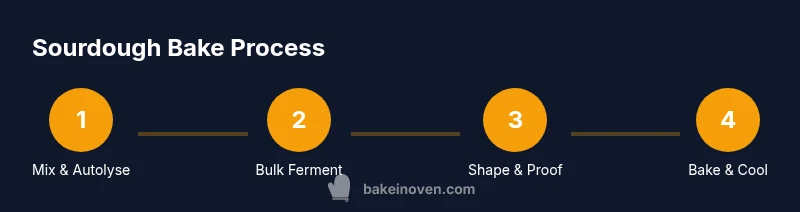
- 1
Measure and prepare ingredients
Weigh your flour, water, salt, and starter. Having everything ready before you begin prevents delays and temperature swings that can affect fermentation. If your kitchen is cool, consider warming water slightly (to around 25°C) to nudge fermentation along. Gather tools in one space to streamline the process.
Tip: Place all ingredients on the scale, tare, and confirm target weights before you start. - 2
Autolyse and mix dough
Combine flour and water and let them hydrate for 20–60 minutes. This autolyse improves gluten development. After hydration, add starter and salt, mixing until the dough comes together with a shaggy, cohesive texture.
Tip: Autolyse reduces kneading effort and improves extensibility of the dough. - 3
Bulk fermentation with folds
Let the dough ferment at room temperature, performing a set of folds every 30–60 minutes during the first half of fermentation. Target a rise where the dough looks puffed and airy and passes the gently pressed test (it springs back slowly).
Tip: Folds build structure without overworking the dough. - 4
Pre-shape and bench rest
Lightly shape the dough into a loose form and let it relax on the counter for 15–30 minutes. This makes final shaping easier and helps preserve gas pockets for a better crumb.
Tip: Use light touches; excessive handling can deflate the dough. - 5
Final shape and proof
Shape tightly and place in a floured banneton seam side up. Proof at room temperature for 1–2 hours or refrigerate overnight for a slower, more flavorful rise. The goal is a dough that holds its shape when tipped out.
Tip: Cold retardation improves flavor and crust color; don’t over-proof. - 6
Score and bake with steam
Preheat the oven with your baking vessel inside for at least 30 minutes. Score the dough, load onto parchment, and bake with steam for the first 15–20 minutes, then finish uncovered until browning is achieved.
Tip: Steam helps oven spring; avoid drafts and maintain consistent heat. - 7
Cool and slice
Cool the loaf completely on a rack before slicing to let the crumb set. Cutting too soon can lead to a gummy interior and misshapen slices.
Tip: Wait at least 1 hour for the crust to set before slicing.
Frequently Asked Questions
What is a sourdough starter and why is it used?
A sourdough starter is a live culture of wild yeasts and lactic acid bacteria that ferments dough. It provides rise and flavor without commercial yeast, producing a characteristic tang and chewy crumb when maintained properly.
A sourdough starter is a living mix of wild yeasts and bacteria that helps bread rise and gives it its tangy flavor.
Can I bake sourdough without a Dutch oven?
Yes. While a Dutch oven traps steam for a strong oven spring, you can bake on a heated stone or steel with added steam using a pan of hot water or a spray bottle. Expect slightly different crust and spring.
You can bake sourdough without a Dutch oven by using a baking stone and steam methods, though results may vary.
How do I know when the dough is properly proofed?
Properly proofed dough should hold its shape when cupped, feel slightly springy, and not be overly soft. A gentle poke should slowly spring back, leaving a slight indentation. Temperature and time will influence this, so observe the dough rather than rely on a clock.
Look for a dough that holds its shape and springs back slowly when poked; timing varies with temperature.
Why is my crust soft or not glossy after baking?
Crust softness can come from insufficient steam, too little oven heat, or improper cooling. Ensure adequate steam in the first 15-20 minutes, bake at high enough temperature, and cool on a rack to avoid trapped moisture.
A soft crust usually means either not enough steam or the bread cooling on a soft surface; improve steam and cooling setup.
How long should I ferment the dough at room temperature?
Fermentation time depends on temperature, starter strength, and dough hydration. In typical settings, bulk fermentation lasts 2–4 hours with folds, while final proof ranges from 1–3 hours. Refrigeration can extend flavor development overnight.
Fermentation duration varies; expect a couple of hours for bulk plus a flexible proof window, or retard overnight for flavor.
Watch Video
Key Takeaways
- Weigh ingredients accurately for consistency
- Starter activity drives rise and tang
- Steam and proper shaping create open crumb
- Cool completely before slicing for clean cuts