How to Bake with Sourdough Starter: A Practical Guide
Learn how to bake with sourdough starter from feeding to baking, with practical steps, tips, and troubleshooting for perfect loaves at home.


By following this guide, you will learn how to bake with sourdough starter from feed to finish. You will need a reliable starter, a kitchen scale, a mixing bowl, and a Dutch oven or stone. The process covers feeding, autolyse, bulk fermentation, shaping, proofing, and baking for flavorful, airy loaves. You will also monitor dough temperature and hydration, adjust timing by feel, and use steam to achieve a crisp crust.
Why sourdough matters for home baking
Sourdough starter is more than a flavor booster; it provides naturally occurring yeast and lactic acid bacteria that leaven bread with time and resilience. For home bakers, the question isn't just how to bake with sourdough starter, but how to build a routine that keeps your starter healthy and your dough predictable. In this guide we cover the fundamentals: feeding, fermentation, shaping, and baking, with practical tips you can apply in any kitchen. Expect a crusty exterior, tender crumb, and complex tang that comes from patient technique and consistent process.
Starter science and feeding schedule
A healthy starter is a living culture that needs regular nourishment. Feed your starter with equal parts flour and water by weight, discard about half first to keep the culture manageable. The goal is a bubbly, slightly domed surface that doubles within 4-6 hours at room temperature. Depending on your climate, you may feed daily or refresh every 12-24 hours when not baking. Bake In Oven's approach emphasizes consistency: maintain a stable feeding window and avoid drastic temperature swings that slow activity.
Tools and ingredients you need
Before you begin, gather essential tools and ingredients. A digital kitchen scale ensures precise hydration; large bowls support mixing and bulk fermentation; a Dutch oven or baking stone provides the ideal steam environment for crust development. For ingredients, use bread flour for higher gluten development, though a portion of whole wheat or rye adds flavor and nutrition. Keep parchment paper handy for convenient transfer, and prepare a clean workspace to minimize dough sticking.
Hydration, flour choices, and dough texture
Hydration, the ratio of water to flour, directly affects dough handling and crumb structure. Start with 70–75% hydration for a typical loaf; higher hydration yields an open crumb but is trickier to handle. Flour choice matters: bread flour has more gluten; all-purpose can work; whole-grain inputs demand longer fermentation and a sturdier starter. Texture should be slightly tacky but not sticky. If your dough drags on the bowl, you likely need more rest or a touch more water.
Autolyse, mixing, and incorporating starter
Autolyse—flour and water resting before salt and starter addition—improves gluten development and extensibility. After autolyse, fold in your starter and salt, mixing until the dough forms a cohesive mass. The goal is a smooth, elastic dough that passes the windowpane test: when stretched, the dough should thin without tearing. If you overmix, gluten can become tight and tough; under-mixing delays fermentation and may yield a dense loaf.
Bulk fermentation, warmth, and folds
Bulk fermentation is where flavor and structure build. Keep the dough in a warm, draft-free spot; 75–78°F (24–26°C) is a comfortable target for many kitchens. Perform a series of gentle folds every 30–60 minutes to strengthen gluten and redistribute gas. By the end of bulk, the dough should feel airy with visible bubbles and have expanded about 1.5 times its original size. Patience here pays off in loaf height and crumb.
Shaping, bench rest, and loaf formation
Shaping defines the loaf’s final form. Lightly flour the bench, turn the dough out, and shape into a tight boule or batard. A short bench rest helps relax the gluten, making shaping easier, then a final tension seal on the surface improves oven spring. Place the dough seam-side up (for round loaves) or seam-side down (for oblongs) on a proofing surface. Remember: discipline in shaping translates to even crumb and better crust.
Proofing, scoring, and oven readiness
Proofing lets the dough finish its rise before baking. A cool fridge proof (overnight) can strengthen flavor and increase digestibility, but time it so the dough is ready for oven entry. Score with a sharp blade to control the expansion and create an appealing loaf pattern. Preheat your oven early—hotly enough to generate steam, which helps crust development and oven spring. If you skip steam, expect a softer crust and slower rise.
Baking outcomes: crust, crumb, and flavor
Steam and heat produce a crackly crust and a light, airy crumb. Bake at high heat initially to promote rise, then reduce to finish cooking the interior. The final crumb should be moist but fully set, with a rich aroma and tang from the starter’s acidity. Remember that every oven is different; note bake times and temperatures for future loaves and adjust accordingly.
Authoritative sources and further reading
For further guidance, consult reputable sources on bread science and sourdough handling. The Federal government’s food safety guidance and university-extension resources provide reliable background on hydration, fermentation, and handling dough safely. Use these references to complement hands-on practice with your starter.
Variations and troubleshooting
If your loaf is dense, try longer fermentation or higher hydration. If the crust is pale, increase steam duration or bake at a higher temperature for the initial minutes. Flavor can be intensified by including a portion of whole grains or by feeding the starter with older flour to heighten acidity. Most issues resolve with consistent practice and careful observation.
Tools & Materials
- Digital kitchen scale(for accurate hydration and starter measurements)
- Large mixing bowls(at least 1.5–2 L capacity)
- Dutch oven or baking stone(for steam and crust development)
- Proofing basket (banneton)(helps shape during final rise)
- Bench scraper(for shaping and portioning)
- Lame or sharp knife(for scoring the loaf)
- Measuring cups and spoons(for ingredients like flour and water)
- Kitchen towel or plastic wrap(to cover dough during fermentation)
- Parchment paper(for easy transfer to oven)
Steps
Estimated time: 4-6 hours
- 1
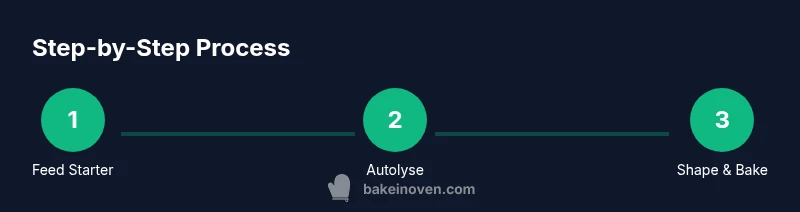
Feed and refresh starter
Refresh your starter 8–12 hours before baking. Discard a portion, then feed with equal parts flour and water by weight. Allow the starter to become bubbly and active at room temperature.
Tip: Use room temperature water (about 75–78°F) to encourage quick activity. - 2
Weigh ingredients precisely
Place flour, water, starter, and salt on the scale, recording exact hydration. Accurate measurements reduce surprises in fermentation and crumb.
Tip: Zero the scale with your bowl on the scale before adding ingredients. - 3
Autolyse dough
Combine flour and water and rest 20–60 minutes to improve gluten development. This helps dough become smoother and easier to handle later.
Tip: A short autolyse yields a sturdier dough; longer autolyse increases extensibility. - 4
Incorporate starter and salt
Add the active starter and salt to the autolysed dough, mixing until evenly distributed and cohesive.
Tip: Salt strengthens gluten; ensure even distribution to avoid pockets of saltiness. - 5
Bulk ferment with folds
Let the dough rise in a warm spot, performing folds every 30–60 minutes to develop structure and gas retention.
Tip: Aim for about 1.5× rise and visible bubbles before shaping. - 6
Stretch and fold technique
Gently stretch and fold the dough to strengthen gluten without tearing, repeating every 30–45 minutes during bulk.
Tip: Keep dough wet enough to prevent sticking but not so wet that it slaps the surface. - 7
Shape the loaf
Turn the dough onto a lightly floured surface and shape into a tight boule or baton with smooth tension on the surface.
Tip: Use a light touch to preserve gas bubbles for oven spring. - 8
Cold proof and scoring
Refrigerate for overnight proof if desired; surface-score just before bake to guide expansion.
Tip: A cold proof enhances flavor and makes scoring easier. - 9
Bake with steam
Preheat a Dutch oven and bake with steam at high heat for 20–25 minutes, then finish without steam to crisp the crust.
Tip: Steam is essential for a crackly crust and good oven spring. - 10
Cool and evaluate
Let the loaf cool completely before slicing. Note crumb structure and crust color to improve future loaves.
Tip: Cooling is when final flavor develops; cut too early and crumb may be gummy.
Frequently Asked Questions
What hydration level should I use for sourdough bread?
A common starting point is 70–75% hydration for a balanced crumb; adjust based on flour brand and desired crumb. Higher hydration yields an open crumb but is harder to handle.
Most bakers start around seventy percent hydration and adjust based on flour and climate.
Can I bake sourdough without a mature starter?
A mature starter makes reliable dough; you can bake with a young starter, but expect slower rise and denser crumb until it matures through regular feedings.
Yes, you can, but the loaf may be denser until the starter is mature.
How long can I keep starter in the fridge?
Starters can be refrigerated for about 1 week between feedings; for longer storage, keep feeding weekly and bring back to room temperature before baking.
Refrigerate for up to a week between feeds, bring to room temperature before use.
Why is my loaf dense or gummy?
Dense loaves often result from underproofing, insufficient fermentation, or insufficient gluten development. Ensure proper hydration, time, and gentle folds to strengthen structure.
Usually underproofing or underdeveloped gluten cause dense crumbs.
What flour works best for sourdough?
Bread flour is a reliable choice for gluten development; a portion of whole wheat or rye adds flavor and acidity. Experiment within 60–100% total flour for best results.
Bread flour is a solid baseline with some whole grain for flavor.
Is a Dutch oven essential?
A Dutch oven or a covered cloche creates the steam environment needed for a good crust and oven spring. If unavailable, use a baking stone with a metal pan of water to generate steam.
A covered vessel like a Dutch oven is ideal for steam at bake time.
Watch Video
Key Takeaways
- Measure ingredients precisely to control hydration.
- Autolyse improves extensibility and dough handling.
- Bulk fermentation builds flavor and structure.
- Steam and proper heat create crusty, well-shaped loaves.