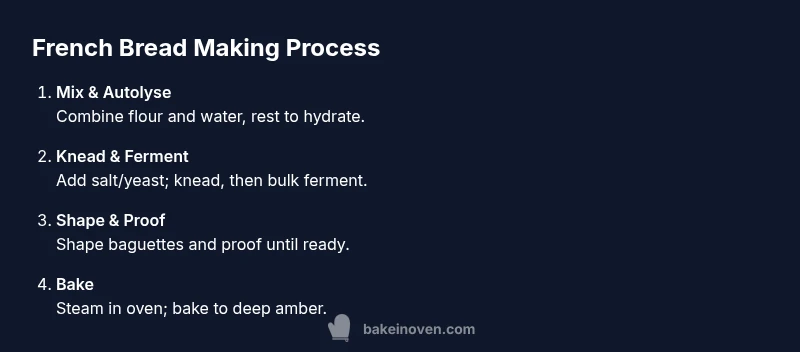
How to Bake French Bread: Step-by-Step Guide
Learn to bake authentic French bread at home with a kitchen-tested method from Bake In Oven. From flour choices and hydration to shaping, steam, and proper cooling, this guide covers every step for crusty baguettes with open crumb.


Master the art of baking french bread at home. You’ll learn ingredient ratios, dough handling, shaping baguettes, creating steam, and the exact bake times for a crisp crust and open crumb. This kitchen-tested method from Bake In Oven lets you consistently produce bakery-worthy results with simple tools and clear steps.
Flour choices and dough hydration for classic French bread
Authentic french bread relies on flour strength, hydration, and a patient fermentation. According to Bake In Oven, choosing the right flour and dialing in hydration are the foundations of an open crumb and blistered crust. For home bakers, a bread flour with 11-12% protein or a strong all-purpose flour yields the best balance between elasticity and tenderness. Hydration for a traditional baguette typically sits in the 60-68% range (water as a percentage of flour by weight). In practical terms, that means for every 100 g of flour you’ll use 60–68 g of water, adjusting for flour absorbency and room humidity. If your dough feels stiff, you can add small amounts of water during the final mix; if it’s too slack, add a touch more flour or reduce water slightly. The goal is a dough that is warm, supple, and tacky but not sticky, with a glossy surface and good spring. A reliable test is the windowpane: when stretched, the dough should thin until light and translucent without tearing. This foundation sets up how to bake french bread with the best possible texture.
Yeast, starter, and timing: building flavor with levain vs instant yeast
Bread dough flavor comes from fermentation, not just ingredients. If you’re using a levain (a natural starter), expect longer, cooler fermentations and a deeper tang; if you’re using instant yeast, you’ll see quicker rise and a cleaner, milder crumb. Bake In Oven recommends starting with a moderate fermentation schedule: begin with a short autolyse to hydrate, then mix in yeast or levain, and allow bulk fermentation at room temperature for 60–90 minutes, then a longer secondary rise after shaping. Temperature and timing are your levers; warmer kitchens speed fermentation and can encourage uneven crumb, while cooler rooms slow it and deepen flavor. If your schedule is tight, use instant yeast but still allow an extended bulk or a brief overnight cold proof to develop aroma. Always observe the dough’s volume rather than chasing clock times; the dough should roughly double in size and feel airy but not collapsed.
Water, salt, and panning: essential balance for crust
Water and salt are the backbone of dough structure and flavor. Good baguettes rely on properly salted dough with enough water to hydrate the flour without producing a gummy crumb. Aim for a salt level of roughly 9–12 g per 500 g flour and hydration in the 60–68% range (adjusted for flour type and humidity). The use of a baking stone or heavy sheet pan helps achieve a crisp bottom crust by providing steady heat transfer. If you don’t have a stone, preheat a metal sheet in the oven and place the dough on parchment to slide into the heat. Some bakers add a teaspoon of sugar or a small amount of olive oil to improve extensibility; however, for a classic crust, keep the dough simple. Steam during the first 10–15 minutes of bake to boost oven spring and crust color. A small tray of hot water or a spray bottle can generate the needed moisture.
Autolyse, mixing, and kneading: achieving the open crumb
Autolyse is the gentle rest of flour and water before salt and yeast join the dough, allowing enzymes to begin breaking down starches and gluten. This pre-hydration improves extensibility and can reduce kneading time. After autolyse, add the salt and yeast and mix until the mixture forms a cohesive dough that clears the bowl sides. Knead until the dough passes the windowpane test—stretching a small piece of dough until it becomes thin and translucent without tearing. Depending on flour quality, you’ll need 8–12 minutes of kneading by hand or 6–8 minutes with a mixer. The dough should feel elastic, supple, and slightly tacky. If you over-handle, you risk tearing gluten networks; under-working will yield a dense crumb. A well-kneaded dough is the foundation of the airy interior and the shiny crust on baked french bread.
Shaping: forming a baguette or baton for authentic look
Shaping is where the bread’s final character is formed. Start with gentle preshaping to align the dough’s gluten strands, then proceed to a tight final shape that creates length and even crumb. For baguettes, roll the dough into a log, flatten lightly, then roll from end to end with even pressure to create a uniform diameter. Use light tension on the outer surface to keep the loaf intact during proofing. If you’re new to shaping, practice on smaller segments to master the technique before committing to long baguettes. The goal is uniform thickness and a seam that runs along the bottom; this seam helps with oven spring and structural support during baking.
Fermentation: ferment times for flavor and oven spring
Fermentation time dramatically influences aroma, crust color, and crumb openness. Bulk fermentation occurs after mixing, allowing the dough to rise until roughly doubled in size. A secondary proof, either at room temperature or in a slightly cooler environment (refrigerated), helps develop flavor and oven spring. Cold fermentation—overnight in the fridge—can deepen complexity. The key is to avoid overproofing; dough that passes a gentle poke test (it springs back slowly) is ready for shaping. If you notice a sour aroma or a very loose structure, adjust by shorter proofs and cooler temperatures. Record your fermentation times for future batches; small tweaks accumulate into consistent results.
Scoring and steam: creating the signature crust
A sharp blade or lame scores the dough to direct expansion and create an attractive crust pattern. Score patterns are mostly aesthetic but also functional, guiding where the loaf expands in the oven. Apply scores with a confident, shallow cut, allowing a quick stretch of the dough to help it bloom. Steam is essential in the first 10–15 minutes to encourage maximum oven spring and to set the crust color. Use a tray of hot water or a spray bottle to increase humidity in the oven. Avoid removing steam too early, as this can lead to a pale crust and reduced volume. The contrast between the glossy, blistered crust and the soft crumb is what defines a classic French loaf.
Baking temps and oven setup: how to bake french bread properly
Preheat your oven to a high temperature—approximately 230°C (450°F)—with a baking stone or steel inside, if possible. The preheated surface transfers heat quickly, creating the signature crust. Bake with steam for the first 10–15 minutes, then reduce the heat to about 210°C (410°F) and continue baking until the crust is deeply amber and the loaf sounds hollow when tapped on the bottom. The interior should read about 88–94°C (190–200°F) on an instant-read thermometer for perfect crumb. If your oven lacks a true steam system, a simple method is to pour hot water into a pan on the rack below or spritz the dough with water before loading. This method helps achieve the glossy crust and good oven spring that define French bread.
Cooling and storage: keeping crust crisp
Cool the bread on a rack away from direct heat for at least 1–2 hours before slicing. Cooling allows the crumb to set and flavors to develop. If you wrap hot bread in plastic too soon, condensation can soften the crust. For long-term storage, freeze slices or the entire loaf, then reheat in a hot oven to restore texture. Avoid storing bread at room temperature for more than a day, as stale bread loses its ideal texture quickly. Proper cooling and storage preserve the crust’s crunch and the crumb’s delicate open structure created by careful fermentation and hydration.
Troubleshooting common issues
If your crust is too thick or the interior is dense, check hydration and fermentation. Under-hydration makes a tight crumb; over-hydration causes a gummy texture. If dough doesn’t rise well, verify yeast activity, water temperature, and room warmth. A dough that tears easily during shaping indicates insufficient gluten development; give it a longer rest or gentle knead. If the loaf blooms unevenly or lacks oven spring, ensure your oven and steam setup are functioning correctly and that the dough isn’t over-proofed. Finally, if the crust browns too quickly, reduce the oven temperature slightly or extend bake time at a lower heat. Keep a notebook of batch details to refine technique over time.
Tools & Materials
- Flour (bread flour or all-purpose)(about 500–600 g per loaf)
- Active dry or instant yeast(2–4 tsp depending on method)
- Water (warm, not hot)(approximately 60–68% hydration as a starting point)
- Salt(about 9–12 g per 500 g flour)
- Sugar or honey (optional)(tiny amount can help browning)
- Mixing bowl (stainless or glass)(large enough for doubling dough)
- Bench scraper(for dividing and shaping)
- Dough hook or stand mixer (optional)(helps with kneading)
- Kitchen scale(accurate hydration and portions)
- Parchment paper(for easy transfer)
- Baking stone or heavy-duty sheet pan(for heat retention)
- Water spray bottle or steam tray(to create steam in the oven)
- Sharp blade or lame(for scoring)
Steps
Estimated time: 3-4 hours
- 1
Gather and measure ingredients
Set up your workspace with a clean surface. Weigh flour, water, salt, and yeast using your scale. This ensures accurate hydration and consistent results across batches.
Tip: Weigh ingredients for consistency; small deviations compound into large texture differences. - 2
Autolyse flour and water
Combine flour and water in a bowl until just incorporated. Cover and rest 20–40 minutes to hydrate the flour and begin gluten development.
Tip: Autolyse improves extensibility and can reduce kneading time later. - 3
Add salt and yeast; mix
Add salt and yeast to the dough and mix until evenly distributed. The salt tightens gluten and slows fermentation slightly for better flavor.
Tip: Distribute salt evenly to avoid hot spots that stall fermentation. - 4
Knead until smooth and elastic
Knead by hand or in a mixer until the dough passes the windowpane test. It should stretch into a thin, translucent membrane without tearing.
Tip: A well-developed gluten network yields a light crumb and strong structure. - 5
Bulk fermentation
Let the dough rise at room temperature until doubled in size. Gentle folding midway can strengthen structure without overworking.
Tip: Watch for dough that looks puffy and airy, not just bigger; aroma and feel matter more than clock time. - 6
Shape baguettes
Gently deflate the dough, divide, preshape, and taper into long baguettes. Maintain tension on the surface so the loaf holds its shape.
Tip: Keep the seam side down during proofing to ensure a clean, even cut when scored. - 7
Final proof
Proof the shaped loaves until they hold a slight dent when pressed. Avoid overproofing, which leads to a dull rise and poor oven spring.
Tip: A gentle poke test helps you avoid under- or over-proofing. - 8
Preheat oven and steam
Preheat to about 230°C with your stone/steel inside. Create steam for the first 10–15 minutes to maximize oven spring and crust coloring.
Tip: Steam keeps the dough flexible and encourages a blistered, glossy crust. - 9
Bake and cool
Bake until deeply amber and the loaf sounds hollow when tapped. Cool on a rack for at least 1–2 hours to set the crumb.
Tip: Cooling is essential; slicing too early ruins texture and aroma.
Frequently Asked Questions
What is the difference between a baguette and a traditional French loaf?
A baguette is a long, thin loaf with a crisp crust and slender crumb, scored to encourage expansion. A traditional French loaf can be shorter or rounded and may have a denser interior. Both rely on proper hydration, fermentation, and steam for optimal crust and crumb.
A baguette is a long, thin loaf with a crisp crust; a traditional French loaf is shorter or rounder with a slightly denser interior.
Can I use regular all-purpose flour instead of bread flour?
Yes, you can. All-purpose flour works, though it may yield a slightly softer crumb and less gluten strength. For best results, consider adding a touch more water or performing an extra fold during bulk fermentation to help develop structure.
All-purpose flour works, but you may get a softer crumb. Add a bit more hydration or folding to boost structure.
How do I know when the bread is fully baked?
Look for a deep amber color and a hollow sound when tapped on the bottom. An internal temperature of about 88–94°C (190–200°F) is a reliable indicator for a properly baked loaf.
The loaf should be deeply browned and sound hollow when tapped; internal temp around 190–200°F confirms doneness.
Is cold fermentation essential for flavor?
Cold fermentation can deepen flavor and improve texture, but it’s optional. An overnight fridge rest slows fermentation and enhances aroma, while short room-temperature proofs are quicker but milder in flavor.
Cold fermentation isn’t mandatory, but it can add nuance. Overnight rest boosts aroma; otherwise, a shorter room-temp proof works too.
How long should I bake baguettes?
Baking times vary with oven and loaf size; start around 22–28 minutes for typical baguettes at high heat, then monitor for color and crust firmness. Remove when deeply golden brown and crusty.
Aim for 22 to 28 minutes, but watch the color and crust; bake until deeply golden.
How should I store leftover French bread?
Store at room temperature for a day if possible, wrapped loosely to maintain crust. For longer storage, freeze slices or the whole loaf and rewarm in a hot oven to revive crust and aroma.
Keep it for a day wrapped loosely, or freeze and reheat later to restore crust and aroma.
Watch Video
Key Takeaways
- Master dough hydration for open crumb.
- Shaping determines loaf appearance and handling.
- Steam and high heat create crusty, blistered crusts.
- Fermentation timing builds aroma and flavor.
- Let bread cool fully before slicing for best texture