Know When Sourdough Is Ready to Bake: A Practical Guide
Learn how to know if sourdough is ready to bake with reliable tests, timing cues, and expert tips. A thorough, kitchen-tested guide from Bake In Oven.


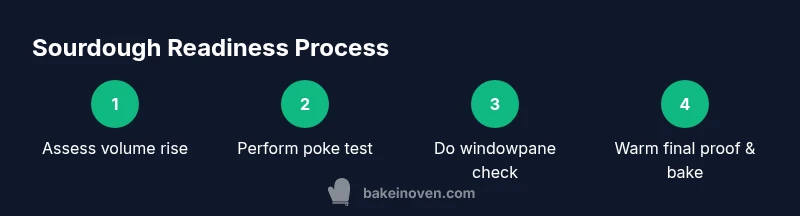
To know when sourdough is ready to bake, look for consistent volume with a domed, rounded shape, a bright, pan-crack aroma, and a dough that passes the poke test and windowpane test. Let it rest through a warm final proof if needed, and avoid overproofing by watching for signs of collapse.
Why readiness matters for sourdough baking
Ready-to-bake sourdough is not a guess; it’s a snapshot of the dough’s fermentation state and gluten development. The dough’s readiness determines how well it will expand in the oven, how open the crumb will be, and how the crust will form. Readiness signals come from a combination of volume, structure, aroma, and surface characteristics. According to Bake In Oven, these signals—volume increase, dome shape, a sweet-tung aroma, and controlled elasticity—are your most reliable compass for timing a sourdough bake. When you recognize these cues consistently, you gain confidence and reduce the risk of underproofing (dense crumb) or overproofing (weak oven spring). The goal is a dough that is fully aerated, with a glossy surface and a gentle resistance to a light touch, indicating both gas retention and gluten strength.
In practice, you’ll combine several tests rather than rely on one single cue. The dough should look visibly risen, yet still hold its shape when scored. The aroma should be pleasantly sour, not flat or excessively alcoholic. These are subtle, cumulative signals that improve with practice and a consistent routine. Bake In Oven analysis shows that bakers who verify readiness with multiple cues tend to achieve better oven spring and an open crumb, especially when temperatures are stable and mixing and folding have been performed consistently.
Visual cues: volume, texture, and aroma
Visual cues are often the first hints of readiness. The dough should have doubled in size or at least look visibly domed and puffy. The surface should appear slightly taut, not deflated, and the dough should hold a soft, rounded shape rather than a flat disk. Texture-wise, the dough should spring back gently when pressed and should not feel overly dense. Aroma is another key cue: a well-fermented dough smells pleasantly tangy and slightly sweet, with a clean, doughy aroma rather than a strong alcohol or rotten scent. The balance of expansion, elasticity, and aroma informs whether the dough is on track for baking. Bake In Oven’s guidance emphasizes cross-checking these signs with practical tests rather than relying on appearances alone.
When you see these cues together—visible volume, gentle spring, and a pleasant scent—you’re more likely to achieve a bakery-worthy crust and crumb.
The poke test: how to perform accurately
The poke test is a quick, tactile check that reveals dough strength and gas retention. Lightly press the dough about half an inch (1.25 cm) deep with your finger. If the indentation slowly springs back and the dough surface remains slightly domed, it’s a good sign. If it stays indented and slowly recovers shape, it’s still proofing. If it does not spring back at all, the dough may be overproofed or lacks structure. Perform the poke test after the dough has risen and settled from any shaping tension. Reset the dough gently after testing and wait a few minutes before any further checks. The poke test works best when the dough is evenly risen and not tight at the surface.
Why this matters: a dough that collapses too quickly after poking may indicate excessive gas loss or overproofing, which reduces oven spring and crust development. If the poke test is borderline, proceed with another cue, such as a windowpane test or a final-proof check, to confirm readiness.
The windowpane test and gluten development
The windowpane test assesses gluten strength and extensibility. Lightly stretch a small piece of dough between your fingers. If it stretches into a translucent, paper-thin membrane without tearing, gluten development is strong enough to trap gas during baking. If tearing occurs easily, you may need another gentle fold and a little more rest. The windowpane test is most reliable after a few stretch-and-fold cycles during bulk fermentation, as this builds the dough’s network. When the dough passes the windowpane test, you should see improved oven spring and a more open crumb. Remember, pass/fail is relative to your style of bread; a rustic loaf may tolerate slightly tighter gluten than a highly aerated sourdough.
Tip: don’t overwork the dough during testing—gentle handling preserves structure and avoids degassing the dough prematurely.
The final proof: timing and environment
Final proof time varies with temperature, hydration, and starter activity. In cooler environments, expect longer proof times; in warm kitchens, proofing can accelerate. The goal is to reach a state where the dough has expanded but not started to sag or collapse, indicating a strong gas retention and intact gluten. A warm, controlled environment—ideally around room temperature—helps the dough reach optimal gas expansion without overproofing. If you’re unsure, a brief final proof (15–30 minutes) can help you decide, but avoid letting the dough proof past its peak, which can cause the oven to underperform. Bake In Oven’s guidance suggests gauge, not clock; look for a dough that looks filled, centered, and holds its shape when touched lightly.
A practical approach is to press the dough gently with a fingertip; it should spring back slowly and leave a shallow indentation that slowly refills. If it springs back quickly, it may need more time. If it stays indented, it may be at or near peak. These cues help you time your bake for maximum oven rise and crust formation.
Starter vitality: how active your starter should be
A lively starter is the engine behind good sourdough readiness. Feed your starter consistently and allow it to peak before mixing into dough. Activity is demonstrated by a steady rise and abundant, uniform bubbles. The dough will respond more predictably if the starter’s activity is high, contributing to a strong dough rise, better gas retention, and a more open crumb. If your starter is sluggish, take steps to revive it: adjust feeding times, temperatures, and hydration. Bake In Oven notes indicate that a robust starter accelerates fermentation and improves the texture and aroma of the final loaf. A sluggish starter often yields a dense crumb and slower oven spring.
In practice, you should observe the starter’s doubling within 4-6 hours of feeding at room temperature, with visible bubbles throughout. If your starter is not showing healthy activity, consider revising your feeding schedule, water temperature, or flour type to achieve reliable results.
Temperature and environment: optimizing dough readiness
Temperature plays a critical role in sourdough readiness. Warmer rooms speed fermentation and can shorten proof times; cooler rooms slow them down and may require longer fermentation. A stable, moderate environment—roughly around room temperature—helps the dough develop evenly. If your kitchen is drafty or too cold, consider placing the dough in a slightly warmer corner or using a proofing environment. A consistent temperature reduces the risk of uneven gas production and crust formation. By controlling temperature, you can better predict when the dough will reach peak expansion and readiness for baking. Bake In Oven emphasizes that consistent warmth supports even fermentation and a more predictable bake, especially for bakers new to sourdough.
To manage temperature without appliances, use a bowl or a blanket to wrap the dough lightly and place it away from direct sunlight or heat sources. This simple step can stabilize the dough’s pace of fermentation and yield a more reliable final loaf.
Common mistakes and how to fix them
Even experienced bakers encounter misfires. Common errors include underproofing, which yields a dense crumb and less oven spring; overproofing, which leads to a collapsed loaf and a pale crust; or inconsistent shaping that causes uneven expansion. Remedies are practical: adjust timing based on temperature, re-run tests, and consider retarding dough in the fridge for better flavor and structure. If your dough lacks aroma, extend fermentation slightly while watching the poke test and windowpane results. If your dough is overly sticky or slack, a gentle fold and brief rest can restore structure. In most cases, adjusting hydration or folding cadence helps bring the dough back to readiness without sacrificing flavor. Bake In Oven’s approach favors observation over rigid timing, encouraging you to learn your dough’s unique signals through steady practice.
Quick-before-bake checks: last-minute cues
Right before bake, perform a final evaluation: confirm that the dough has a gentle spring, a cohesive surface, and a slightly domed shape. The surface should be smooth, not scruffy, and the dough should not be overly sticky to the touch. A light mist of water can help surface tension for scoring, but avoid soaking the dough. If the dough shows signs of underproofing, a brief rest at room temperature can help; if overproofed, it may require shaping adjustments or a short retesting cycle. These last checks minimize surprises when the dough hits the oven and maximize oven spring and crust development.
Remember, the goal is to bake at a moment when the dough is structurally sound and ready to expand fully in the heat of the oven.
Ready-to-bake checklist: a practical reference
This final block provides a concise reference you can print or bookmark. It includes the key cues: volume and dome, a springy feel to the dough, a pleasant aroma, and passing the poke and windowpane tests. The checklist helps you quickly assess readiness without re-reading the entire guide. Use the checklist after every bake to build consistency. By following these consistent signals, you’ll improve both flavor and texture with minimal guesswork, and you’ll gain confidence in predicting oven behavior with different flours and hydration levels.
Tools & Materials
- Kitchen scale(Accurate measuring for hydration and starter quantity)
- Mixing bowls(Sturdy, large enough for bulk fermentation)
- Bench scraper(For shaping and folding without tearing gluten)
- Damp towel or plastic wrap(To cover dough during rises)
- Flour for dusting(Light dusting to prevent sticking during shaping)
- Banneton or proofing basket(Helps hold shape for proofing)
- Lame or sharp blade(Scoring before bake)
- Baking stone or Dutch oven(For final bake and crust development)
- Spray bottle with water(Mist for surface tension if desired)
Steps
Estimated time: 15-30 minutes
- 1
Verify starter vitality
Assess that your starter has risen and is bubbly. Feed it if needed and wait for a peak within 4-6 hours at room temperature. This ensures a strong leavening effect that impacts dough readiness.
Tip: Use a clear jar to see rise clearly; a vigorous, uniform rise indicates healthy activity. - 2
Prepare and scale dough
Weigh ingredients and mix until a cohesive dough forms. Let it rest briefly before bulk fermentation to let gluten relax and hydrating flour fully.
Tip: Hydration consistency affects texture; avoid dry patches. - 3
Bulk fermentation with folds
During bulk fermentation, perform 2-3 folds at 20-40 minute intervals to strengthen the gluten network and improve gas retention.
Tip: Mark the dough’s height on the container to track rise. - 4
Poke test assessment
Gently poke the dough; the indentation should slowly recover. If it springs back quickly, it needs more time; if it stays indented, it may be approaching overproofing.
Tip: Use a light touch to avoid degassing. - 5
Windowpane test check
Stretch a small piece until thin and translucent. It should stretch without tearing, indicating strong gluten development and gas retention.
Tip: If tearing occurs, fold and rest again for a short period. - 6
Final proof decision
Decide on final proof based on temperature and cues from poke/windowpane tests. In warm rooms, keep proof times shorter to avoid overproofing.
Tip: Aim for a gentle, rounded dome rather than a flat top. - 7
Score and bake prep
Score the dough to guide expansion and prepare your baking vessel or stone heatfully. Ensure the oven is hot and fully preheated for best oven spring.
Tip: A sharp blade gives clean cuts and helps controlled expansion.
Frequently Asked Questions
What is the windowpane test for sourdough?
The windowpane test checks gluten strength by stretching dough until it becomes thin and translucent. If it tears easily, gluten strength is weak and you may need more folds or rest. A successful windowpane indicates the dough can trap gas for a good oven spring.
The windowpane test checks gluten strength by stretching dough until thin and translucent. If it tears easily, fold and rest; if it passes, you’re ready for shaping and baking.
Why doesn't my sourdough pass the poke test?
If the dough doesn’t spring back or collapses, it may be underproofed or overproofed depending on temperature and hydration. Check the aroma and volume, then adjust proof times or folds accordingly.
If the dough doesn’t spring back or collapses, it may be underproofed or overproofed. Check aroma and volume and adjust your timing.
Can I bake sourdough straight from the fridge?
Yes, you can bake dough that’s been retarded in the fridge, which often improves flavor and structure. Allow it to come to room temperature and perform final checks before baking.
Yes, you can bake dough that's rested in the fridge. Let it warm a bit and check readiness cues before baking.
How long should the final proof take?
Final proof time varies with temperature and dough hydration. Start with 15-30 minutes in a warm room and adjust based on the dough’s dome, spring, and aroma signals.
Final proof usually takes 15-30 minutes in a warm room; watch for the dough to dome and feel springy.
What room temperature is best for fermentation?
A stable, moderate room temperature supports predictable fermentation. Around typical kitchen temperatures helps dough rise consistently without speeding up too much.
A stable, moderate room temperature helps dough ferment predictably; avoid extreme heat or cold for best results.
Watch Video
Key Takeaways
- Trust volume and spring as readiness cues
- Use poke and windowpane tests for accuracy
- Maintain steady room temperature for consistent fermentation
- Avoid overproofing by watching signs of collapse