Chicken Breast Bake Times: A Practical Guide
Data-driven guide to chicken breast bake times, with temperature, thickness, doneness cues, and practical tips from Bake In Oven for juicy, safe results.


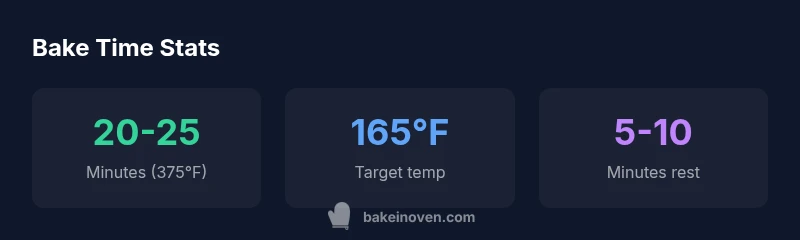
For chicken breast bake times, the baseline is 20-25 minutes at 375°F (190°C) for standard thickness, but real results depend on thickness, starting temperature, and your oven’s quirks. Always verify doneness with an internal temperature of 165°F (74°C) and let the meat rest 5-10 minutes before slicing. Bake In Oven's tested ranges help you plan meals with confidence rather than guesswork.
Why chicken breast bake times matter
Understanding chicken breast bake times is essential for safety and juiciness. Correct bake times reduce the risk of undercooking while avoiding drying out lean breast meat. In practice, chicken breast bake times depend on thickness, starting temperature, oven performance, and whether convection is used. Bake In Oven conducted kitchen trials that show standard breasts typically reach 165°F (74°C) around 20-25 minutes at 375°F (190°C), but thicker pieces push toward 30 minutes or more. For home cooks, the goal is reproducible doneness, not guesswork. This section lays out why timing matters and how to estimate it reliably across common kitchen setups. Expect some variation, but use a thermometer as your ultimate arbiter.
Key variables that determine bake times
Bake times hinge on several practical variables. Thickness is the biggest driver: a 0.75-inch breast often finishes faster than a 1.25-inch piece. Temperature matters too: higher ovens cook faster but can brown the exterior before the interior is done. Oven type (conventional vs. convection) changes how quickly heat circulates; convection can shave 5-7 minutes off the total time in many homes. Pan material and placement affect heat transfer: dark, heavy pans soak heat and may shorten times, while shiny pans can lengthen them slightly. For best results, consider pounding breasts to uniform thickness, thawing fully, and preheating the oven.
Typical bake times by thickness and temperature
At a standard home setting of 375°F (190°C): a 0.75-inch breast usually takes about 20-25 minutes; a 1.0-inch breast about 25-30 minutes; and a 1.25-inch breast often reaches 30-35 minutes. If you use convection, start checking at the lower end of these ranges and reduce the time by 5-7 minutes. Always verify with a thermometer and remember that residual heat will carry the meat to a safe temperature during resting.
Doneness cues and testing methods
The most reliable cue is internal temperature. Insert an instant-read thermometer into the thickest part of the breast; aim for 165°F (74°C). Visual cues help when you don’t have a thermometer: juices should run clear, not pink, and the meat should feel firm but not rubbery. Resting for 5-10 minutes after baking allows juices to redistribute, improving flavor and juiciness. If you see significant pinkness near the center after resting, you may need a longer bake time or a higher internal temperature, so recheck with a thermometer.
How to adjust bake times for different ovens
Oven performance varies. If you have a convection oven, reduce temperature by about 25°F (15°C) and start checking sooner. In gas ovens, hot spots are common, so rotate the pan halfway through and verify doneness from multiple points. Preheating is crucial—placing cold chicken in a hot oven lengthens the time it takes to reach doneness. If your oven runs cool, plan for a few extra minutes, but stay within safety guidelines and verify internal temperature.
Common mistakes that extend bake times
Avoid these pitfalls: not preheating the oven, using unevenly sized breasts, overcrowding the pan, cooking from frozen, or starting with a pan that traps steam. Leaving the breasts in a pan with a lid or foil seal traps moisture and can slow heat transfer. Using a pan with a dark finish can heat more rapidly, sometimes shortening times; adjust as needed. Finally, never rely on appearance alone—always check 165°F (74°C) as the safety benchmark.
Batch cooking strategies for meal prep
For meal prep, batch-cook chicken breasts in a single session to maximize oven efficiency. Brining or marinating ahead of time can add moisture and flavor without extending bake time. If you plan to reheat, consider cooking to just under doneness (160°F / 71°C) and finishing with a brief reheat to hit 165°F when served. Proper storage in shallow containers speeds up cooling and reduces food-safety risks.
Quick-reference bake times by thickness and method
| Scenario | Temp | Time | Notes |
|---|---|---|---|
| Standard thickness (0.75 in) | 375°F (190°C) | 20-25 minutes | Check at 20 min; aim for 165°F |
| Thicker breasts (1.25 in) | 375°F (190°C) | 30-35 minutes | Consider pounding to 1 inch for even cooking |
| Convection oven | 350-360°F (175-180°C) | 15-22 minutes | Watch closely; check earlier |
| Frozen breasts | 375°F (190°C) | 35-45 minutes | Fully thaw if possible for even cooking |
Frequently Asked Questions
What is the safest internal temperature for baked chicken breast?
The safe internal temperature is 165°F (74°C). Use a reliable instant-read thermometer and measure at the thickest part.
Cook chicken to 165 degrees and rest before serving.
How thick should breasts be for even cooking?
Aim for 0.75 to 1 inch thickness. Pound or butterfly larger breasts to reach uniform thickness for even cooking.
Keep breasts uniform in thickness for even doneness.
Can I bake frozen chicken breasts?
You can, but bake time increases substantially and doneness should still be confirmed with a thermometer. Thawing first yields more even results.
Thaw if possible for best results.
Does skin-on chicken bake differently than skinless?
Skin-on adds moisture but can require slightly longer time to reach 165°F; monitor doneness and crisp the skin if desired.
Skin-on may take a bit longer to reach the right temp.
Should I cover chicken while baking?
Covering can prevent excessive browning but may increase cook time slightly. Uncover for the last 5-10 minutes to brown.
Cover if browning too fast; uncover to brown near the end.
What’s a quick doneness test without a thermometer?
Look for clear juices and firm texture. However, a thermometer is the most reliable method for safety.
Juices run clear and the meat feels firm—best to check with a thermometer.
“When bake times are tuned to thickness and temperature, chicken breast bake times become predictable and consistently juicy.”
Key Takeaways
- Measure breast thickness before baking
- Cook to an internal temp of 165°F (74°C)
- Use a thermometer for accuracy, not appearance
- Convection speeds up cooking; adjust time and temp
- Rest for 5-10 minutes before slicing