How Long to Bake Chicken: A Practical Timing Guide
Discover how long to bake chicken with precise times, temperatures, and doneness guidance. This kitchen-tested guide covers boneless breasts, bone-in thighs, and whole cuts, plus safety tips and practical timing strategies.


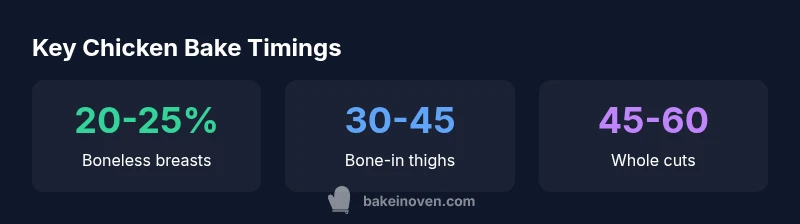
Most boneless, skinless chicken breasts bake in 20-25 minutes at 375°F (190°C), while bone-in thighs require 30-45 minutes. Whole leg quarters or bone-in cuts range 45-60 minutes at the same temperature. Always verify doneness with an instant-read thermometer to reach 165°F (74°C) internally, ensuring juicy yet safe results. Adjust times for thickness, oven performance, and whether you cover the meat.
How long to bake chicken: a practical framework
When you ask how long to bake chicken, you’re really asking about how the cut, thickness, and oven behavior interact with a chosen temperature. In practice, three broad categories determine timing: boneless, skinless breasts; bone-in thighs; and bone-in whole cuts or mixed pieces. As highlighted by Bake In Oven, the baseline times can serve as a starting point, but you must tailor them to your oven, pan, and whether you prefer juicier or crisper results. In this guide we’ll translate those baselines into actionable steps you can apply with confidence, whether you’re preparing a weeknight dinner or batch-cooking for the week.
Baseline times by cut: quick reference
- Boneless, skinless chicken breasts: approximately 20-25 minutes at 375°F (190°C). This is a reliable range when breasts are similar thickness and not overly large. - Bone-in thighs: approximately 30-45 minutes at 375°F (190°C). Dark meat tends to take longer and remains juicy with this window. - Whole leg quarters or mixed bone-in cuts: approximately 45-60 minutes at 375°F (190°C). Faster results come with thinner pieces; slower results require finishing in a warmer oven or tenting loosely with foil for even doneness. Bake times are guidelines; you should verify with a thermometer for safety and texture.
Thickness and portion size matter more than total weight
Thickness is a primary driver of bake time. A 1-inch thick breast will finish well within the 20-25 minute range, while a 1.75-inch thick piece will push toward 28-32 minutes. Portion size also matters: multiple thinner fillets cook faster than a single thick breast. For chicken pieces of uneven thickness, consider portioning or pounding to even thickness to achieve uniform doneness and avoid overcooking the outer edges while the center remains underdone.
Temperature, tools, and methods
Conventional ovens at 375°F (190°C) provide consistent results for most home bakes. Convection ovens can reduce bake times by about 5-10 minutes due to improved air circulation, but you should reduce the temperature by 25°F (about 14°C) if you use convection to prevent drying. Using a reliable instant-read thermometer is the simplest and most accurate approach to schedule checks, especially when cooking multiple pieces with varying thickness.
Doneness checks and safety
Internal temperature is the most dependable doneness signal. For poultry, aim for 165°F (74°C) in the thickest part, checked without touching bone. Resting meat for 3-5 minutes after removal from the oven allows juices to re-distribute, improving texture without large temperature swings. A quick press-test can supplement thermometer checks, but it should not replace thermometry for safety.
Step-by-step timing guide by cut and thickness
- Preheat to 375°F (190°C). 2) Arrange pieces in a single layer on a parchment-lined sheet pan for even exposure. 3) Leave space around each piece so air can circulate. 4) Start with the longest times (thighs or bone-in cuts) and add thinner breasts later if cooking together. 5) Check internal temperature at the 20-minute mark for breasts and at 30 minutes for thighs; resume cooking in 5-minute increments if needed. 6) Rest 3-5 minutes before serving for juicier texture.
Common mistakes and how to fix them
- Overcrowding the pan slows heat transfer; solve by cooking in batches or using two pans. - Cooking to a set time without checking temperature risks undercooking or drying out; always confirm 165°F. - Not letting the meat rest leads to a temperature drop and juiciness loss; rest briefly before slicing. - Using very cold chicken straight from the fridge can extend cook time; bring pieces to room temperature for 15–20 minutes before baking.
Convection and oven variability: practical tips
If your oven runs hot or cold, adjust by ±10–15 minutes based on observed results from previous batches. For convection, start at a lower temperature (350°F / 175°C) and monitor closely, removing or tenting if the surface browns too fast. Each oven has its quirks; keep notes on your favorite settings for several batch sizes.
A practical dinner timeline you can reuse
Assuming bone-in thighs and a 1-inch-thick breast, you might begin with thighs at 375°F for 40 minutes, then add breasts for the final 20 minutes. Check temps near the end, remove pieces as they reach 165°F, and let everything rest briefly before serving. This approach minimizes guesswork and yields consistent results.
Guidance table for common chicken cuts when baking at 375°F
| Cut Type | Typical Bake Time (at 375°F) | Internal Temp Target | Notes |
|---|---|---|---|
| Boneless chicken breast | 20-25 min | 165°F | Thickness matters; flatten if needed |
| Bone-in chicken thigh | 30-45 min | 165°F | Dark meat helps keep juiciness |
| Whole leg quarter | 45-60 min | 165°F | Can finish in foil if needed |
| Mixed bone-in parts | 35-50 min | 165°F | Monitor with thermometer |
Frequently Asked Questions
What is the safest internal temperature for baked chicken?
The safe internal temperature for baked chicken is 165°F (74°C) in the thickest part. Use an instant-read thermometer for accuracy and allow the meat to rest briefly after removing from the oven to finish cooking evenly.
Cook chicken until it reaches 165 degrees at the thickest part, then rest before serving.
Does boneless breast cook faster than bone-in thighs?
Yes. Boneless breasts typically finish in about 20-25 minutes at 375°F, while bone-in thighs take roughly 30-45 minutes. The difference comes from bone, fat distribution, and meat density.
Boneless breasts cook faster than bone-in thighs due to bone and density.
How does thickness affect bake time?
Thickness is the main driver of bake time. A 1-inch piece may finish within the 20-25 minute window, whereas nearly 2 inches can push times beyond 30 minutes. Even thickness helps ensure uniform doneness.
Thicker pieces take longer; thinner pieces finish sooner.
Should I cover chicken while baking?
Covering can prevent surface browning and moisture loss, useful for very lean cuts or when using very high heat. For golden skin, bake uncovered and finish under a brief broil if needed.
Covering can help retain moisture, but uncovered finishes browning.
Can I check doneness without a thermometer?
Without a thermometer, look for clear juices running from the thickest part and opaque cooked color. However, thermometer use is strongly recommended for safety and consistency.
Thermometer is the best method; visual checks are less reliable.
Do convection ovens require different times?
Convection often reduces bake time by about 5-10 minutes. If using convection, lower the temperature by about 25°F (14°C) to prevent over-browning and drying.
Convection speeds things up; lower the temp accordingly.
Is resting meat after baking important?
Yes. Resting for 3-5 minutes allows juices to redistribute, improving juiciness and flavor without significantly raising total cook time.
Resting helps keep the meat juicy.
Should I use parchment paper or foil?
Parchment helps prevent sticking and supports even cooking; foil can trap moisture for very lean cuts but may reduce browning. Choose based on your goals for texture.
Parchment for even cooking; foil for moisture retention.
“Precise timing matters, but a thermometer is the true truth-teller for poultry doneness.”
Key Takeaways
- Start with baseline times by cut.
- Thickness drives most of the timing.
- Always verify 165°F with a thermometer.
- Convection speeds up doneness; adjust temps.
- Rest briefly before serving for juicy texture.