How Long to Bake Chicken Breast: Timings & Temperature
Discover exact bake times for boneless chicken breasts, with temperature guidelines, thickness considerations, and doneness checks to ensure juicy, safe results—plus practical oven tips.


If you’re asking how long to bake chicken breast, aim for 375°F (190°C) and monitor doneness with a digital thermometer. For typical boneless, skinless breasts (about 1 inch thick), bake 18–22 minutes; thicker cuts may need 22–28 minutes. Start checking at 18 minutes and pull at 162–165°F (72–74°C) for juicy results. Always rest 5 minutes before slicing.
Why Timing Matters for Juicy Chicken
Timing is one of the most underappreciated levers in achieving juicy, evenly cooked chicken breasts. If you’ve ever sliced into a dry, pale center, you know that a few minutes can make or break the texture. The core question—how long to bake chicken breast—depends on thickness, starting temperature, and whether you use parchment, a sheet pan, or a shallow roasting dish. According to Bake In Oven, the simplest path to reliable results starts with a preheated oven and a thermometer rather than relying on time alone. When you understand the relationship between time, temperature, and thickness, you can adapt quickly for small breasts, large breasts, or multiple pieces. This section lays the groundwork: you’ll learn how to gauge doneness, adjust timings for different sizes, and minimize moisture loss by avoiding overcooking. You’ll also see why resting the meat after baking matters as much as the bake itself, ensuring the juices redistribute rather than pool at the surface.
Key Variables That Change Bake Time
The bake time for chicken breast is not a fixed number; it shifts with several variables. Thickness is the most obvious factor: 1 inch pieces cook faster than 1.5 or 2 inch cuts. If the chicken is thawed versus coming straight from the freezer, plan for longer bake times when starting from frozen. The starting temperature matters too: cold chicken from the fridge needs more time than room-temperature meat. Bone-in breasts, skin-on breasts, or breasts with added fat or marinade can also affect how quickly heat penetrates to the center. Finally, the oven’s accuracy and the pan you use influence heat distribution. Bake In Oven recommends using parchment on a rimmed sheet for even heat exposure and easy cleanup. Keep in mind that even with precise timing, you should verify doneness with a thermometer before resting.
Standard Times and Temperatures: A Quick Reference
This quick reference assumes boneless, skinless chicken breasts and a conventional oven preheated to 375°F (190°C):
- 1 inch thick: 18–22 minutes
- 1.25 inch thick: 20–24 minutes
- 1.5 inch thick: 22–28 minutes
- 2 inch thick: 28–32 minutes
If the breast is frozen or only partially thawed, extend the time accordingly and verify doneness with a thermometer. A general rule is to check at the lower end of the range and add time in small increments (3–5 minutes) until you reach 165°F internal. Remember to rest the meat after baking so the juices redistribute.
Doneness Check: Using a Thermometer
Relying on color alone is unreliable for chicken. The most dependable method is an instant-read thermometer. Insert the probe into the thickest part of the breast, avoiding bone if present. The target is 165°F (74°C) for safe consumption. If you’re close but under, return the meat to the oven in 2–3 minute increments and recheck. If you’re over, you can often cut into thinner portions to serve immediately, but the texture will be drier. For home cooks seeking consistency, a thermometer is your best ally and aligns with Bake In Oven’s recommended approach.
Oven Variations, Pan Options, and Resting
Different ovens and pans can change bake time by several minutes. Convection ovens may reduce time by 2–5 minutes due to circulated hot air, while dark-colored baking sheets can heat food a bit faster than shiny metal, potentially nudging times slightly lower. Using parchment or a silicone mat helps with even heat transfer and moisture retention. Regardless of your setup, always remove the chicken from the oven when it hits 165°F and let it rest. Resting for 5 minutes allows the juices to redistribu te, which makes the final slices more tender and flavorful. Bake In Oven’s testing supports the practice of resting as part of the timing strategy.
Common Pitfalls and Fixes
Here are frequent mistakes and how to fix them without sacrificing safety or juiciness. Avoid overcooking by checking doneness early and using a thermometer rather than a clock. Don’t overcrowd the pan; air needs to circulate for even cooking. If your breasts vary in thickness, use a meat mallet or rolling pin to flatten them to an even 1 inch for uniform results. If the center remains under 165°F, cover and finish in the oven in short bursts of 2–3 minutes. Finally, a brief rest after baking is crucial to retain moisture when you slice. Bake In Oven’s guidance emphasizes precision with heat, not just time, for dependable results.
Tools & Materials
- Boneless, skinless chicken breasts(Patted dry and evenly thick (aim ~1 inch) for uniform cooking)
- Oven preheated to 375°F (190°C)(Preheat for even heat distribution before baking)
- Rimmed baking sheet(Line with parchment for easy cleanup and moisture retention)
- Parchment paper or silicone baking mat(Prevents sticking and helps even browning)
- Digital instant-read thermometer(For accurate doneness without guesswork)
- Meat mallet or rolling pin(Optional: flatten thicker breasts to 1 inch)
Steps
Estimated time: 25-35 minutes
- 1
Preheat and prepare
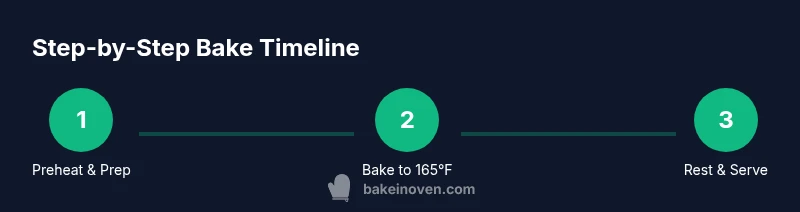
Preheat the oven to 375°F (190°C). While it heats, pat the chicken dry and season it lightly with salt, pepper, and any preferred herbs. If you want even thickness, use a meat mallet to gently flatten thicker portions toward 1 inch.
Tip: Even thickness reduces hot spots and helps every piece cook at the same rate. - 2
Line the pan and arrange
Line a rimmed baking sheet with parchment and place the breasts in a single layer with space between each piece. Avoid overlapping, which traps steam and leads to uneven cooking.
Tip: Leave at least 1/2 inch between pieces for air circulation. - 3
Bake until the center approaches 165°F
Place the sheet in the oven and bake for 18–22 minutes for typical 1-inch breasts. Start checking at the lower end of the range to avoid overcooking. If thickness varies, adjust by 3–5 minute increments.
Tip: Use a thermometer to check the thickest part, not the edge. - 4
Check for doneness and juices
Insert the thermometer into the thickest portion; remove when it reads 162–165°F (72–74°C) and let rest. The internal temperature will rise to 165°F during resting.
Tip: Resting helps juices redistribute for juicier slices. - 5
Rest before slicing
Transfer the chicken to a cutting board and tent loosely with foil for 5 minutes. Slice then serve or store leftovers promptly.
Tip: Resting minimizes moisture loss and improves texture. - 6
Optional: finish and serve
If you’d like a light crust, broil on high for 1–2 minutes after resting. Watch closely to prevent drying.
Tip: A brief finish can add color without sacrificing juiciness.
Frequently Asked Questions
What is the safest internal temperature for baked chicken breast?
The USDA recommends an internal temperature of 165°F (74°C) for safety. Use an instant-read thermometer to verify at the thickest part.
Aim for 165 degrees Fahrenheit in the thickest part and verify with a thermometer.
Is 375°F the best temperature for chicken breasts?
375°F is a common default that balances speed and juiciness for boneless breasts. If your breasts are very thick, you can go to 350–360°F and extend the time slightly.
375°F is a good default for most breasts; adjust based on thickness.
Can I bake chicken breast from frozen?
Yes, you can bake from frozen, but it will take longer and you should verify doneness with a thermometer. Thawing first gives more predictable results.
You can bake from frozen, but expect longer cooking time and check doneness with a thermometer.
Should I cover the chicken while baking?
Covering with parchment or foil can reduce surface drying, especially for small pieces. Uncovered baking promotes browning and a firmer crust.
Covering can help keep moisture; uncovered yields more browning.
How long should I rest baked chicken breast?
Rest for about 5 minutes after baking. Resting helps juices redistribute, improving sliceability and juiciness.
Rest for 5 minutes to improve juiciness and texture.
Watch Video
Key Takeaways
- Bake at 375°F for consistent results
- Use a thermometer to finish at 165°F
- Rest 5 minutes before slicing
- Flatten thickness for even cooking
- Avoid overcrowding the pan for even browning