How Long to Bake Chicken: A Practical Oven Timing Guide
Learn how long to bake chicken for juicy, safe results. Explore time ranges by cut, oven type, and weight, plus tips on resting, thermometers, and common mistakes for reliable, delicious results.


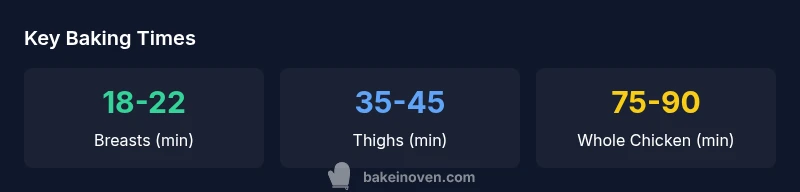
How long to bake chicken depends on cut, thickness, and oven. In a standard home oven, boneless, skinless breasts typically bake at 375°F for about 18 to 22 minutes, while bone-in portions like thighs or drumsticks usually need 35 to 45 minutes. Always verify doneness with a thermometer until the internal temp reaches 165°F (74°C).
How Long to Bake Chicken: Basic Timelines
In the world of oven-baked chicken, timing hinges on cut, thickness, starting temperature, and whether you’re using a conventional or convection oven. According to Bake In Oven, home cooks should think in ranges rather than exact minutes to accommodate variability in piece size and oven performance. The guiding question—how long to bake chicken—has a practical answer: aim for doneness, not just color, and verify with a thermometer. For the most reliable results, plan around the safe internal temperature of 165°F (74°C). This section lays out core timelines that you can adapt to your recipes and pantry staples. The emphasis is on consistent results across weeknight dinners and weekend roasts alike, balancing speed with texture and juiciness.
Cut-by-Cut timing guide for common chicken pieces
Different cuts cook at different rates. Here are practical time ranges for common pieces when baked in a conventional oven:
- Boneless, skinless chicken breasts: 18–22 minutes at 375°F (190°C). If the breast is particularly thick, you can move toward 400°F (204°C) and shorten to ~22–25 minutes, but rely on a thermometer for accuracy.
- Boneless, skinless breasts (thick): 22–25 minutes at 400°F (204°C) to ensure interior doneness without drying the exterior.
- Bone-in, skin-on thighs: 35–45 minutes at 400°F (204°C) for juicy texture and browning on the skin.
- Whole chicken (about 4–5 pounds): 75–90 minutes at 375°F (190°C), adjusted for weight with an internal check near the end.
- Chicken wings: 25–30 minutes at 425°F (220°C) for crispy skin and even cooking.
These ranges assume standard home ovens and unseasoned chicken pieces. If you have very thick portions or irregular shapes, start checking earlier with a thermometer.
The impact of thickness and starting temperature
Thickness is a major driver of bake time. A uniformly thick piece cooks more evenly and finishes closer to the lower end of the range, while a very thick portion may push you toward the higher end. Starting temperature also matters: cold or refrigerated meat will take slightly longer, while pieces at room temperature heat more evenly. If you’re short on time, consider pounding thicker pieces to an even thickness or slicing larger pieces into thinner portions to reduce bake time and promote even cooking.
Convection vs conventional ovens and browning
Convection ovens circulate hot air, which typically reduces bake time and promotes browning. Expect roughly a 15–25% time reduction compared with a conventional oven for the same piece, but monitor closely to avoid over-browning. If you prefer a crisper crust on skin or surface, convection can be advantageous. If you’re following a recipe originally written for a standard oven, you may need to reduce the temperature by about 25°F (15°C) and shorten the time slightly when using convection.
Resting and carryover cooking: timing beyond the oven
Resting after baking is essential. Allow chicken to rest 5–10 minutes before cutting or serving. During this rest, carryover cooking raises the internal temperature slightly and juices redistribute, improving juiciness and slicing ease. Resting also helps you plan the final plate timing, so you’re not serving hot, uneven portions.
In practice, set a timer for 5 minutes after you pull the tray, then slice and serve after a full 10-minute rest if possible. If you’re multitasking, rest is a great window to prepare sides or finish sauces without compromising texture.
Practical weeknight example: a two-dish dinner
Suppose you want to serve chicken with roasted vegetables. Start by prepping bone-in thighs (35–45 minutes) at 400°F (204°C). While they bake, spread vegetables on a separate sheet and start roasting them about 20 minutes earlier. If you’re using breasts, plan for 18–22 minutes at 375°F (190°C) and finish sides concurrently. Use a thermometer to confirm both proteins hit 165°F, then rest for 5–10 minutes before portioning.
Tailoring times to weight and thickness
When you’re cooking multiple pieces with different thicknesses, consider removing thinner pieces a bit earlier and resting them while thicker pieces finish. For large or multiple items, use a thermometer and start checking near the expected end of the time window. If you’re cooking a whole chicken, verify near the end and adjust by 5–10 minutes per cycle to reach the target internal temperature without overcooking.
Common mistakes and fixes
Common mistakes include starting from very cold meat, under-seasoning, and not using a thermometer. To fix these, temper thicker cuts for 15–20 minutes, season generously, and invest in an accurate meat thermometer. Avoid crowding the pan, which can trap steam and hinder browning. If browning is happening too quickly, tent with foil and lower the oven temperature slightly while finishing the bake.
Quick reference chart you can print
If you need a fast guide, print this quick-start reference:
- Boneless breasts: 18–22 minutes @ 375°F
- Thick breasts: 22–25 minutes @ 400°F
- Bone-in thighs: 35–45 minutes @ 400°F
- Whole chicken: 75–90 minutes @ 375°F
- Wings: 25–30 minutes @ 425°F
Common bake times by chicken cut and temperature
| Cut | Oven Temp | Time Range (min) | Notes |
|---|---|---|---|
| Boneless, skinless breasts | 375°F (190°C) | 18-22 | Typical for even thickness |
| Boneless, skinless breasts (thick) | 400°F (204°C) | 22-25 | Higher heat reduces time |
| Bone-in, skin-on thighs | 400°F (204°C) | 35-45 | Juicy and flavorful |
| Whole chicken (4–5 lb) | 375°F (190°C) | 75-90 | Weight-based estimate |
| Chicken wings | 425°F (220°C) | 25-30 | Crispy skin |
Frequently Asked Questions
What is the safe internal temperature for baked chicken?
The safe internal temperature for baked chicken is 165°F (74°C). Use a calibrated thermometer inserted into the thickest part to confirm it’s reached the target.
Chicken is safe to eat when it reaches 165 degrees inside; use a thermometer to be sure.
Does the size and thickness affect bake time?
Yes. Thicker pieces take longer to reach 165°F. Try to make pieces uniform in thickness, or divide cooking into batches for even results.
Absolutely—thicker pieces need more time; uniform thickness helps.
Should I bake from refrigerated or room-temperature chicken?
Chilled chicken will require slightly more time. Letting pieces rest at room temperature for 15–20 minutes can help with even cooking, but don’t leave poultry out too long.
Room temperature helps, but don’t leave it out too long.
Can I cover chicken with foil to prevent over-browning?
Tenting with foil can prevent excessive browning, but remove the foil toward the end to finish browning and crisp the surface.
Yes, tent with foil and uncover at the end for browning.
What if I don’t have a thermometer?
Timing alone is less reliable without a thermometer. Use timing as a guide and verify doneness with a thermometer as soon as possible.
Timing helps, but a thermometer is best for safety.
Does resting affect juiciness?
Resting for 5–10 minutes allows juices to redistribute, improving juiciness and ease of slicing.
Resting makes the chicken juicier and easier to cut.
“Precise temperature and proper rest are the two levers that turn raw chicken into reliably juicy meals.”
Key Takeaways
- Start with uniform pieces for even cooking
- Always use a thermometer to verify 165°F
- Convection can reduce time; watch browning
- Rest 5-10 minutes for juiciness and even texture
- Plan around thickness, weight, and starting temperature