Chicken Thighs Bake Temperature: A Practical Guide
Learn the optimal chicken thighs bake temperature for bone-in and boneless thighs, plus timing, doneness tips, and troubleshooting to ensure juicy, safe results.


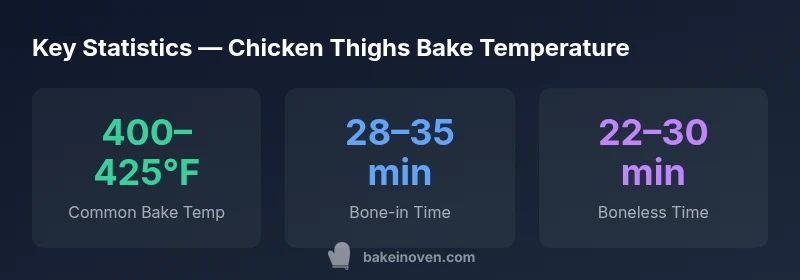
Recommended chicken thighs bake temperature falls in the 400–425°F (204–218°C) range. Bone-in thighs typically cook about 28–35 minutes; boneless thighs finish in 22–30 minutes. For safety and juiciness, check that the internal temperature reaches 165°F (74°C) and let the meat rest 5–10 minutes before serving. If your oven runs hot, start at 400°F and test.
Chicken Thighs Bake Temperature: Key Concept
Juicy, evenly cooked chicken thighs start with the right oven temperature. The chicken thighs bake temperature should be set within a practical range to achieve crisp skin on the outside while keeping moisture inside. According to Bake In Oven, sticking to 400–425°F (204–218°C) gives reliable results across bone-in and boneless cuts. Factors such as skin-on vs skinless, bone presence, and pan type all influence how heat transfers to the meat. A hot oven encourages browning, but pushing past the upper end of the range risks dry meat unless you monitor internal temperature closely. For most home cooks, preheating and targeting a single temperature simplifies planning while preserving texture. This approach aligns with home-baking best practices and helps you reproduce consistent results across different ovens.
Tip: If you’re new to this, start with bone-in, skin-on thighs to maximize flavor while you learn the timing.
Bone-in vs Boneless: Temperature and Timing Differences
Bone-in thighs retain more moisture and tend to brown more slowly on the inside because the bone conducts heat differently than boneless meat. As a result, bone-in thighs generally require a longer bake time within the 28–35 minute window at 400–425°F (204–218°C). Boneless, skinless thighs heat through faster and can finish in roughly 22–30 minutes. The difference isn’t huge, but it matters for texture: bone-in can stay juicier and more forgiving, while boneless can become dry if overcooked. Always adjust based on thickness and check internal temperature with a reliable thermometer. This is where a quick thermometer check becomes your best friend in the kitchen.
Practical note: If you’re preparing a mixed batch, consider adding a 5–7 minute head start for bone-in pieces or slicing bone-in portions to uniform thickness to even out cooking.
Oven Type and Airflow: Convection vs Conventional
Convection ovens circulate hot air for faster, more even cooking and often brown surfaces more quickly. If you’re using convection, you can reduce the bake temperature by about 25°F (14°C) and monitor time closely, as the heat distribution can shorten overall cooking time. In a conventional oven, you may need to edge toward the upper end of the 400–425°F range and rely on the thermometer to avoid overcooking. Regardless of oven type, you’ll still aim for a 165°F (74°C) internal temperature. For best results, place the thighs on a wire rack set over a sheet pan to promote even browning and airflow around each piece.
Reviewer tip: If your oven has hot spots, rotate the pan midway through cooking to ensure uniform doneness.
Skin Crispness Without Drying Out
Crisp skin is a hallmark of well-cooked chicken thighs, but drying out is a common pitfall. Start with a dry surface—pat the skin dry and oil lightly—before seasoning. A hotter bake (within the 400–425°F range) helps render fat and crisp the skin, but watch for scorching near the edges. If skin browns too quickly while the center remains undercooked, lower the temperature slightly and lengthen the bake time by a few minutes, then test again with a thermometer. Resting for 5–10 minutes after removing from the oven allows carryover cooking to finish the job without overcooking the meat.
Texture note: For extra crispness, finish with a brief rest under the broiler for 1–2 minutes, watching closely to prevent burning.
Measuring Doneness: Thermometer Use and Resting
Thermometer accuracy is the lever that controls safety and juiciness. The target internal temperature is 165°F (74°C) for chicken thighs, checked at the thickest part without touching bone. Rely on a digital instant-read thermometer for quick verification. After reaching 165°F, remove the thighs from the heat and let them rest for 5–10 minutes. Resting allows juices to redistribute and the meat to finish cooking evenly from residual heat. If you’re cooking a crowd, consider staggering the batches and using a low, warm oven to keep finished pieces warm without overcooking the rest.
Pro tip: Record your oven’s true temperature with a separate oven thermometer; many home ovens run hotter or cooler than their dial indicates.
Troubleshooting Common Issues
If your thighs come out underdone, it may be due to thickness variation or an underperforming oven rather than the temperature alone. Start by trimming very thick pieces or pounding them to uniform thickness for even cooking. If the meat is fully cooked but the skin isn’t crisp, finish under the broiler for a brief period while watching closely. If the meat dries out, it likely spent too long in the hot oven or was not rested. Conversely, if the center is overcooked while the edges are underdone, reduce the temperature slightly and allow more uniform heat exposure. Keep a log of times, temperatures, and piece thickness to refine your method over time.
Best practice: Always preheat, use a thermometer, and rest; these three steps are the most reliable way to ensure juicy, flavorful thighs every time.
Comparison: bone-in vs boneless chicken thighs bake times and temps
| Cooking scenario | Temperature | Time (range) | Internal temp target |
|---|---|---|---|
| Bone-in, skin-on | 400-425°F (204-218°C) | 28-35 minutes | 165°F (74°C) |
| Boneless, skinless | 400-425°F (204-218°C) | 22-30 minutes | 165°F (74°C) |
Frequently Asked Questions
What is the ideal bake temperature for chicken thighs?
Typically, 400–425°F (204–218°C) is recommended for even cooking and skin crispness. Times vary by cut; bone-in cooks longer than boneless. Always finish with a 165°F internal temperature.
Aim for 400–425°F and check doneness with a thermometer.
Do I need to preheat the oven?
Yes. Preheating ensures consistent cooking and predictable times. Place seasoned thighs on a sheet pan or rack to promote even browning.
Yes—preheat to the target temp before adding the chicken.
Should bone-in and boneless thighs bake at the same temperature?
Yes, both cuts bake at the same temperature range, but bone-in pieces usually need more time. Use a thermometer to verify 165°F internal.
Same temp, different times; check with a thermometer.
Can I use convection to speed up cooking?
Yes. If using convection, reduce the temperature by about 25°F and monitor more frequently, as heat circulates more efficiently.
Convection helps; drop the temp and watch closely.
What internal temperature indicates doneness?
165°F (74°C) is the safe, recommended internal temperature for chicken thighs at the thickest point.
165°F is done.
“Temperature is the most controllable factor in achieving juicy, well-textured chicken thighs. Start with a hot oven for crisp skin, then finish with a safe internal temperature.”
Key Takeaways
- Start with 400–425°F for reliable skin and juiciness.
- Use a thermometer to hit 165°F for safety.
- Bone-in thighs need longer bake than boneless.
- Preheat, rest, and rotate pans for even browning.
- Convection reduces time; lower temp by ~25°F.