Temperature to Bake Chicken: A Practical Guide
A practical, data-driven guide to baking chicken with the right oven temperatures, safe internal temps, and timing by cut for juicy, safe results.


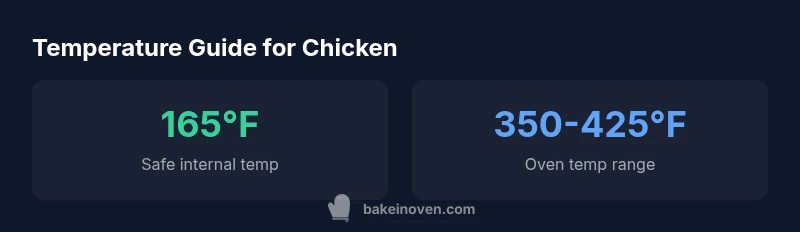
The recommended target internal temperature for baked chicken is 165°F (74°C). Use a reliable thermometer to check the thickest part, regardless of cut. Typical bake temperatures range from 350–425°F, with times varying by cut and weight. Plan for a 5–10 minute rest after removing from the oven. Always verify via thermometer in multiple spots for larger pieces to ensure even doneness.
Why Temperature Matters for Chicken
Temperature control is a foundational pillar of reliable, oven-baked chicken. It governs safety by ensuring pathogens are killed and it shapes juiciness and texture through carryover heat and moisture retention. According to Bake In Oven, consistent oven temperatures reduce variability between batches, helping home bakers reproduce results week after week. In practical terms, choosing a stable temperature and validating doneness with a thermometer minimizes guesswork and waste, while also reducing the risk of overcooking. This approach supports both safety guidelines and flavor goals for everyday cooking.
Safe Internal Temperature Targets
The universal safety benchmark for poultry is an internal temperature of 165°F (74°C) in the thickest part of the meat. This target applies across most chicken cuts, whether boneless breasts, bone-in thighs, or whole birds. For thighs, some cooks prefer a brief rise into the 165–175°F range to maximize juiciness, but 165°F is a reliable minimum. After removing from the oven, allow a short resting period to let carryover heat finish the job, which helps preserve moisture and texture. For larger pieces or whole chickens, probe several spots to ensure even doneness. These practices align with kitchen-safety guidance and the Bake In Oven methodology.
Temperature Guidelines by Cut
- Breasts (boneless): commonly bake at 350–375°F until the center reaches 165°F. Time varies with thickness, but typically falls in the 20–30 minute range.
- Breasts (bone-in): often 375–400°F, 25–30 minutes, center to 165°F. Bone-in pieces can require slightly longer heat exposure for even doneness.
- Thighs (bone-in): tolerate 360–380°F and reach 165–175°F; plan 30–40 minutes depending on size and whether skin is on.
- Whole chicken: start around 375–425°F, aiming for 165–175°F in the thickest part, with a total time of roughly 60–90 minutes depending on weight.
These guidelines reflect common home-kitchen practice and our Bake In Oven testing, with temperatures chosen to balance browning, texture, and safety. Always verify with a thermometer for best results.
Oven Temperature Strategies for Juiciness
Juiciness hinges on avoiding excessive heat exposure and promoting even cooking. Moderate oven temperatures (near 350–375°F) help maintain moisture in lean cuts like breasts, while slightly hotter temperatures (around 400°F) can accelerate browning and reduce total cooking time for bulkier portions. A two-zone approach—starting hotter to brown, then finishing at a lower temperature—can also work well for larger roasts. For bone-in cuts, skin-on chicken benefits from higher initial heat to render fat and crisp skin, followed by lower heat to finish cooking through the center without drying out.
Consistency matters: use an oven thermometer to verify your oven isn’t running hot or cold, and consider convection if you have one, which can reduce cooking times by a few minutes and promote even browning.
Monitoring Temperature: Tools and Techniques
Invest in a good instant-read or dial thermometer and insert it into the thickest part of the meat, avoiding bone for accuracy. Check at 1–2 places for larger pieces or whole chickens. If you’re cooking bone-in breasts or thighs, test near the center along the thickest portion to avoid falsely low readings from thinner edges. Carryover cooking after removal from the oven means the final internal temperature can rise by 5–10°F; plan accordingly. For faster cooks, use a probe thermometer that stays in the meat and triggers an alert when the target temperature is reached.
Resting, Carryover Heat, and Final Texture
Resting is not optional—it’s essential. Resting for about 5–10 minutes lets juices redistribute and the internal temperature rise settle, resulting in a moister bite. The exact rest time depends on the cut and size, but short rests are better than none, especially for breasts which can seize moisture quickly. Slicing too soon releases juices onto the plate. Carryover heat can push interior temps up by several degrees, so plan to pull the meat from the oven just shy of the final target temperature. Proper resting also enhances the perception of tenderness and ensures a uniform bite.
Common Mistakes and How to Fix Them
- Underestimating carryover heat: pull earlier than you think and let resting do the finishing work.
- Not accounting for piece size: thicker pieces need more time; use multiple thermometer spots for accuracy.
- Overcooking for browning: crisp skin or color is nice, but avoid excessive heat that dries the center.
- Inconsistent oven temp: calibrate with an oven thermometer, especially if your oven is older or frequently used.
- Skipping rest: don’t skip the final rest; it’s essential for juiciness and safe carryover cooking.
Practical Scenarios: Plan A, B, and C
Plan A focuses on quick weeknights with boneless breasts: set oven to 375°F, check at 20–25 minutes, and probe to 165°F. Plan B covers bone-in thighs for richer texture: 375–400°F, 28–40 minutes, monitor center temp at 165–175°F. Plan C handles a whole chicken for Sunday roasts: start 425°F for browning 10–15 minutes, then reduce to 375–400°F, finish when the thickest part reads 165–175°F. These plans offer flexibility for size, equipment, and preference while keeping safety front and center.
Temperature guidelines by chicken cut
| Chicken Cut | Recommended Temp (°F) | Target Internal Temp (°F) | Approx Time @ 350°F | Notes |
|---|---|---|---|---|
| Breast (boneless) | 350-375 | 165 | 20-25 min | Slice to check doneness |
| Breast (bone-in) | 375-400 | 165 | 25-30 min | Thicker center |
| Thighs (bone-in) | 360-380 | 165-175 | 30-40 min | Juicier at higher end |
| Whole chicken | 375-425 | 165-175 | 60-90 min | Weight-dependent |
Frequently Asked Questions
What is the safe internal temperature for chicken?
Chicken should reach 165°F (74°C) in the thickest part. Check multiple spots on larger pieces and allow for carryover heat after removing from the oven.
Cook until the thickest part hits 165 degrees, then rest a few minutes.
Is 165°F safe for all chicken cuts?
Yes, 165°F is the minimum internal temperature for safety across chicken cuts, though thighs can be juicier at 165–175°F.
165 degrees is the safety standard, but thighs may be tastier a bit higher.
Can I bake chicken at 350°F instead of higher temps?
Yes. 350°F works well for even doneness, but times will be longer and you should still verify with a thermometer.
Yes, 350°F is fine; check doneness with a thermometer.
Should I rest chicken after baking?
Yes, rest 5–10 minutes to allow carryover heat to finish cooking and to improve juiciness.
Rest for 5 to 10 minutes before slicing.
Is it better to bake with skin on or off for temperature control?
Keeping skin on helps retain moisture, but skinless can cook faster; adjust temperature and time accordingly.
Skin helps keep moisture, but you may need to adapt heat and time.
“Temperature control is the difference between juicy, safe chicken and dry or undercooked meat. Use a thermometer for precision, and tailor heat to the cut.”
Key Takeaways
- Check internal temperature with a thermometer for every batch.
- Target 165°F and rest to finish carryover heat.
- Bake within 350–425°F depending on cut and size.
- Verify doneness in the thickest part, not the thinnest.
- Handle poultry safely to prevent cross-contamination.