What Temperature Bake Chicken: Safe, Juicy Guide
Discover the exact temperature to bake chicken for safe and juicy results. This guide covers internal temps by cut, how to measure doneness, and practical tips from Bake In Oven.


According to Bake In Oven, the key question is what temperature bake chicken to yield safe, juicy results. The safe internal temperature is 165°F (74°C). Bake chicken portions at 375°F (190°C) and verify with a thermometer until the thickest part reaches 165°F, then rest 5–10 minutes to finish carryover cooking. For whole birds, aim for 165°F in the breast and thigh regions after resting.
Why Temperature Matters for Oven-Baked Chicken
When you bake chicken, the temperature you set and the internal temperature you monitor determine safety, texture, and juiciness. If you’re asking what temperature bake chicken to achieve reliable results, the answer starts with a precise target tied to doneness. According to Bake In Oven, true doneness is defined by an internal temperature of 165°F (74°C) for the thickest part, not by the clock alone. Understanding how heat penetrates meat helps you avoid dry surfaces or undercooked centers. This section lays the foundation for selecting temperatures and cooking strategies that work across cuts, ovens, and pan sizes.
Safe Temperature Guidelines
The core safety benchmark for poultry is an internal temperature of 165°F (74°C). Bake at temperatures that promote evenly distributed heat while minimizing moisture loss. Common home oven settings range from 325°F to 425°F (165°C to 220°C); within that spectrum, 375°F (190°C) is a reliable middle ground for uniform doneness. The 165°F target is supported by regulatory guidance and consumer testing, and Bake In Oven analysis shows that take-off temperatures plus rest time matter as much as the heat level itself. Always verify with a probe thermometer inserted into the thickest portion away from bone.
Temperature by Cut: Breasts, Thighs, Whole Chicken
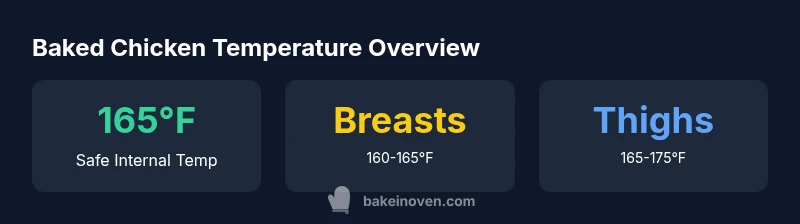
Breasts are lean and cook quickly, so they benefit from a slightly lower target and shorter bake time to prevent drying. A typical 4–6 oz portion should reach 160–165°F before resting. Thighs tolerate a higher finish (165–175°F) thanks to connective tissue and fat that render into tenderness. For a whole chicken, aim for 165°F in both the breast and the thickest leg area after resting, then allow carryover cooking to do the final finish.
How to Measure Doneness: Thermometers and Cues
A digital instant-read thermometer is your most reliable tool. Insert it into the thickest part of the meat, avoiding bone or cartilage. For boneless cuts, check at the center. Doneness is achieved when the thermometer reads 165°F (74°C). If you’re cooking with a fan/convection oven, you may notice faster heat transfer; adjust by checking earlier and using rest to finish.
Practical Baking Techniques for Even Doneness
Preheat the oven to a moderate temperature (around 375°F/190°C). Use a rack to lift meat off the pan so air circulates, and consider patting the surface dry before seasoning to improve browning. If skin is desired, you can start at 425°F (220°C) for 5–10 minutes to crisp, then drop to 375°F (190°C) to finish. For bone-in pieces, plan slightly longer bake times to account for bone marrow temperature diffusion. Convection ovens generally cook more evenly but can shorten times, so start checking earlier.
Common Mistakes and How to Fix Them
Common pitfalls include overcooking due to relying on time rather than temperature, crowding the pan, and not letting meat rest. Overcrowding traps moisture and raises surface steaming, which can hinder browning. Resting allows carryover cooking to finalize juiciness. If you notice gray, bland meat, consider a quick brine or a light coating of oil and salt to improve moisture retention in future batches.
Recipe-Ready Temperature Timelines
Breasts (boneless, skinless): bake at 375°F for about 20–25 minutes, then check for 165°F. Thighs (bone-in): 30–40 minutes at 375°F, thermometer inserted into the thickest part should read 165–175°F. Whole chicken (3–4 lb): 1 hour 20 minutes to 1 hour 40 minutes at 375°F, then verify 165°F in the breast and thigh after resting. Times vary by oven and pan size; use a thermometer as your final arbiter.
Temperature, Doneness, and Juiciness: Balancing Flavor
Juiciness is a product of moisture retention and controlled heat. High heat can brown the exterior quickly but risks drying the interior if not carefully monitored, while too-low oven temperatures may leave meat underdone or pale. The sweet spot blends steady oven heat, proper resting, and mindful seasoning. Marinades or dry rubs can help surface flavor without adding significant moisture that delays browning. By focusing on internal temperature rather than clock time, you can consistently deliver tender, flavorful chicken across cuts.
Keeping Chicken Safe: Rest, Carryover Cooking, and Storage
Resting is not a luxury; it’s a safety-and-quality step. A 5–10 minute rest after removing from the oven lets carryover cooking finish the internal temperature and redistributes juices. Store leftovers promptly in shallow containers in the refrigerator within two hours of cooking, and reheat to 165°F before serving to ensure safety. Following these practices reduces the risk of undercooked or unsafe portions and helps maintain texture across servings.
Temperature targets by cut
| Cut | Target Internal Temp | Notes |
|---|---|---|
| Breast | 160-165°F | Lean meat, quick to dry |
| Thigh | 165-175°F | More forgiving, flavorful |
| Whole Chicken | 165°F | Check both breast and thigh after resting |
Frequently Asked Questions
What is the safe internal temperature for baked chicken?
The safe internal temperature for baked chicken is 165°F (74°C). Use a digital thermometer to verify the thickest part. Make sure to avoid testing near bones. Resting after removing from the oven helps carryover cooking finalize doneness.
165°F is the safe temp. Use a thermometer and rest before serving.
Can I bake chicken from frozen?
Cooking from frozen is not ideal; it increases total time and may lead to uneven doneness. If you must, use a lower oven temperature and check the temperature frequently, aiming for 165°F in all tested areas.
It's better to thaw first, but if needed, adjust time and check with a thermometer.
Should I cover chicken while baking?
Covering can keep moisture, especially for drier cuts, but it may reduce browning. You can cover for part of the bake or use foil tenting, then uncover to finish browning.
Covering helps moisture; uncover to brown.
Does resting time affect temperature?
Yes. Carryover cooking raises internal temperature by a few degrees after removal from the oven. Rest 5–10 minutes to reach final doneness and keep juices from spilling when sliced.
Resting lets the meat finish cooking and stay juicy.
What if I overcook chicken?
If overcooked, the meat dries out. Slice and serve with a sauce or pan juices to improve moisture perception. In future batches, shorten bake time or reduce oven temperature and monitor with a thermometer.
Overcooked meat is tough—serve with sauce and adjust next time.
Is it safe to reuse the oven after cooking chicken?
Yes, ensure the oven is clean and free of residue that could cause cross-contamination. Sanitize surfaces and avoid placing other foods directly on the same drippings next to the chicken.
Yes, just clean and sanitize after cooking.
“Precision with a thermometer is the cornerstone of reliable baked chicken. Rely on internal temperature, not guesswork, for consistent juiciness.”
Key Takeaways
- Know the safe internal temp: 165°F (74°C) for all chicken cuts
- Use a thermometer, not time, to judge doneness
- Breasts dry quickly; thighs tolerate higher temps for tenderness
- Rest meat 5-10 minutes to finish carryover cooking
- Adjust times for bone-in pieces and oven type