For How Long to Bake Chicken Breast: Timings Guide
Learn exactly how long to bake chicken breast for juicy, safe results. This guide covers boneless and bone-in cuts, thickness, resting, and how to test doneness with a thermometer.


To achieve juicy, safe chicken breast, bake boneless, skinless pieces at 375–400°F (190–205°C). Typical breasts weighing 6–8 oz finish in about 18–25 minutes, thicker pieces 25–30 minutes, and bone-in breasts require 5–10 more minutes. Always verify with a meat thermometer to reach 165°F (74°C) internal temperature. Adjust for oven performance and starting temperature of the chicken.
Why timing matters for juicy chicken breast
Juicy, safely cooked chicken breast hinges on more than a single number on a timer. The difference between a tender dinner and a dry, chewy result often comes down to understanding for how long to bake chicken breast at a given temperature and thickness. According to Bake In Oven, the key is to control three variables: oven temperature, the thickness of the breast, and how long you let the meat rest after baking. If any one of these is off, you risk overcooking or undercooking. In practice, you’ll notice that small differences in piece size or starting temperature can shift the final result by several minutes. By focusing on those core variables, you can predict outcomes with confidence and adjust on the fly for your oven’s quirks. This knowledge helps you consistently produce juicy, evenly cooked chicken breast across weeknight meals and weekend cooks alike.
Understanding oven temperatures and cook times
Ovens vary, so the exact minute you pull a tray out can differ even for the same recipe. The general rule is to bake at a moderate to hot temperature to promote browning without drying the meat. A common range is 375–400°F (190–205°C) for boneless, skinless breasts, with finish times typically around 18–25 minutes for 6–8 oz portions. If you go hotter, 425°F (220°C), you’ll shorten the time to ~15–22 minutes but should watch the internal temp closely. For bone-in breasts, add roughly 5–10 minutes. The goal is an internal temperature of 165°F (74°C) in the thickest part. Remember, convection ovens can shave a few minutes off these numbers. Bake In Oven analysis shows that the starting temperature of the chicken and its thickness can influence the bake time by several minutes.
Boneless, skinless vs bone-in: how thickness changes time
Boneless, skinless breasts cook faster than bone-in cuts because there is less connective tissue and no bone mass to heat through. Thickness is the more reliable predictor than total weight. A one-inch-thick piece will take longer than a half-inch slice, even if the total weight seems similar. To estimate: 6–8 oz breasts that are about 1 inch thick usually require about 18–25 minutes at 375–400°F; thicker breasts (1.25–1.5 inches) may run 25–30 minutes. If a breast has a bone, add 5–10 minutes. Seasoning and brining can influence juiciness but not the essential timing; they affect moisture retention.
How to prep for even cooking
Start with patting dry: moisture on the surface steams rather than browns. Season generously or marinate briefly. If you want even browning, arrange breasts on a lightly oiled sheet with space between pieces. Use parchment paper or a wire rack to improve air circulation. If you have very irregularly sized breasts, consider trimming to uniform thickness or pounding to 3/4 inch to ensure even cooking. A little oil helps with browning, but you don’t need a heavy coating—just enough to reduce sticking and promote a golden crust.
How to test doneness without guessing
Invest in a reliable instant-read thermometer. Insert into the thickest part; avoid bone contact. Remove from the oven when the temperature reaches 160–162°F; it will rise to 165°F during resting (carryover cooking). If you are not using a thermometer, the juices should run clear and the meat should feel firm but not hard. For best results, take the chicken out a bit before the target, then let it rest under tented foil for 5 minutes to finish cooking evenly.
Common mistakes and how to fix them
Common mistakes include underpreheating, overcrowding the pan, and skipping the resting period. Preheat completely before loading meat; give each piece space so heat circulates. Don’t crowd the pan or you’ll steam the surface instead of browning. If you notice uneven color or a cooler center, raise the sheet on a rack or switch to a higher rack position. Finally, never skip resting—this step lets juices redistribute and improves sliceability.
Oven performance and pan choices
A shallow, rimmed baking sheet yields even browning when used with a light layer of oil. Lining with parchment paper makes cleanup easy, while a wire rack (placed on the sheet) elevates the chicken for better air flow and crust development. Convection ovens can shave minutes off bake time, so monitor closely and use an immediate thermometer check. If you rely on timers alone, you may miss subtle cues that the meat has finished cooking.
Sample timelines for common breast sizes
For boneless, skinless breasts, a typical 1-inch-thick piece weighs about 6–8 oz and bakes at 375–400°F in roughly 18–25 minutes. A thicker 1.25–1.5 inch piece may require 25–30 minutes. If breasts are as small as 4–6 oz, start checking around 14–20 minutes at the same temperature. For bone-in breasts, add approximately 5–10 minutes depending on thickness. Always confirm with a thermometer to 165°F and adjust for your oven’s performance.
Resting, slicing, and serving for best texture
Resting is essential for juicy slices; tent the chicken lightly with foil for about 5 minutes after removal from heat. Slice against the grain to maximize tenderness and serve promptly to preserve moisture. If you’re preparing ahead, store cooked chicken in shallow containers to cool quickly, then refrigerate within two hours. Slices can be used in salads, sandwiches, or grain bowls for quick meals.
Safe storage and reheating leftovers
Cool and refrigerate leftovers within two hours of cooking. Use airtight containers and aim to consume within 3–4 days. Reheat to 165°F (74°C) before serving; add a splash of broth or water to prevent drying. For longer storage, frozen chicken breast can be kept for up to 3 months; thaw in the fridge before reheating to maintain texture. Always label with date for easy rotation.
Tools & Materials
- Oven(Preheat to target temperature before inserting chicken.)
- Baking sheet(Line with parchment for easy cleanup; or use a wire rack on top.)
- Wire rack (optional)(Elevates chicken for even air circulation and browning.)
- Parchment paper(Helpful if not using a rack; prevents sticking.)
- Meat thermometer(Probe into thickest part; avoid bone contact.)
- Tongs(Use to place and turn chicken pieces without piercing.)
- Paper towels(Pat dry to promote browning and even cooking.)
- Oil (olive or neutral)(Lightly coat to aid browning and prevent sticking.)
- Knife and cutting board(Trim excess fat and slice after resting.)
- Aluminum foil (optional)(Tent meat during resting if needed to keep warm.)
Steps
Estimated time: Total time: 30-40 minutes (plus resting)
- 1
Preheat and prep
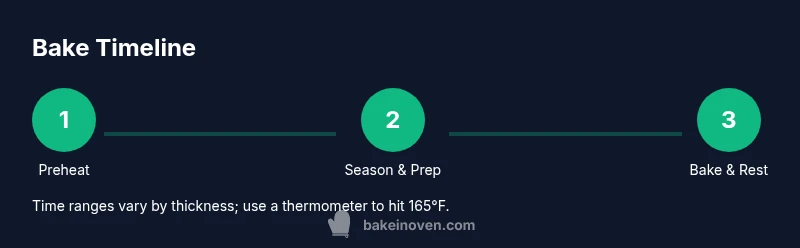
Preheat the oven to 375–400°F (190–205°C). Pat chicken dry with paper towels to remove surface moisture, which helps browning. Lightly oil and season generously to flavor and moisture retention.
Tip: Starting with dry surfaces improves crust formation and even cooking. - 2
Arrange on pan
Line a baking sheet with parchment or place a lightly oiled rack. Space breasts evenly so heat circulates. If pieces vary in thickness, consider trimming or flattening to 3/4 inch for uniform cooking.
Tip: Spacing prevents steaming and promotes browning rather than pale centers. - 3
Bake and monitor
Place the sheet in the center of the oven. Bake for 18–25 minutes for typical 6–8 oz breasts at 375–400°F; thicker pieces may need up to 30 minutes. Begin checking with a thermometer near the 18-minute mark.
Tip: Use the thermometer rather than the clock for accuracy. - 4
Check doneness
Insert the thermometer into the thickest part; avoid bone contact. Pull at 160–162°F so carryover brings it to 165°F.
Tip: If you’re near the end of the range, remove early and let rest to finish cooking. - 5
Rest and slice
Let the chicken rest loosely tented with foil for 5 minutes to redistribute juices. Slice against the grain for tenderness and serve promptly.
Tip: Resting is essential; skipping it leads to a drier bite. - 6
Store or reuse
Cool quickly, refrigerate in airtight containers within two hours. Reheat to 165°F before serving, with a splash of broth to retain moisture.
Tip: Label containers with date to keep track of freshness.
Frequently Asked Questions
What is the safe internal temperature for baked chicken breast?
The safe internal temperature is 165°F (74°C) measured in the thickest part with a thermometer.
Aim for 165 degrees, checked with a thermometer.
Does thickness affect bake time?
Yes. Thicker breasts take longer to reach 165°F. Always measure thickness and adjust time accordingly.
Yes, thickness changes bake time; thicker pieces take longer.
Can I bake chicken breast from frozen?
It’s safer to thaw first; baking from frozen requires longer time and may cook unevenly.
Thaw for best results; if you must bake from frozen, expect longer time.
Should I cover chicken while baking?
Covering traps moisture but reduces browning. Uncovered yields a browner crust.
Covering can keep moisture; uncovered browns more.
How long should I rest the chicken after baking?
Rest for about 5 minutes to allow juices to redistribute before slicing.
Let it rest for about five minutes.
Watch Video
Key Takeaways
- Preheat accurately and space pieces for even browning.
- Use a thermometer to hit 165°F safely.
- Rest 5 minutes before slicing for juiciness.
- Adjust timing by thickness and bone presence.