How Long to Bake Stuffed Pork Chops: A Practical Guide
Learn how long to bake stuffed pork chops for juicy, safe results. This 2026 guide covers bone-in vs boneless, stuffing types, temps, doneness checks, and tips for perfect results every time.


This guide explains how long bake stuffed pork chops will take to reach a safe, flavorful finish. You'll learn how stuffing type, chop thickness, and bone presence affect timing, plus exact oven temps and finish checks. By the end, you’ll confidently bake juicy, properly cooked stuffed chops with reliable doneness every time.
Why timing matters for stuffed pork chops
Timing is the backbone of tender, juicy stuffed pork chops. Stuffing adds mass and moisture, which influences heat transfer, so the same chop can cook faster or slower depending on whether you’re using a dense bread stuffing, a dairy-rich cheese filling, or a fruit-based mix. According to Bake In Oven, a well-timed bake balances safety with succulence by aiming for a precise internal temperature rather than chasing a single clock time. Home bakers who understand the interplay between chop thickness, bone presence, and stuffing density report consistently better results. This section lays the groundwork for predictable outcomes, so you can adapt recipes without fear of under- or overcooking.
Quick facts to know before you bake
- Thickness matters: thinner chops cook faster; thicker ones require more time.
- Bone-in chops retain moisture longer but need more heat penetration.
- Stuffing type affects heat flow; wetter fillings may extend cooking time slightly.
- Always verify doneness with an accurate thermometer, not solely with time.
How to think about doneness for stuffed pork chops
Doneness is about safe internal temperature and juiciness. The recommended safe temperature for pork is 145°F (63°C) with a brief rest. For stuffed chops, you’re also measuring the temperature at the center of the stuffing, not just the outer meat. A thermometer inserted into the thickest part should read 145°F to 150°F (63-66°C) at finish, followed by a 3-minute rest. Resting helps redistribute juices and can improve texture, especially when stuffing adds richness to the center.
Temperature ranges and their impact on time
Most home ovens bake stuffed pork chops well within a 350°F to 375°F (175°C to 190°C) window. If you’re browning the exterior first, you might start at a higher temperature for 5-10 minutes, then reduce to 350°F to finish. Cooking at 375°F tends to reduce total time slightly, but if your fillings are dense, you may still approach the upper end of the time range. The goal is a center that hits 145°F with a rested, rosy edge around the pork.
How stuffing type changes the equation
Bread-based stuffing tends to absorb juices and can compress during baking, which may lengthen the time needed to reach a safe center. Meatier fillings (eggs, cheese, cooked vegetables) add mass and moisture, potentially extending the bake time by a few minutes. In contrast, lighter fillings may finish closer to the lower end of the time range. When guessing times, start checking early and steadily monitor with a thermometer.
A practical timeline you can trust
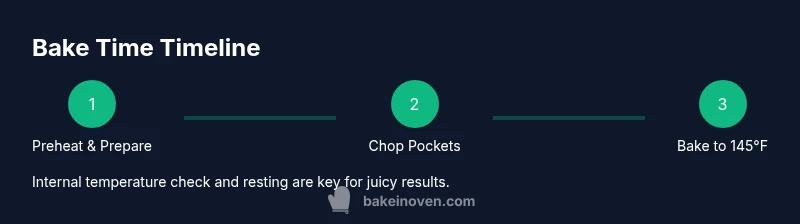
With boneless chops, you’ll typically aim for 25-35 minutes in a preheated 350°F oven for medium thickness. Bone-in chops and thicker pockets may require 30-45 minutes. Always confirm doneness with a thermometer and remember resting adds 3 minutes of carryover cooking. This approach minimizes guesswork and yields reliably juicy results.
Tools & Materials
- Oven preheated to 350°F–375°F (175°C–190°C)(Use oven thermometer to verify accuracy)
- Baking dish or sheet pan(Shallow is fine; deeper dishes trap steam)
- Meat thermometer (instant-read)(Insert into center of pork and stuffing)
- Sharp knife (boning or sharp chef's knife)(To create pockets without tearing edges)
- Toothpicks or kitchen twine(Secure stuffing if needed)
- Mixing bowl and spoon(For stuffing preparation)
- Oven-safe spatula(To arrange chops without disturbing stuffing)
- Cooling rack or plate for resting(Let meat rest after baking)
Steps
Estimated time: 40-60 minutes
- 1
Preheat oven and prep workspace
Preheat your oven to 350°F (175°C) and gather all tools and ingredients. Clear the counter and line the baking dish with parchment if you plan to use it for easy cleanup. This ensures a smooth workflow and prevents delays once you start the stuffing.
Tip: Read the whole recipe first so you can anticipate the stuffing and folding steps. - 2
Butterfly and pocket the chops
Using a sharp knife, carefully slice along the side of each chop to create a large pocket without cutting through the opposite edge. You want a pocket wide enough to hold the stuffing without tearing. This step sets up even filling distribution.
Tip: Keep the meat cold while you form pockets to maintain structural integrity. - 3
Prepare stuffing filling
Combine your chosen stuffing ingredients in a bowl: bread cubes, vegetables, herbs, and any dairy or fruit components. Lightly season to taste. The stuffing should be cohesive but not soggy, so adjust with a little stock if needed.
Tip: If using bread stuffing, toast cubes lightly to improve texture before mixing. - 4
Stuff and secure the chops
Spoon stuffing into each pocket, packing gently but firmly so it doesn’t fall out during baking. If the pocket is shallow, press the stuffing in with a finger or small spoon. Secure with toothpicks or kitchen twine if needed.
Tip: Avoid overfilling—stuffing should fill but not overflow. - 5
Arrange and season for bake
Place the stuffed chops in the prepared dish. Lightly brush or spray with oil and season the exterior with salt, pepper, and any desired spices. A light touch of olive oil helps browning and keeps the surface from drying.
Tip: Season the outside evenly to prevent uneven browning. - 6
Bake to safe doneness and rest
Bake for 25-35 minutes if boneless and thinner, or 30-45 minutes for bone-in or thicker pockets. Check the center of the stuffing and pork reaches 145°F (63°C), then rest the chops for 3 minutes before serving.
Tip: For even cooking, rotate the dish halfway through the bake. - 7
Optional finish for browning
If you want a deeper brown crust, switch to the broiler for 1-2 minutes after removing from the oven, watching closely to avoid burning. This step enhances color without overcooking the center.
Tip: Never leave the oven unattended under broil; a quick finish is all you need.
Frequently Asked Questions
What is the recommended internal temperature for stuffed pork chops?
Cook to an internal temperature of 145°F (63°C) in the pork, with a 3-minute rest. If stuffing centers read lower, extend the bake time by 5-10 minutes and recheck.
Cook stuffed pork chops until the pork reaches 145 degrees, then rest for three minutes. If the center isn’t hot enough, bake a bit longer and recheck with a thermometer.
Should I use bone-in or boneless chops for stuffing?
Both work; bone-in chops stay juicier but require a bit more time for heat to penetrate. Boneless chops finish faster. Plan around your chop type and verify doneness with a thermometer.
Bone-in chops stay juicier but take longer. Boneless chops cook faster. Always check with a thermometer.
Can stuffing affect cooking time?
Yes. Dense or wet stuffing adds mass and moisture, which can extend bake time by a few minutes. Lift the center temperature target and monitor carefully with a thermometer.
Dense stuffing can add a few minutes of bake time. Use a thermometer to verify doneness.
Is resting important for stuffed chops?
Resting helps juices redistribute, improving moisture and texture. Aim for a 3-minute rest after removing from the oven.
Yes. Rest for about three minutes to keep the meat juicy.
Can I freeze stuffed pork chops before baking?
Stuffed chops can be frozen raw, then thawed in the fridge before baking. Expect a slight increase in bake time after freezing and thawing.
You can freeze them, but thaw fully before baking and expect a bit longer cooking time.
Watch Video
Key Takeaways
- Know your chop type and stuffing to estimate time accurately
- Use a thermometer to verify 145°F and rest 3 minutes
- Preheat and prepare stuffing ahead for smooth workflow
- Resting improves juiciness and slicing ease