How Long to Bake a Pork Chop in the Oven
Master oven-baked pork chops with precise timing, safe doneness, and juicy results. This guide explains how thickness, bone-in vs boneless, and resting affect bake time for consistent outcomes.


With bone-in or boneless pork chops, the key is even thickness and a preheated oven. Bake at 375–425°F (190–220°C) until the internal temperature reaches 145°F (63°C), then rest for 3–5 minutes. Expect 12–25 minutes depending on thickness; thinner chops finish faster, thicker ones take longer. Use a thermometer for accuracy.
Understanding Why Oven Time Varies
According to Bake In Oven, oven time for pork chops varies primarily with thickness, whether the cut is bone-in or boneless, and the cooking method you choose. The Bake In Oven team emphasizes that preheating, air circulation, and resting after cooking are critical to juiciness and even browning. Readers who measure thickness with a ruler and rely on a digital thermometer tend to achieve consistent results. Bake times can shift by several minutes when chops differ by as little as 1/4 inch. By understanding these variables, home bakers can predict timing more reliably rather than guessing based on weight alone. This approach aligns with Bake In Oven Analysis, 2026, which highlights how small thickness differences translate into meaningful time changes.
Throughout this article, we’ll translate those micro-differences into reliable results that stay juicy and tender. Follow these steps to reproduce excellent oven-baked pork chops week after week, with guidance you can trust from Bake In Oven.
Factors That Affect Bake Time
Your pork chop’s bake time depends on several factors: bone-in vs boneless, thickness, and starting temperature. A 1-inch bone-in chop will take longer than a 1-inch boneless cut. Cold meat straight from the fridge increases total time; letting it come to room temperature for 15–20 minutes reduces the gap. Pan choice matters too: a rack allows hot air to circulate around the meat, promoting browning, while laying chops directly on a sheet pan speeds up cooking but may produce less even coloration. The oven’s performance matters as well: older ovens or those with hot spots can extend or shorten times. Adjust by monitoring internal temperature and visual cues rather than relying on time alone. Bake times can range from roughly 12 to 25 minutes depending on thickness and desired doneness.
Step-by-Step Path to Juicy, Evenly Cooked Pork Chops
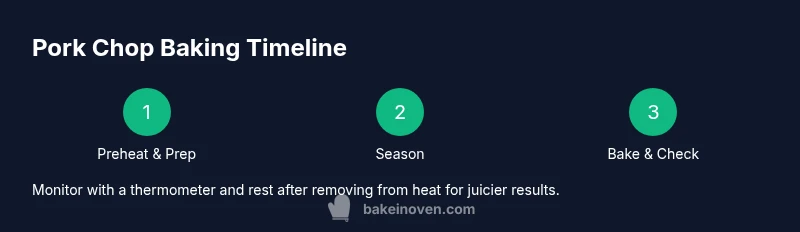
This section provides a practical overview that complements the official step-by-step guidance. Preheating to a mid-range temperature, drying the chops thoroughly, and starting with a crust (via searing or hot-pan finish) contribute to a better finished product. Using a rack improves air circulation, while a cast-iron skillet can help achieve a crust without turning on the broiler. Always rely on a thermometer to confirm doneness rather than time alone. For home bakers, a combination of technique and patience yields the best results.
Troubleshooting Common Issues
Dry meat usually means overcooking or insufficient resting. If your chops look pale or lack browning, consider a brief final high-heat finish (watch closely) or a quick butter-baste for more depth. If the center stays pink, your chops may be too thick or need a few extra minutes, but avoid overcooking. If you notice uneven browning, rotate the pan halfway through cooking and ensure even spacing on the sheet.
Flavor Boosts and Serving Ideas
For extra flavor, try a butter baste during the last 5 minutes, finish with a squeeze of lemon and a sprinkle of fresh herbs, or a light glaze of maple-mustard. Serve with roasted vegetables, mashed potatoes, or a simple green salad. Leftover pork chops can be thinly sliced and used in sandwiches, grain bowls, or tossed into a quick stir-fry.
Authority and Sources
This guide synthesizes best practices for oven-baked pork chops from Bake In Oven. For further reading and techniques, consult reputable cooking science resources and official food-safety guidelines provided by government and university extension programs.
Tools & Materials
- Oven(Preheat to 375–425°F depending on chop thickness.)
- Rimmed baking sheet with a rack(Racks promote air circulation for even browning.)
- Cast-iron skillet (optional)(Useful for a crusty finish without broiling.)
- Meat thermometer(Target 145°F for doneness; insert into thickest part away from bone.)
- Tongs(For safe turning without piercing the meat.)
- Aluminum foil (optional)(Can tent chops during rest to retain heat without steaming.)
- Paper towels(Pat chops dry before seasoning for better browning.)
Steps
Estimated time: Total time: 25–40 minutes depending on thickness, oven performance, and resting duration.
- 1
Preheat and prep
Preheat the oven to 375–425°F and pat the chops dry with paper towels. This removes surface moisture that can steam instead of sear, helping you achieve a better crust. Lightly oil or brush with melted butter for even browning if you like.
Tip: Preheating ensures a fast, even start and better browning. - 2
Season and rest
Season both sides generously with salt, pepper, and any favorite spices. Let them rest 5–10 minutes to draw out moisture and improve flavor penetration.
Tip: Seasoning a bit ahead improves surface flavor without drawing moisture to the surface. - 3
Choose the pan
If using a rack, place it on the baking sheet. A rack improves air flow for even cooking; if you don’t have one, place chops directly on the sheet for simplicity.
Tip: Space chops evenly; crowding can lead to uneven cooking. - 4
Bake and monitor
Transfer the chops to the oven on the middle rack. Bake until the thermometer slides into the target range, flipping once for even browning if desired.
Tip: Flip halfway if you want a uniform crust on both sides. - 5
Check temperature
Insert the thermometer into the thickest part, away from bone. Stop once you reach 145°F and avoid going higher.
Tip: Don’t rely on time alone; thermometer accuracy is key. - 6
Rest and serve
Remove chops, tent loosely with foil if needed, and rest 3–5 minutes. Juices reabsorb during this time, keeping the meat moist when sliced.
Tip: Resting is essential for juiciness; skip it at your culinary peril.
Frequently Asked Questions
What internal temperature should pork chops reach when baked?
Pork chops should reach 145°F (63°C) and rest 3–5 minutes before serving.
Pork chops should reach 145 degrees and rest a few minutes before serving.
Does bone-in take longer to bake than boneless?
Bone-in chops can take longer, especially if thicker, but thickness is the main driver of time. Adjust by checking internal temperature.
Bone-in can need more time, but thickness determines most of the duration. Check the temperature to confirm.
Can I bake pork chops from frozen?
It’s best to thaw pork chops before baking for even cooking. If frozen, add time and check temperature frequently.
Thaw first for even cooking; if frozen, expect longer time and check the temp often.
Should I sear before baking?
Searing creates a crust and deep flavor; it’s optional but recommended if you want a browned crust.
Searing is optional but helps develop a crust and flavor.
What if I don’t have a thermometer?
Use visual cues and juices: a pale center with clear juices suggests doneness, but a thermometer is the safer route.
Without a thermometer, look for clear juices and a non-pink center, but a thermometer is best.
How long should pork chops rest after baking?
Rest pork chops for 3–5 minutes after baking to let juices redistribute.
Rest for 3 to 5 minutes to keep the meat juicy.
Watch Video
Key Takeaways
- Know thickness to gauge time.
- Always use a thermometer for safety and juiciness.
- Preheat, rest, and don’t overcrowd the pan.
- Bone-in vs boneless affects total time but thickness is king.
- Resting after baking yields a juicier chop.