How Long to Bake Hot Wings: A Practical Guide
Discover reliable bake times for hot wings, including bone-in vs boneless, thawed vs frozen, and tips for achieving crisp, juicy results. Learn practical steps, temps, and safety guidance from Bake In Oven.


You can bake hot wings until crispy and safe to eat by baking bone-in wings at 425°F for about 25-30 minutes, flipping once halfway. Larger wings may need 30-35 minutes. If frozen, add 5-10 minutes. For extra crispness, finish under the broiler for 1-2 minutes. Ensure an internal temp of 165°F.
Why Timing Matters for Crispy Wings
If you're wondering how long to bake hot wings, timing matters as much as technique. The goal is a crispy, safe bite with juicy meat inside, and the exact minutes depend on wing size, starting state (thawed or frozen), and your oven's quirks. According to Bake In Oven, preheating to a hot oven and using a rack yields the most consistent browning and even texture. When done well, the skin tightens around the meat and the surface browns evenly rather than steaming in a crowded pan. Moisture is the enemy of crispness, so pat the wings dry, and avoid overcrowding the pan. A well-ventilated sheet with a rack allows air to circulate around each piece, producing uniform color. Keep in mind that small wings cook faster than larger ones, and frozen wings will need extra time. These variables mean you should start with a baseline and adjust based on visual cues and a quick thermometer check.
Temperature and Cook Time: Options for Different Wings
The bake time for hot wings hinges on temperature and wing size. A common baseline is 425°F (218°C) for bone-in wings, which usually takes about 25-30 minutes with a mid-cook flip to promote even browning. If your wings are larger or you’re cooking more pounds, plan for 30-35 minutes and consider a final 1-2 minute broil for extra crispness. Frozen wings typically require 5-10 additional minutes, but still benefit from a thorough drying step before baking. Convection ovens can shorten total time by roughly a few minutes due to stronger air circulation, so monitor closely and adjust as needed. For best results, use a meat thermometer to verify 165°F (74°C) at the thickest part of the wing; some cooks prefer 170-175°F for firmer, more developed texture.
Prepping Wings for Even Cooking
Even cooking starts long before the oven heats. Begin with thorough pat-drying of all wings to reduce surface moisture that slows browning. If you’re using a dry rub, apply it evenly and let the seasonings cling to the surface for a few minutes. Use a rimmed baking sheet lined with parchment or foil and set a wire rack on top so air can circulate around each piece. Arrange wings in a single layer with space between them; crowded wings steam instead of crisp. Finally, allow the wings to come closer to room temperature for a few minutes before baking to promote even cooking.
Common Factors That Change Bake Time
Several practical factors can cut or add minutes to your bake. Oven calibration matters: two ovens set to 425°F can perform differently. The placement of the rack (middle vs. top) can affect browning, as can using convection. Sauces or glazes introduce moisture and sugar that may lead to slower browning or faster scorching if not monitored. Deboned wings cook faster than bone-in varieties, and extra-large pieces require a longer bake. Altitude, humidity, and the pan material also influence heat transfer and drying rate. Monitoring and adjusting by visual cues plus a thermometer yields the best results.
Practical Baselines and Quick Reference
Here are practical baselines you can start with and adapt to your oven:
- Bone-in wings, thawed: 25-30 minutes at 425°F, flip halfway.
- Larger or more pounds: 30-35 minutes, monitor browning and internal temp.
- Frozen wings: add 5-10 minutes after an initial dry pat-dry step.
- Convection ovens: reduce time by about 3-7 minutes; keep an eye on color.
- Finish with 1-2 minutes under the broiler if you want extra crispness. Remember to check the thickest part reaches 165°F.
Final Notes on Doneness and Doneness Cues
Doneness isn’t just about time. Look for deep golden-brown skin, crisp edges, and a no-pink interior near the bone. A quick thermometer check is your most reliable guide. If you see juices pooling near the bone, give them a few more minutes and retest. Resting for a couple of minutes after removal helps the juices redistribute and keeps the meat juicy.
Tools & Materials
- Oven preheated to 425°F (218°C)(Ensure oven has reached target temp before adding wings)
- Rimmed baking sheet(Line with parchment/foil for easy cleanup)
- Wire cooling rack(Raises wings for air circulation)
- Paper towels(Pat wings dry thoroughly to promote crispness)
- Tongs(Turn wings halfway through cooking)
- Meat thermometer(Target 165°F (74°C) at the thickest part)
- Mixing bowl(For dry rub or glaze if desired)
- Parchment paper(Optional, for extra easy cleanup)
- Sauce or glaze(Toss after baking if using a sauce)
Steps
Estimated time: 40-50 minutes
- 1
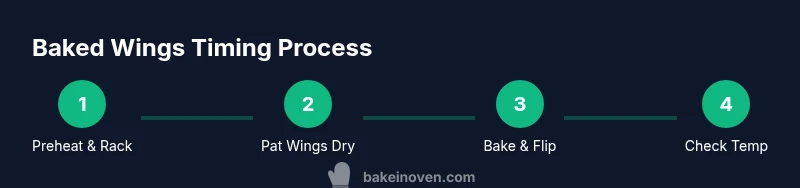
Preheat oven and rack
Preheat your oven to 425°F (218°C) and place a middle rack. This ensures consistent heat distribution and browning from the start.
Tip: A preheated oven reduces the chance of pale skin and uneven texture. - 2
Pat wings dry
Use paper towels to pat each wing dry. Remove as much surface moisture as possible to promote crisp browning rather than steaming.
Tip: Drying is the single most impactful step for crisp skin. - 3
Season or prep glaze
Mix a light coat of oil with salt or a dry rub, then evenly coat all wings. If using sauce, keep it separate for later tossing.
Tip: Even coating helps color develop uniformly across the surface. - 4
Arrange on a rack
Set wings in a single layer on the rack over the lined sheet, spacing them apart for air to circulate.
Tip: Crowding prevents crisp browning and makes shading uneven. - 5
Bake and flip
Bake 25-30 minutes, then flip and bake another 5-10 minutes. Check color and internal temp with a thermometer.
Tip: Flipping halfway ensures both sides brown evenly. - 6
Check doneness and finish
Aim for 165°F (74°C) at the thickest part. If desired, broil 1-2 minutes for extra crispness but watch closely to prevent burning.
Tip: A quick broil adds crisp surface without overcooking the meat.
Frequently Asked Questions
Can I bake frozen hot wings?
Yes. Bake frozen wings, but expect extra minutes—usually 5-10 more—after patting dry and starting with a hot oven. Always check internal temperature to ensure doneness.
Yes, you can bake frozen wings; expect a few extra minutes and confirm they hit 165 degrees Fahrenheit before serving.
What internal temperature should wings reach?
Aim for 165°F (74°C) at the thickest part of the wing. Some cooks prefer slightly higher for firmer texture, but 165°F is the safe minimum.
Target 165 degrees Fahrenheit in the thickest part for safe, juicy wings.
Bone-in vs boneless wings: which cooks faster?
Boneless wings cook faster due to less mass, but bone-in wings typically stay juicier. Adjust time accordingly and check internal temperature frequently.
Boneless wings cook faster; bone-in wings stay juicier. Check the temp to be sure.
Is broiling necessary for crispness?
Broiling for 1-2 minutes at the end can enhance crispness, but watch closely to avoid burning the glaze.
A quick broil finish adds crispness; stay nearby to avoid burning.
How can I tell when wings are done without a thermometer?
Color and texture are clues: deep golden color and a firm, not mushy feel. However, a thermometer is the most reliable method.
Color plus firm texture helps, but a thermometer is best for certainty.
How do I keep wings crispy after baking?
Serve immediately after baking or keep warm on a rack in a low oven. Sauces should be added just before serving to preserve texture.
Serve right away for best crispness; keep the wings on a rack if waiting a bit.
Watch Video
Key Takeaways
- Preheat to 425°F for optimal browning.
- Dry wings thoroughly and space them apart.
- Flip halfway and verify doneness with a thermometer.
- Finish with a brief broil for extra crispness.