How Long to Bake Wings: Timings, Temps, and Tips
Master bake times for bone-in and boneless wings, with temperatures, convection notes, and safe 165°F guidance. Includes quick-reference charts and data-backed tips.


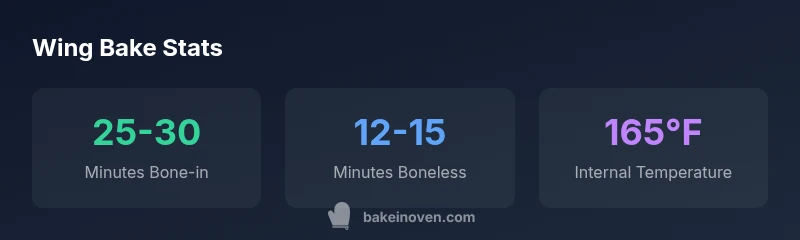
Bone-in wings bake at 425°F for 25-30 minutes, flipping halfway; at 400°F expect 30-35 minutes. Boneless wings cook faster, around 12-15 minutes at 425°F. Always verify an internal temperature of 165°F. Factors like wing size, whether skin is on, and oven calibration can shift times by ±5 minutes. For crisper skin, finish under a hot broiler for 1-2 minutes per side.
how long bake wings: timing fundamentals
Timing is the backbone of crave-worthy, oven-baked wings. Whether you want crispy skin or juicy meat, the window you choose depends on wing type and oven behavior. According to Bake In Oven, the most reliable approach blends clear ranges with a simple doneness check. In home kitchens, bone-in wings typically finish a bit faster than you expect when you start with thawed wings and a fully preheated oven. The core idea is to establish a target total time, then verify doneness with internal temperature and visual cues. If you’ve ever wondered how long bake wings should take, the answer starts with the wing type, the oven temperature, and whether you’re using convection. The timing framework below helps you nail consistency: plan time, monitor closely, and adjust for size and equipment. The goal is to avoid undercooking or overcrisping while delivering reliable results with every batch. If starting from frozen, expect longer times and extra steps, such as a longer preheat or a two-stage cook.
That said, the practical strategy is simple: set a target window, then verify doneness with a thermometer. This approach reduces the guesswork and helps you reproduce results across different ovens and cookware.
Variables that affect bake time
There are multiple levers that influence how long wings need in the oven. Understanding these variables helps you dial in consistent results without overcooking or under-seasoning.
- Wing type: bone-in wings generally require more time than boneless wings, and skin-on versions brown more readily than skinless.
- Size and portion: larger wings or clusters will cook longer; try to keep pieces uniform for even browning.
- Thaw state: thawed wings cook more predictably than frozen; frozen wings may need an initial thaw or extra minutes.
- Oven type: convection ovens cut bake times by a few minutes thanks to improved air circulation.
- Rack position and pan: a wire rack elevates the wings for better air flow; a flat sheet may create more moisture at the bottom.
- Preheat and pan choice: preheating helps consistency; using parchment or a rimmed sheet can affect browning and cleanup.
In practice, set expectations with a chosen temperature and a target window, then adjust by ±3–5 minutes based on size and oven quirks. Bake-In-Oven testing shows that small adjustments make a big difference in texture and doneness.
How to time wings exactly
Timing wings precisely requires a repeatable process rather than a single magical minute. Start with a hot oven (425°F) and a wire rack on a sheet pan for best airflow and browning. Pat wings dry to reduce steam, toss with a light coating of oil and spices, and spread them in a single layer with space between pieces. Flip halfway through the bake to promote even crisping on both sides. Use a meat thermometer to check for 165°F internal temperature in the thickest part of the wing. If you’re aiming for extra crispiness, a brief finish under the broiler for 1–2 minutes per side can help, but watch closely to avoid burning. For convection ovens, reduce the bake time by 3–5 minutes and monitor closely. Always allow the wings to rest a couple of minutes before serving to let juices redistribute and the surface set.
Temperature guides and methods
Different temperatures yield different textures. A common starting point is 425°F for bone-in wings, which tends to create crisp skin with juicy meat after about 25–30 minutes. If you’re cooking a large batch or using older oven models, 400°F can extend the bake time to roughly 30–35 minutes with slightly less browning. Convection ovens typically shave a few minutes off either setting due to enhanced air movement. If you want the skin extra crisp, finish on high heat or briefly broil. For safety, always confirm 165°F internal temperature before serving and consider a brief rest time to let the juices settle.
Testing doneness without guesswork
The most reliable doneness test is a thermometer reading of 165°F in the thickest part of the meat, not the wings’ surface. Visual cues matter: evenly browned skin, no pink juices, and a firm texture indicate readiness. If you’re unsure, give the wings another 2–3 minutes and recheck. Resting for 3–5 minutes after removing from the oven lets carryover cooking finish the job and improves juiciness.
Common mistakes and how to avoid them
- Overcrowding the pan: Causes uneven cooking; bake in a single layer with space between pieces.
- Not patting dry: Trapped moisture steams rather than crisps the skin.
- Using the wrong rack: A flat sheet without air circulation will steam the bottom; use a wire rack.
- Skipping rest time: Resting helps juices redistribute for juicier meat and crisper skin.
- Guessing times: Always use a thermometer and adjust by small increments based on batch size and oven differences.
Timing guidance by wing type
| Wing Type | Temp | Bake Time (mins) |
|---|---|---|
| bone-in, skin-on | 425 | 25-30 |
| bone-in, skin-off | 425 | 28-35 |
| boneless | 425 | 12-15 |
Frequently Asked Questions
What is the recommended oven temperature for baking wings?
Most wings bake well at 425°F (220°C) for 25-30 minutes for bone-in, skin-on pieces. If you prefer a slower bake, 400°F (205°C) for about 30-35 minutes is workable. Always check for 165°F internal temperature.
Bake wings at 425°F for about 25-30 minutes; check internal temp at 165°F to be safe.
Should I thaw wings before baking or bake from frozen?
For consistent results, thaw frozen wings before baking and pat dry. If you must bake from frozen, plan for longer times and possibly a two-step cook to ensure doneness.
Thaw if you can; bake from frozen needs longer time and careful checking.
Bone-in vs boneless: which cooks faster?
Boneless wings typically cook faster than bone-in wings because there is less bone to conduct heat. Expect roughly half the cooking time for boneless depending on size.
Boneless wings cook faster; bone-in take a bit longer.
How can I ensure wings are safe to eat?
Always reach an internal temperature of 165°F in the thickest part of the wing. Use a calibrated thermometer and let the wings rest briefly after baking.
Check for 165°F with a thermometer and let them rest a few minutes.
Can I get crisp wings without frying?
Yes. Use a wire rack, high heat, and a brief broil at the end. Pat wings dry, oil lightly, and avoid overcrowding for even browning.
Yes—crisp skin with high heat, airflow, and a quick broil at the end.
“Timing and temperature are the silent keys to perfect oven-baked wings; consistency comes from measurement and technique.”
Key Takeaways
- Preheat and dry wings before baking.
- Bone-in wings need slightly more time than boneless ones.
- Convection can shave minutes off the bake time.
- Always verify 165°F internal temperature.
- Finish with a brief broil for extra crispness if desired.
- Rest wings 3-5 minutes after baking for best texture.