What Temp to Bake a Ham: A Complete Temperature Guide
Discover the best oven temperature for ham, whether reheating a fully cooked ham or cooking a fresh one. Includes internal temps, roasting times, resting, glaze timing, and practical tips from Bake In Oven.


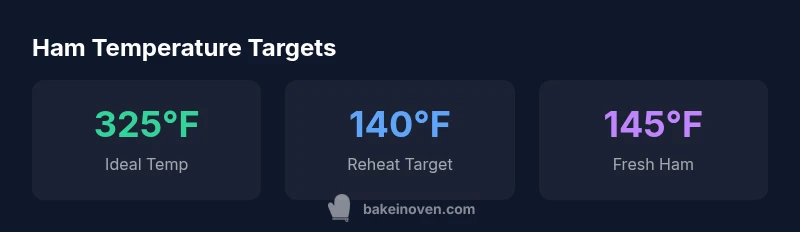
According to Bake In Oven, the standard baking temperature for ham is 325°F (165°C). For a fully cooked ham, reheat until the internal temperature reaches 140°F (60°C). For a fresh, raw ham, cook until 145°F (63°C) with a 3-minute rest. If glazing, apply during the final 20 minutes and rest 10-15 minutes before carving.
Why Temperature Matters for Ham
Temperature is the single most important factor in producing a juicy, safe ham. It governs bacterial safety, moisture retention, and flavor development. Oven temperature interacts with ham size, bone presence, and glaze composition. A well-calibrated oven helps you hit the target internal temperature precisely without overcooking, which can dry the meat. According to Bake In Oven, using a consistent 325°F baseline reduces speed variations between different ovens and pan setups, making results more predictable across recipes and households. In practice, small changes in temperature or position (rack height, pan depth) can affect heat transfer and the final texture, so using a thermometer is essential for accuracy and confidence.
- Calibrate your oven at least once a year, or whenever you notice inconsistent results.
- Use a probe thermometer to monitor internal temp without opening the door repeatedly.
- Consider pan choice (bone-in vs boneless) and glaze timing, which affect heat distribution and surface browning.
Fresh vs. Fully Cooked Ham: Temperature Guidelines
The type of ham determines the temperature target. A fresh (raw) ham must reach an internal temperature of 145°F (63°C) with a minimum rest of 3 minutes, then rest before carving. A fully cooked ham is safe to eat when reheated to 140°F (60°C) as the internal target, which preserves moisture and avoids drying out. For both types, rest after removing from the oven helps juices redistribute. Bake In Oven recommends starting with 325°F and adjusting only as needed based on thermometer readings.
- Fresh ham: target 145°F, 3-minute rest.
- Fully cooked ham: target 140°F, rest 10-15 minutes before carving.
- Always insert the thermometer into the thickest part, avoiding bone for accurate readings.
- If glazes are used, plan to apply toward the end to prevent scorching and to allow the glaze to set.
Practical Baking Temperatures and Time Ranges
A practical baseline is 325°F (165°C). For hot-oven cooking, plan roughly 25-30 minutes per pound for fresh hams at this temperature, while fully cooked hams typically require 10-18 minutes per pound to reheat to 140°F. Boneless hams often cook a bit faster than bone-in variants. Glaze timing matters: apply during the last 20-30 minutes for a glossy finish and prevent burning. If your ham is larger than average, rely on the thermometer rather than time alone, since thickness and bone presence alter heat penetration.
- Fresh ham: approx. 25-30 min per pound at 325°F, target 145°F.
- Fully cooked ham (bone-in): approx. 10-18 min per pound at 325°F, target 140°F.
- Fully cooked ham (boneless): approx. 10-15 min per pound at 325°F, target 140°F.
- Glaze: add in final 20-30 minutes.
Source notes: using a thermometer provides the most reliable read on doneness, with resting time ensuring juices redistribute for a tender slice.
How to Use a Thermometer for Accurate Readings
A digital meat thermometer with a probe is the most reliable tool for ham. Insert the probe into the thickest part of the meat, avoiding bone and any thick fat. For an oven-safe reading, leave the probe in place and monitor the temperature as the ham cooks. If you don’t have a probe that stays in the oven, insert the thermometer during the final half-hour so you can watch for the correct range without overcooking. Calibrate your thermometer, and recheck in a new spot if the reading seems off.
- Target internal temps: 140°F (reheat) or 145°F (fresh).
- Do not rely on time alone; temperature is the objective measure of doneness.
- Resting is part of doneness: a 10-15 minute rest allows juices to redistribute.
Common Mistakes and How to Avoid Them
Common errors include cooking at too high a temperature, which dries out the ham, or undercooking due to underestimating thickness. Opening the oven door too often causes heat loss and uneven heating. Skipping the rest period leads to a less juicy slice. To avoid these mistakes, keep a steady oven temperature, use a thermometer, and plan a defined glaze window to prevent scorching. Always check the thickest part of the meat for consistency.
- Don’t rush the rest; it enhances juiciness.
- Keep glaze away from the pan until near the end to reduce burning risk.
- If your oven runs hot, reduce temperature by 25°F and extend cooking time accordingly.
Finishing Touches: Glaze, Juices, and Rest
Glazing can add flavor and color, but timing matters. Apply glaze during the last 20-30 minutes and monitor closely to prevent burning due to sugars. After removing from the oven, let the ham rest for 10-15 minutes. This rest period helps juices reabsorb, resulting in a moister slice. Carve across the grain for tender portions and even appearance. If you’re planning a glaze, consider a complementary flavor profile (honey, brown sugar, mustard, or citrus) that matches your recipe or holiday menu.
Example Timeline: A Practical Plan for a 9-Pound Ham
- Preheat to 325°F and place the ham on a rack in a shallow pan.
- Insert a thermometer into the thickest part without touching bone.
- Bake for approximately 10-18 minutes per pound depending on bone presence and whether the ham is fully cooked or fresh. For a 9-pound fully cooked ham, this could translate to roughly 1 hour 30 minutes to 2 hours.
- In the last 20-30 minutes, apply glaze and continue baking until reaching 140°F.
- Remove from the oven and rest 10-15 minutes before carving. Slice against the grain for tenderness.
This timeline is a practical guideline; always rely on a thermometer for the final doneness check.
Ham temperature targets, timing ranges, and glaze guidance by ham type
| Ham Type | Recommended Internal Temp | Time Range per Pound | Notes |
|---|---|---|---|
| Fresh ham | 145°F | 25-30 min | Rest 3 min; glaze end as desired |
| Fully cooked ham (bone-in) | 140°F | 10-18 min | Reheat gently; cover to prevent drying |
| Fully cooked ham (boneless) | 140°F | 10-15 min | Check thickest part; glaze last |
| Glazed variations | 140°F (reheat) / glaze timing | 15-20 min | Expect glaze to caramelize toward end |
| General guidance | — | — | Rely on thermometer, not time alone |
Frequently Asked Questions
Is 325°F the only recommended temperature for ham?
325°F is the standard baseline used for most ham preparations, but the best temperature can vary slightly based on ham type and oven characteristics. The key is to reach the target internal temperature with minimal drying. Always verify with a thermometer.
325°F is the standard baseline, but use a thermometer to verify doneness.
Should I cover the ham while baking?
Covering helps retain moisture and prevents surface browning too quickly. You can tent the ham with aluminum foil for the majority of the bake and remove the foil during the final stage to brown and glaze.
Cover it to keep moisture; uncover near the end to brown and glaze.
Can I glaze ham during the entire bake?
Glazes contain sugars that can burn if baked too long. It’s best to glaze during the last 20-30 minutes of cooking, when the surface is set and the glaze can caramelize without scorching.
Glaze near the end, not from the start.
What if my ham is larger than a typical grocery size?
For larger hams, rely on internal temperature rather than time. You may need extra time at 325°F. Check the thermometer in the thickest part and adjust gradually.
Check the temp in the thickest part and adjust time as needed.
Is rinsing or soaking the ham before baking recommended?
Rinsing is unnecessary and can spread bacteria. Pat dry and proceed with seasoning or glaze. The main goal is to ensure even heat and proper moisture retention.
No rinsing needed, pat dry and proceed.
“Temperature precision is the difference between a juicy ham and a dry disappoint. Use a thermometer and a steady oven to achieve repeatable, delicious results.”
Key Takeaways
- Start with 325°F as the baseline for ham baking
- Reheat fully cooked ham to 140°F; fresh ham to 145°F + 3-min rest
- Use a probe thermometer for accurate readings
- Glaze during the final 20-30 minutes to avoid burning
- Rest the ham for 10-15 minutes before carving