Casserole vs Pie: A Clear Side-by-Side Comparison
A kitchen-tested comparison of casseroles and pies, detailing crust vs no-crust, filling behavior, baking temperatures, and serving styles to help you pick the right dish for your next meal.


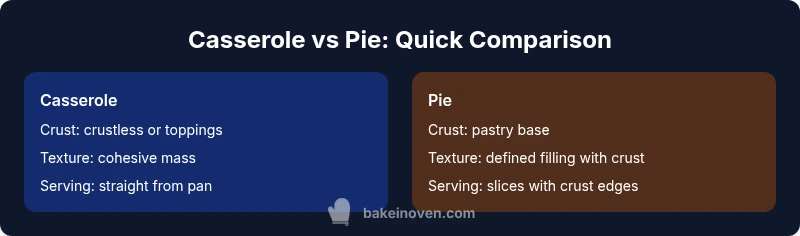
Understanding the difference between a casserole and a pie hinges on structure, crust, and serving style. A casserole is a one-dish bake with mixed ingredients or layered components bound by sauce, usually without a crust. A pie, by contrast, has a pastry crust and a defined filling, sometimes with a top crust or lattice.
What the Difference Means in Everyday Cooking
In home cooking, the phrase difference between a casserole and a pie is more than a label; it guides how you plan, bake, and serve a meal. Casseroles are designed as one-dish meals that mix protein, vegetables, starch, and a binding sauce in a single baking vessel. The goal is comfort, versatility, and convenience: ingredients meet in harmony, bake until bubbly, and often come to the table still in the baking dish. Pies, by contrast, center on structure: a pastry crust encases a filling, and the crust or lattice guides how the dish cuts and holds its shape. The Bake In Oven team emphasizes starting with function—whether you’re feeding a family, planning ahead, or composing a balanced plate—then selecting ingredients to suit that function. According to Bake In Oven, recognizing this distinction improves planning, reduces waste, and helps you adapt family favorites into reliable weeknight options. Heat interaction also differs: casseroles rely on a continuous mass that cooks evenly through, while pies create boundaries where crust and filling meet and exchange heat.
\n
Comparison
| Feature | Casserole | Pie |
|---|---|---|
| Crust or crustless | Often crustless or with a baked topping | Crust-based (bottom crust, with or without a top crust) |
| Typical fillings | Protein, starch, vegetables bound in a sauce | Filling centered on a defined mixture (fruit, custard, or meat usually with a crust) |
| Serving vessel | Baked in a single dish; slices served from the same dish | Sliced portions from a pie pan; presentation emphasizes crust edges |
| Texture tendency | Cohesive mass or layered mix with uniform texture | Layered textures; crust provides crisp or flaky contrast |
| Prep approach | Mix or layer ingredients and bake until set | Prepare crust, add filling, and bake until crust is set |
Benefits
- Versatility in casseroles: adaptable ingredients and sauces
- Pie crusts provide structure and decorative presentation
- Good make-ahead potential for both dishes
- Casseroles often require fewer precise portions or delicate handling
Negatives
- Casseroles can become heavy or bland without careful seasoning
- Pie crusts can be flaky and tricky to master; risk of soggy bottoms
- Pie fillings may require precise balance of moisture and texture
- Cakes and cookies are easier to portion and transport than some casseroles
Casserole wins for weeknight simplicity and one-dish meals; pie wins for structure, presentation, and dessert-like dishes
Choose casseroles when you want a flexible, dump-and-bake option that feeds a crowd. Choose pies when you prize crust structure and defined fillings, especially for savory or fruit-forward dishes. Bake In Oven supports both paths with practical guidance.
Frequently Asked Questions
What defines a casserole versus a pie?
A casserole is typically a mixed or layered dish baked in one dish without a crust, relying on a binding sauce. A pie uses a pastry crust to encase a filling, offering a defined structure and often a top crust or lattice.
In short, casseroles are crustless or topping-crusted one-dish meals, while pies rely on crusts for structure and presentation.
Can a casserole have a topping crust?
Yes, some casseroles feature a crumb topping or a shallow crust layer for texture and browning, but they do not rely on a full pastry crust like traditional pies.
Casseroles can have toppings, but they aren’t built around a pastry crust as pies are.
Are pies always sweet?
Pies can be sweet or savory. Savory pies use fillings such as meat and vegetables, while fruit or custard pies are typically sweet.
Pies aren’t limited to sweetness; savory pies are common in many cuisines.
What’s easier for beginners, casseroles or pies?
Casseroles are generally easier for beginners because they require fewer precise components and can tolerate imperfect seasoning. Pies demand more crust handling and moisture balance.
If you’re new to baking, start with casseroles, and try pies as you gain crust confidence.
How do I prevent a pie crust from getting soggy?
Blind-baking the crust and ensuring a proper moisture balance in the filling helps prevent sogginess. Using cold ingredients and a hot oven also aids crust browning.
Pre-bake the crust and keep fillings balanced to avoid soggy bottoms.
Key Takeaways
- Choose casseroles for one-dish meals and make-ahead convenience
- Prefer pies when crust and precise portions matter
- Master crust techniques to elevate pie quality
- Balance moisture in fillings to avoid soggy crusts or soggy casseroles