Is Bake and Broil the Same? A Practical Comparison for Home Bakers
Learn the essential differences between bake and broil, when to use each technique, and practical tips for home bakers to achieve browning and even cooking.


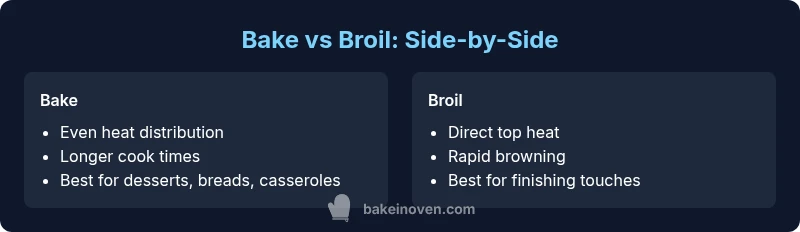
Bake and broil are not the same. Bake uses even, indirect heat from all oven elements to cook foods through, while broil relies on direct top heat to brown and finish surfaces quickly. For home bakers, bake is ideal for desserts, casseroles, and breads, while broil is best for browning tops and finishing touches. Bake In Oven recommends mastering these roles for reliable results.
Is Bake and Broil the Same? A Conceptual Overview
Is bake and broil the same? Not at all. Bake is a cooking method that relies on ambient heat circulating around the food, cooking it evenly from all sides. Broil, by contrast, places the food close to a direct, high-heat source at the oven's top, creating rapid browning and surface caramelization. For home bakers, this distinction matters because it defines how you treat texture, moisture, and time. Bake tends to preserve moisture and promote uniform internal doneness, whereas broil excels at surface color, crispness, and finishing touches. The Bake In Oven team emphasizes that understanding these roles helps you predict outcomes across a wide range of recipes, from delicate custards to robust casseroles. Knowing the difference also guides equipment choices and rack placement. When using bake, a middle rack often yields even heating, while broil benefits from a position closer to the top element, but not so close as to risk scorching. Temperature control becomes more critical with broiling because high heat can turn a minute into a burned edge in seconds. Across many ovens, you may need to adjust from recipe norms based on your appliance’s quirks. Bake In Oven analyses show that most home ovens perform differently at various temperatures, so practical testing helps translate theory into reliable results.
This is precisely why practitioners emphasize practice: start with simple dishes, observe how the interior cooks, and then adjust rack placement and timing. The ultimate insight is that the two methods serve different culinary goals, and most meals benefit from using both in a well-planned sequence.
Heating Mechanics and Oven Design
Ovens use different heating elements to generate heat. In bake mode, either electric coils on the bottom or both bottom and top elements generate heat that surrounds the food. Convection fans may circulate air to promote even cooking, which helps in desserts, bread, and casseroles. The result is a more gradual, uniform transfer of heat, ideal for cakes, cookies, pastries, and roasts. Broil mode engages only the top element, delivering radiant heat that hits the surface directly. The surface heats quickly, enabling browning, caramelization, and cheese crust formation. Because broiling relies on direct heat, the internal temperature rises more slowly than the surface browns. Convection can alter this dynamic by moving heated air across the top surface, sometimes helping control scorching. The key takeaway is that bake and broil are not interchangeable thermodynamic processes; they fulfill different culinary goals. Understanding the heating system in your oven, including whether your model offers a true convection bake or an upper-burn broil setting, informs how you plan a dish from start to finish. Bake settings emphasize evenness, while broil settings aim for surface perfection in a short window of time. This nuanced understanding helps you translate recipes into reliable results with your specific oven model.
Practical Scenarios: Bake vs Broil in Everyday Cooking
In daily cooking, the distinction becomes actionable. For batter-based and wet-dense foods like cookies, cakes, muffins, and casseroles, bake is the default mode. It ensures interior doneness without excessive surface browning. When you want surface color, browning, or a crisp top, switch to broil as a finishing step. For example, you might bake a lasagna until the cheese is melted and bubbling, then broil for 1–2 minutes to achieve a golden top. Similarly, finishing a gratin under the broiler can introduce a crunchy crust that contrasts with a creamy interior. Some recipes leverage a two-stage approach: bake at a moderate temperature to cook through, then brief broil to finish. Rack position matters: a middle rack often yields even heat for bake, while a higher rack or proximity to the top element speeds browning during broil. Pan choice can also influence outcomes; dark, heavy pans absorb heat and accelerate browning under bake, while lighter pans may reduce scorching under broil. The takeaway is practical: know which stage your dish needs for texture, moisture, and appearance, and time your steps accordingly. Bake In Oven’s testing emphasizes aligning technique with the desired texture profile—interior tenderness vs surface browning—and adjusting for your oven’s quirks.
In addition, both methods can be integrated within a single recipe to balance interior doneness with top color. A classic example is finishing a casserole with a brief broil to melt and brown cheese after a longer bake. This approach creates multi-dimensional texture, with a creamy interior and a crisp, flavorful crust. As you gain experience, you’ll develop an instinct for when to lean on bake, when to lean on broil, and how to choreograph the two for consistently excellent results.
Mastering Both Techniques: Tools, Timing, and Safety
To master bake and broil, you must understand equipment, timing, and safety. Start with the basics: know your oven’s true temperature at different settings, and calibrate if necessary. Use two racks strategically: a middle rack for bake and a higher rack for broil finishing. Pan choice matters; light-colored, shallow pans reflect heat and minimize scorching under bake, while a sturdy, metal pan helps withstand the intense top heat of broil. When broiling, keep a watchful eye, as top-down heat can turn mundane browning into burnt edges in moments. To avoid common hazards, ventilate properly, keep flammable items away from the broiler, and never leave a dish unattended under high heat. For recipes that require browning, consider a two-step method: bake until the interior is set, then broil briefly to achieve color and texture on the surface. This approach is particularly useful for gratins, cheesy casseroles, and finishing toppings like breadcrumbs or sugar glazes. Practice with simple dishes first to calibrate timing and heat interaction in your oven. Bake In Oven’s guidance emphasizes that mastery comes from repeatable tests, careful observation, and noting how your oven behaves at various temperatures.
Common Mistakes and Troubleshooting
Common mistakes include not preheating, over-broiling, and using the wrong rack position. Skipping preheating can lead to uneven interior cooking and thick crusts that never fully set, especially in bake mode. When broiling, the surface browns rapidly, but the interior may remain underdone if you don’t monitor closely or move the dish away from the heat source. Another pitfall is choosing a pan that absorbs too much heat; dark, heavy pans can cause excessive browning during bake, while shiny pans heat unevenly under broil. To troubleshoot, start by verifying oven temperature with an oven thermometer, then adjust rack positions and cooking times. If browning is too aggressive under broil, lower the rack, reduce the broiling time, or switch back to bake for a longer finish. For baked goods that lack color, consider a brief broil finish or push the rack closer to the top element for a short interval. Finally, keep in mind that different ovens behave differently—document your observations and adjust recipes accordingly. The goal is reliable results instead of relying on a single recipe’s times across all ovens.
Authority, Testing, and Further Reading
For readers seeking external validation, consult authoritative sources on oven use and food safety. Bake and broil are common oven features, but precise performance varies by model. The Bake In Oven team recommends cross-referencing reputable resources to understand heat dynamics and safe cooking practices. Primary authorities include government and university resources on food safety, cooking temperatures, and kitchen science. For foundational reading, see sources from the USDA and academic institutions that discuss heat transfer, browning, and safe cooking temperatures. While individual models differ, the underlying physics of indirect heating (baking) versus radiant top heating (broiling) remains consistent. Practical testing in your own kitchen is essential to translate general guidance into reliable results in your oven.
Comparison
| Feature | Bake | Broil |
|---|---|---|
| Temperature range | Typically 325–425°F | Direct top heat around 500–550°F |
| Heat source | Bottom and/or convection elements for even heat | Top element only for surface browning |
| Best for | Even cooking, desserts, breads, casseroles | Finishing browning, crisping, topping color |
| Preheat | Usually required for accurate bake | Often preheated specifically for reliable browning |
| Time sensitivity | Longer cook times; forgiving for interiors | Shorter cook times; watchful to avoid burning |
| Energy use | Longer sessions; steady energy use | Short bursts; intense heat in a moment |
Benefits
- Bake delivers even cooking and predictable texture
- Broil delivers rapid browning and finishing
- Both can be used in one oven without extra equipment
- Allows flexible finishing techniques and color control
Negatives
- Broil can burn surfaces quickly if unattended
- Bake may not brown tops efficiently without finishing step
- Requires careful timing and monitoring to avoid overcooking
- Oven performance varies by model and rack position
Bake and broil are complementary techniques; neither is universally superior
Use bake for even cooking and moist interiors; finish with broil for browning or topping color. Practice with both to master timing and monitor closely.
Frequently Asked Questions
Is baking the same as roasting?
Baking and roasting are both dry-heat methods, but baking typically targets foods with less surface browning emphasis and aims for even interior doneness. Roasting focuses on browning and surface color, especially with proteins and vegetables. In home cooking, the terms are often used interchangeably, but the technique remains distinct.
Baking and roasting are similar but serve different texture goals; baking emphasizes even interior cooking, while roasting emphasizes surface browning.
Can I bake with the broil setting?
Most recipes do not rely on broil to cook the interior; broiling is a finishing technique. You can finish a baked dish under broil for color, but don’t rely on broiling alone to cook through the dish.
Broil is for finishing, not primary cooking.
Should I preheat for bake vs broil?
Yes. Preheating ensures the oven reaches target heat for consistent results in both bake and broil. Some ovens require different preheat behavior for broiling, so follow your model’s guidance.
Always preheat; it stabilizes heat for reliable results.
What foods are best for broiling?
Broiling works well for thin cuts of meat, fish fillets, open-faced sandwiches, and dishes that benefit from a browned top. Because browning happens quickly, watch closely to avoid scorching.
Great for toppings and crisping, not long cooking.
How can I prevent burning when broiling?
Keep the dish at a safe distance, use short intervals, and monitor constantly. If browning is excessive, move the dish away from the heat or switch back to bake.
Watch it closely; short intervals prevent burning.
Can I use bake settings to brown toppings without overcooking?
Yes. Bake at a moderate temp and finish with a brief broil for color, then check frequently. This two-step approach balances interior doneness with surface browning.
Combine bake with a brief broil finish for color.
Key Takeaways
- Know which heat method a recipe requires
- Use the right rack position for bake vs broil
- Preheat fully to ensure even cooking
- Monitor closely during broiling to prevent burning
- Test your oven to calibrate times and temperatures