Is Bake or Broil Better for Salmon? A Practical Comparison
Explore whether baking or broiling yields better texture, moisture, and color for salmon. This analytical comparison covers heat, time, texture, moisture, and practical tips to help home bakers choose the right method.


When cooking salmon, bake and broil each offer distinct advantages. Baking provides even doneness and moisture retention for thicker fillets, while broiling delivers a faster finish with a crusty surface. For most home cooks, bake is the safer default, with broiling used for a quick finish when a crust is desired.
What does the question really ask: is bake or broil better for salmon?
The question is less about a universal winner and more about outcomes: evenness of doneness, moisture retention, surface browning, and practical timing in a home kitchen. In this context, the keyword is is bake or broil better for salmon, which signals a need to weigh uniform interior texture against a crusty exterior. Bake and broil use different heat delivery mechanisms: bake relies on ambient oven heat circulating to cook the fish, while broil applies direct radiant heat from above. Each method can produce excellent salmon, but their strengths are different, depending on the thickness of the fillet and the desired final texture.
Heat source, temperature, and texture: how each method behaves
Understanding the physics helps you predict results. Baking uses steady, surrounding heat that penetrates evenly, minimizing dry edges and promoting uniform protein coagulation. Broiling, by contrast, is a rapid, intense heat source that sits close to the food, creating a higher surface temperature quickly. For salmon, this means baking tends to yield a soft, moist interior with gentle flaking, while broiling can yield a tawny crust and a more assertive outer texture. The trade-off is that broiling can dry out thinner pieces if not watched closely. If you are balancing moisture and crust, a hybrid approach—start with bake to set the interior, finish with a brief broil for browning—often delivers the best of both worlds.
Practical guidelines by thickness: thick fillets vs thin fillets
Thickness matters more than you might expect. Thick fillets (1 inch or more) benefit from baking: you get even doneness without excessive moisture loss. For thin fillets (less than 3/4 inch), broiling is appealing because you can achieve surface browning quickly without lengthy exposure to heat that could overcook the interior. In practice, many cooks use a two-step approach: bake a thicker portion to finish the interior, then broil briefly to develop color on top. This method respects the integrity of the fish while delivering a pleasing crust on the surface.
When to choose bake or broil boils down to thickness, goal texture, and time constraints. If your priority is reliable doneness and moisture, choose bake. If you crave a fast finish with a crust, choose broil, keeping a watchful eye to prevent charring.
Flavor, browning, and crust development: what to expect
Baking tends to preserve delicate flavors and moisture, producing a mild taste with a tender texture. Broiling enhances Maillard browning, creating a flavorful crust and deeper color on the surface. If you like a golden crust on top, broiling is the way to go, but be mindful of fat distribution and potential uneven browning on very thick pieces. A parchment-lined pan can help with cleanup and even browning, particularly when broiling, but avoid folding parchment under the high heat of close radiant exposure. Remember: the salmon’s fat content can also influence how quickly it browns and how moist the interior remains during both methods.
Tools, setup, and oven settings for consistency
Consistency comes from a few reliable steps: preheat the oven to a moderate range (around 400-425°F or 205-218°C) for bake; for broil, position the rack so the fish is a few inches from the heating element. Use a rimmed sheet pan with a wire rack or a parchment-lined surface to promote even heat exposure and prevent sticking. If you want to maximize crust without drying the interior, start with a brief broil at the end of a bake cycle (a technique popular among home bakers in Bake In Oven’s tests). A light brush of oil or a thin layer of olive oil can also help achieve a crisp exterior without drying out the inside.
Common mistakes and how to avoid them
Overcooking is the main enemy of both methods. Salmon cooks quickly, so check early and use reliable doneness cues. When baking, avoid overcrowding—the heat needs space to circulate. When broiling, keep a close eye and tilt the pan slightly to avoid an uneven crust or burnt edges. Also consider the skin: skin-on fillets retain moisture and can finish beautifully under bake, while skinless portions may benefit more from broiling’s crust-building effect. By understanding the internal texture you want, you can choose the method that aligns with your goals.
A practical decision framework: quick callouts for home cooks
If you have a thick fillet and you want predictable texture, bake first; if you crave a crust and color, broil briefly near the end. For a balanced approach, bake the salmon until near desired doneness, then finish with a 1- to 3-minute broil to develop color. Always rest the fish briefly after cooking to redistribute juices. With these guidelines, you can tailor is bake or broil better for salmon to your preference and the equipment you have on hand.
Comparison
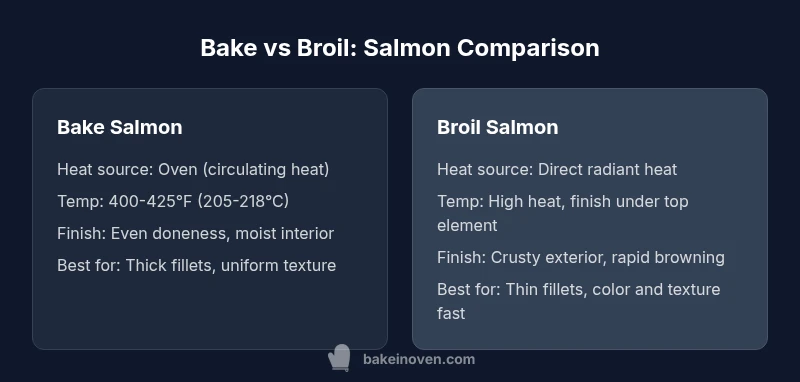
| Feature | Bake Salmon | Broil Salmon |
|---|---|---|
| Heat source | Oven heat circulating around the fish | Direct radiant heat from the broiling element |
| Typical temperatures | Approx. 400-425°F (205-218°C) for even cooking | High radiant heat; use later in the process for crust |
| Approximate cook time | 8-14 minutes per inch thickness (varies by oven and fillet) | 2-6 minutes per side (thickness dependent) |
| Texture outcome | Even doneness with moist interior | Crisped exterior with browned surface |
| Best for | Thick fillets, moisture retention, low risk of overbrowning | Thin fillets, fast finish, dramatic crust |
| Cleanup and setup | Pan or rack; parchment optional for easier cleanup | Requires attentive timing to avoid burning; often shorter cleanup |
Benefits
- Even heat distribution preserves moisture
- Less risk of overbrowning with thicker fillets
- Simple workflow with predictable results
- Good for bulk cooking and batch meals
Negatives
- Longer total time than broiling in some cases
- Less surface browning compared to broiling
- Requires oven preheat and energy usage
Bake is the safer default for most salmon; broil is ideal for crust and color.
For thicker fillets, bake yields even doneness and moisture. Broil shines when a crust is desired or time is tight, especially with thinner portions. A combined approach—bake then brief broil—often delivers the best overall result.
Frequently Asked Questions
Is bake or broil better for salmon?
Both methods have their merits. Baking emphasizes even doneness and moisture, while broiling creates a crust quickly. For most home cooks, baking is the safer default, with broiling used to finish the top for color and texture.
Bake for even doneness and moisture; broil to finish with color. Use baking as the default, broil sparingly for crust.
Can you bake salmon from frozen?
Yes, you can bake salmon from frozen, but expect longer cooking times and check for doneness with a thermometer. It's usually better to thaw for more even cooking, but baking from frozen is feasible in a pinch.
You can bake from frozen, but expect longer cooking times. Thawing is preferred for even cooking.
Should I flip salmon when baking or broiling?
Flipping is not always necessary. When baking, you can flip once to promote even doneness on both sides. When broiling, flipping is less common, but can help with even browning if your oven's heat is uneven.
Flip if you want even browning, especially when baking. Broiling usually requires less flipping but monitor closely.
What internal temperature should salmon reach?
Salmon is safe at 145°F (63°C) according to food safety guidelines, but many home cooks prefer removing from heat around 125-135°F for a softer, medium-rare center before resting. Always verify with a reliable thermometer.
Cook to 145°F for safety, or a bit lower if you prefer a softer center; rest before serving.
Do I need to use foil or parchment when baking or broiling?
Parchment or foil can aid cleanup and prevent sticking, especially when broiling. Use parchment for bake sessions to keep the fish from sticking and to promote even browning. Avoid wrapping too tightly when broiling, as it could trap moisture and hinder browning.
Parchment helps prevent sticking and makes cleanup easier; use foil sparingly for broiling if you need extra protection.
Is preheating the pan necessary?
Preheating the pan is not strictly required but helps achieve consistent results. For bake, a preheated pan can start the crust quicker, while for broil, a preheated rack near the element supports faster browning.
Preheating speeds consistent browning and helps with texture, but it's not mandatory.
Key Takeaways
- Bake for even doneness and moisture
- Broil for crust and color when time is tight
- Use a hybrid bake-then-broil approach for best of both
- Adjust based on fillet thickness and thickness uniformity
- Preheat, monitor closely, and rest before serving