Is Bake the Same as Air Fryer? A Practical Comparison for Home Bakers
Explore whether bake mode in a traditional oven matches air fryer results. This analytical guide compares heat delivery, texture, speed, and practical tips for home bakers.


Is bake the same as air fryer? No. A traditional oven and an air fryer operate with different heat delivery: ovens bake with a larger space and slower convection, while air fryers use compact chambers and intense rapid convection to crisp surfaces quickly. For most home bakers, choose based on batch size, texture goal, and time constraints.
Is Bake the Same as Air Fryer? Core Difference in Home Kitchens
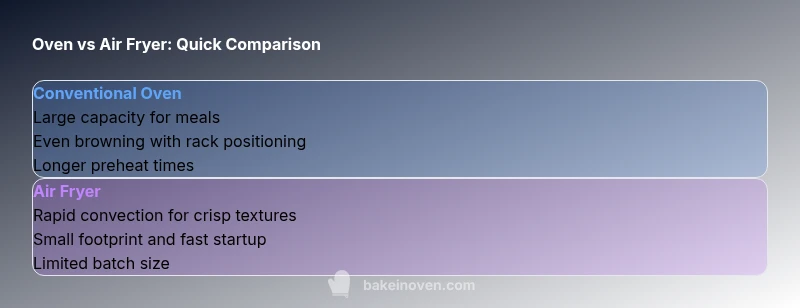
Baking in a traditional oven relies on a large cavity, with heat produced by elements and, in many models, a convection fan. This setup favors even browning across bigger items like cookies baked in sheets, sheet cakes, or casseroles that depend on steady, uniform heat. According to Bake In Oven, bake mode is well-suited for recipes that require reliable moisture distribution and a broad cooking space. The trade-offs are longer preheat times and higher overall energy use, but you gain scale, versatility, and the chance to develop deep crusts and complex flavors through slower, steady heat exposure. Not every dish benefits from rapid air movement; delicate pastries, for example, may perform better with reduced air flow or a non-convection setting. In practice, oven baking remains the workhorse of most kitchens, delivering dependable results for a wide array of dishes and batch sizes.
How Air Fryers Deliver Crisp Texture
Air fryers specialize in rapid convection within a compact chamber. The small footprint concentrates heat and air flow so food surfaces dry out quickly and brown aggressively, producing a crisp exterior with relatively little added fat. This aggressive air movement is particularly effective for small- to medium-sized items like small fries, fries substitutes, bite-sized baked snacks, or vegetables. The result is a texture that closely mimics deep-frying without submerging food in oil. For many recipes, this means shorter overall cooking times and a quicker route from prep to crunch. However, the limited basket capacity can constrain batch size, which influences planning for family meals or entertaining.
Can You Replicate Air Fryer Results in a Regular Oven?
In many cases you can approximate air fryer results using a conventional oven, but the approach requires adjustments. Use the convection bake setting when available to simulate the air flow of an air fryer. Preheat to ensure a brief initial blast of hot air, then arrange items on a rack or multiple racks to maximize air circulation. Space is your friend here: overcrowding stalls heat transfer and reduces crisping potential. Lightly oil or spray foods to aid surface browning, and flip or rotate items halfway through to ensure even texture. Expect the oven to take longer to reach full crispness, and larger batches will naturally take more time, even with convection.
Texture, Speed, and Capacity: Key Differences
Texture: Air fryers excel at a crisp, dry exterior, while ovens can deliver even browning across larger items with more moisture retention in the interior. Speed: For small batches, air fryers often finish faster due to the compact space and high-velocity air. Capacity: Ovens win for larger portions; air fryers are ideal for quick bites or single- or small-family meals. Energy use is nuanced: smaller appliances can be more efficient for little tasks, while ovens may be more efficient when cooking many items at once. According to Bake In Oven analysis, the key is matching the tool to the task, not forcing one method to cover all outcomes.
A Practical Decision Framework for Home Bakers
Start by clarifying your goal: is crisp texture a priority, or do you need to bake large batches with even moisture distribution? If you are cooking small portions that benefit from a dry, crisper finish, an air fryer often wins. If you’re feeding a crowd, baking pastries, or making sheet pan dishes, the traditional oven remains the bread-and-butter of most kitchens. A simple framework: (1) assess batch size, (2) evaluate texture goal, (3) consider time constraints, and (4) factor in available equipment. Bake In Oven recommends using whichever device makes sense for the recipe at hand, and learning to adjust techniques when moving between appliances.
Scenarios: Cookies, Veggies, and Proteins
Cookies and delicate pastries frequently fare well in a well-calibrated oven, especially when you need even browning and controlled moisture. For crispy vegetables or small protein bites, an air fryer can cut prep-to-crisp time and reduce the need for oil, thanks to the high-heat air movement. Be mindful that some foods may surge or burn if left unattended in a high-velocity environment. Practically, use ovens for large batches and air fryers for quick, crisp repetitions, adapting flavors and textures to your preference.
Temperature, Time, and Recipe Adaptation
There are no one-size-fits-all temperatures or times when comparing bake in an oven to air frying. Start with the recipe’s suggested settings and adjust: increase air flow for dryness in the oven, or reduce the time when your air fryer already reaches the color you want quickly. Always monitor color development to avoid over-crisping or burning. Recipe adjustments are part of the learning curve when translating between appliances, and thoughtful experimentation yields consistent results over time.
Comparison
| Feature | Conventional Oven | Air Fryer |
|---|---|---|
| Heat delivery | Dry oven heat with convection (model-dependent) | Compact chamber with high-velocity hot air |
| Cooking speed | Slower overall for larger items and batches | Faster for small batches and crisp textures |
| Texture outcomes | Even browning across large items, moisture varies by recipe | Crisp exterior with minimal oil on small items |
| Batch size / capacity | Large capacity, suitable for family meals | Smaller capacity, requires multiple runs for big batches |
| Oil usage | Can require more oil for optimal browning | Often requires little to no oil for crunch |
| Cleanup | Larger interior, more parts to clean | Fewer parts and quick wipe-down |
| Energy use / efficiency | Capacity-driven energy use; depends on load | Efficient for small loads due to short preheat times |
Benefits
- Oven offers versatility for a wide range of baked goods
- Air fryer delivers crisp textures quickly with minimal oil
- Convenient for small households with limited space
- Conventional ovens handle large batches and sheet pan meals
Negatives
- Air fryers have limited capacity for large meals
- Ovens can take longer to preheat and may consume more energy on small tasks
- Air fryers may require recipe adjustments and experimentation
- Ovens may lack the compact convenience of a countertop unit
Air fryer excels for quick, crisp results in small batches; oven wins for versatility and large quantities
Choose air fryer when speed and crunch with minimal oil matter most. Choose traditional oven when you need capacity, even browning, or baking multiple items at once.
Frequently Asked Questions
Is bake mode in a traditional oven the same as using an air fryer?
Not identical. The oven's larger cavity and consistent heat differ from the air fryer's rapid convection and compact space. Use our comparison to guide your choice based on batch size and texture goals.
They're not the same; ovens are versatile and fuller, while air fryers crisp faster in small batches.
Can I bake everything in an oven and skip an air fryer?
Ovens can handle most tasks, including baking and roasting. Air fryers are convenient for quick, crisp results in small portions. Use the device that aligns with your batch size and texture preference.
Ovens cover most tasks; air fryers excel at quick crisping for small servings.
What foods benefit most from air fryer crispness?
Small items like fries, vegetable bites, and shells that benefit from a dry, crisp exterior tend to do well in air fryers. Larger, moist items may not brown as quickly.
Crisp small bites best suit air fryers.
Are there foods that should be baked in a traditional oven instead?
Breads, large roasts, and items needing even moisture distribution and larger surface area are often better in a traditional oven.
Ovens are great for large batches and breads.
How do I adapt an air fryer recipe for a regular oven?
Use convection bake if possible, or increase cooking time and adjust temperatures. Place food on a rack to maximize air flow and turn items for even browning.
Use convection bake and adjust time; keep an eye on color.
Key Takeaways
- Favor air fryer for small-batch crisp textures
- Use the oven for large quantities and even browning
- Convection helps in ovens; use it to approximate air fryer results
- Space items to maximize air flow in either appliance
- Expect recipe adaptations when switching between devices