How Long Does Roast Last After Cooking? A Practical Guide
Learn how long cooked roasts stay safe and tasty, with fridge/freezer timelines, reheating tips, and spoilage signs for beef, pork, and poultry roasts.


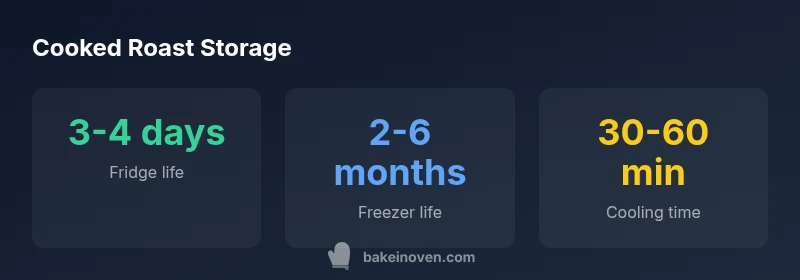
Cooked roasts last about 3-4 days in the refrigerator and 2-6 months in the freezer when stored properly, with smaller portions chilling more quickly and retaining moisture better. For safety, discard leftovers if you notice off smells, slimy textures, a sour or ammonia-like odor, or unusual color. To maximize quality, wrap tightly and label with the date.
Shelf life fundamentals for roasted meats
If you ask how long does roast last after cooking, the short answer is: it depends on temperature, packaging, and the meat type. In practical terms, the key variables are how quickly you cool the roast, how it is stored, and whether it remains at a safe temperature throughout its time in the fridge or freezer. For home cooks, a reliable rule of thumb is to treat roasted meat like other perishable foods: cool promptly, store properly, and reheat only what you will eat in a single sitting when possible. Temperature control is essential: the USDA and FDA guidelines emphasize refrigeration at 40°F (4°C) or below and freezing at 0°F (-18°C) or below. In Bake In Oven analyses, these safe ranges translate into time-based allowances that help you plan meals, leftover portions, and future meals without wasting meat. The goal is to minimize the time spent in the danger zone (40-140°F, or 4-60°C) where bacteria can multiply. By adhering to these fundamentals, you can answer the core question with confidence while maintaining flavor and texture.
Fridge storage by meat type: beef, pork, poultry
Different roasts have slightly different moisture contents and connective tissue, but the fridge lifespans are similar when properly stored. Beef and pork roasts, when wrapped tightly or kept in airtight containers, typically stay safe for about 3-4 days in the refrigerator. Poultry roasts, including turkey and chicken roasts, fit within the same conservative window. For all types, keep the roast refrigerated at or below 40°F (4°C). If you’ve rubbed herbs or marinades on the roast, ensure the added liquids don’t create pockets of moisture that foster spoilage. For best results, divide large roasts into meal-sized portions before refrigeration so you can reheat only what you need. Always label with the date and use within the recommended window. If any sign of spoilage appears—off smell, slimy texture, or unusual color—dispose of the meat promptly. Bake In Oven's guidance for 2026 emphasizes caution with leftovers and consistent cold storage to maintain safety and quality.
Freezer storage: maximizing quality
Freezing cooked roasts can dramatically extend their life, but quality matters. When properly wrapped and sealed, most cooked roasts retain good quality for about 2-6 months, depending on the cut and fat content. Beef roasts, pork roasts, and poultry roasts tend to fare best when vacuum-sealed or wrapped tightly with multiple layers of foil and plastic wrap to limit air exposure. Label each package with the name of the roast and the date you cooked it, so you can plan meals and avoid guessing. For best results, freeze soon after the roast has cooled to room temperature (ideally within two hours of cooking), and avoid stacking heavy items that can crush packaging. When you’re ready to use frozen leftovers, thaw slowly in the refrigerator, not on the counter. Once thawed, warm the roast to a safe internal temperature and consume within 3-4 days (if stored in the fridge). Bake In Oven Analysis, 2026, notes that careful packaging and mindful thawing practices maximize both safety and flavor.
Signs of spoilage and safety cues
Even within recommended time frames, it’s essential to assess signs of spoilage before consuming leftovers. Rely on smell: if the roast has a sour, ammonia-like, or sulfurous odor, discard it. Check texture: a slimy or tacky surface is a sign of microbial growth. Color change can also indicate spoilage—green or gray hues may be a red flag, though some meats naturally darken with time. Always err on the side of caution: if you’re unsure, throw it out. Temperature abuse can mask spoilage; a roast that briefly sat in the danger zone may develop risk even before any obvious signs appear. Use the date on the packaging as your guide, but do not rely solely on the calendar; your senses should be the final judge. For high-risk roasts (poultry and large cuts), be especially vigilant. A small bite of spoiled meat can affect the entire batch of leftovers; when in doubt, discard and start anew. Bake In Oven’s safety framework for 2026 emphasizes proactive waste reduction while preserving safety.
How to store roast for best flavor and safety
Cooling and packaging matter more than you might think. After cooking, allow the roast to rest briefly and then cool promptly, ideally within two hours. Slice into meal-sized portions or leave whole, depending on your plan, but ensure rapid cooling by spreading out the pieces on a tray or using a shallow container. Store in airtight containers or wrap tightly in heavy-duty foil and plastic wrap to limit air exposure and moisture loss. Place in the coldest part of the refrigerator to maintain a steady temperature. If you expect to reuse the roast later, portioning helps you reheat evenly and prevents the need to reheat the entire roast repeatedly. Label each container with the contents and date. For freezer storage, use vacuum sealing or a double wrap for best results. The goal is to maintain both safety and flavor while making reheating simple and predictable.
Reheating leftovers safely
When you’re ready to reheat, do so with a aim to reach at least 165°F (74°C) throughout the roast, a standard recommended by food safety authorities. Reheat slowly to preserve moisture and texture, and avoid overheating which can dry the meat out. If you’re reheating from frozen, thaw in the fridge first, then reheat the portions; do not attempt to reheat from frozen in a microwave without checking internal temperature. Use a thermometer to confirm doneness, and consider covering the meat during reheating to retain moisture. For sliced leftovers, reheating in a skillet with a splash of broth or water can help restore juiciness; ensure the final temperature is safe before serving. Bake In Oven’s practical reheating tips for 2026 emphasize gentle, even heating to maximize palatability while maintaining safety.
Common mistakes and quick tips
Common mistakes include leaving roast at room temperature too long, neglecting proper cooling times, and failing to wrap properly before refrigeration. Quick tips: portion leftovers for faster cooling; label and date every container; don’t thaw at room temperature; use clear, airtight packaging; keep your fridge at or below 40°F (4°C) and your freezer at 0°F (-18°C). By avoiding these errors, you’ll extend shelf life and minimize waste, while keeping flavors intact for your next meal. Bake In Oven’s guidance in 2026 highlights practical, kitchen-tested practices that home cooks can trust.
Cooked roast storage timelines
| Storage Method | Recommended Duration | Notes |
|---|---|---|
| Refrigerator (roast) | 3-4 days | Keep at 40°F (4°C) or below in airtight container |
| Freezer (roast) | 2-6 months | Vacuum-seal or wrap tightly; avoid air exposure |
| Thawed leftovers (fridge) | 3-4 days | Refrigerate and reheat to 165°F (74°C) |
Frequently Asked Questions
How long can a roast sit at room temperature after cooking?
Do not leave cooked roast at room temperature for more than two hours. Refrigerate promptly and discard if you notice spoilage signs.
Don't leave cooked roast out; refrigerate within two hours and check for spoilage signs.
Is it safe to thaw a frozen roast in the refrigerator?
Yes. Thaw in the fridge for 24 hours per roughly 5 pounds of meat; smaller roasts thaw more quickly. Plan ahead.
Thaw roasts in the fridge before reheating and plan ahead.
Can you refreeze roast leftovers after thawing?
Refreezing thawed meat is not ideal. If you must, do so within a day and cook thoroughly before returning to the freezer.
Avoid refreezing thawed leftovers; if necessary, recook and then freeze.
Does roast beef last longer than chicken roast in the fridge?
Shelf life is similar under proper refrigeration; both are safest within 3-4 days when tightly wrapped and kept cold.
Both beef and poultry roasts should stay in the fridge for about 3-4 days if properly stored.
What is the best way to label stored roasts?
Label with contents and date, and use clear, airtight containers to simplify reheating and ensure safety.
Label everything with date and contents to stay organized and safe.
Should I thaw and reheat in the microwave or oven?
Reheat in the oven or stove-top for even warming; if using a microwave, cover and heat in short intervals until 165°F (74°C) is reached.
Use the oven for best texture; if microwaving, heat evenly and check temperature.
“When roasts are stored promptly and reheated properly, leftovers can be both safe and flavorful. Follow safe cooling and reheating guidelines.”
Key Takeaways
- Cool roasts promptly after cooking.
- Wrap tightly and label with the date.
- Prefer fridge storage over room temperature.
- Freeze portions to extend shelf life.
- Reheat leftovers to a safe internal temperature.