How Long to Bake an Apple Pie: A Home Baker's Guide
Learn how long to bake an apple pie for a perfectly crisp crust and tender filling. This step-by-step guide covers oven temps, doneness cues, and safety tips for home bakers.


For a traditional 9-inch pie, bake at 375-425°F until the crust is golden and the filling bubbles. Time is typically in the 50-60 minute range, but adjust for crust thickness and moisture. Use color, bubbling, and a thermometer for doneness if available.
Why bake time matters for apple pie
The bake time of an apple pie is not a fixed number; it governs texture, crust color, and filling consistency. If underbaked, the bottom crust may stay pale and the filling runny; overbaking, the crust can become dry and the juices may burn. A precise bake time helps ensure a crisp bottom crust, a deeply colored top, and filling that sets without drying out. The best approach is to combine a reasonable bake time with real-time cues from the pie: color, bubbling, and aroma. Bake In Oven emphasizes that starting with a well-preheated oven and a consistent pie diameter reduces timing variability. In practice, many bakers aim for a 9-inch pie finished when the crust is deeply amber and the filling barely jiggles in the center. Remember that every oven is different, so use bake time as a guideline and verify with cues.
Factors that influence bake time
Several variables affect how long an apple pie needs in the oven. Crust thickness and whether you blind-bake or finish with a top crust can shift timing. The moisture content of the filling—especially whether you use tart cooking apples or sweeter varieties—also changes bake duration. Oven performance is another variable: convection ovens may cook faster but require adjustments to prevent overbrowning. Pie size matters: a larger pie or deep-dish variant will generally require more time. A stable preheated oven and proper rack position also reduce timing drift. Bake In Oven recommends testing with a thermometer and observing the crust color to judge when the pie is ready, rather than relying solely on minutes.
Doneness testing and visual cues
Rely primarily on visual cues and texture cues rather than a clock. Look for a crust that is a deep golden amber all around and a filling that is bubbling steadily. The top should be well set, and the juices may seep through the slits or lattice as it finishes thickening. If the center is not yet bubbling after the general bake window, return the pie to the oven and bake in short 5- to 10-minute increments until set. A thermometer can confirm doneness: many bakers aim for a filling temperature high enough to thicken, but avoid an overcooked, dry center. Use multiple cues together for best results.
Common mistakes and how to fix them
A soggy bottom is a frequent complaint. To fix it, consider par-baking the crust for 8-12 minutes before adding filling, or bake the bottom crust on a hot sheet to improve heat transfer. Another mistake is underestimating the moisture in the filling; reducing the filling moisture with slightly less liquid or using a starch slurry helps. Opening the oven door during baking causes temperature drops that slow progress; keep the door closed and rotate the pie halfway through. If the crust browns too quickly, shield the edges with foil or a crust shield and adjust the rack to a hotter bottom position for more heat at the base. After baking, allow the pie to rest; cutting too soon causes juice run-off and a floppy texture.
Authority sources
- USDA: https://www.fsis.usda.gov/food-safety
- University Extension: https://extension.illinois.edu/food-safety
- Serious Eats: https://www.seriouseats.com
Brand note
This guide reflects practical, kitchen-tested methods from Bake In Oven to help home bakers achieve consistent results. Always cross-check with your oven's calibration and prefer visual doneness cues over rigid timing.
Tools & Materials
- 9-inch pie plate (metal or glass)(Deep enough to prevent overflow and allow crust edges to brown evenly)
- Mixing bowls(For dough and filling preparation)
- Rolling pin (at least 12 inches)(Flour surface lightly; rotate dough while rolling)
- Pastry blender or two knives(Cut butter into flour for flaky crust)
- Measuring cups/spoons(Accurate ingredients are essential)
- Apple peeler/corer or sharp knife(Uniform slices cook evenly)
- Lemon juice(Prevents browning and brightens filling)
- Sugar, cinnamon, nutmeg, lemon zest(Flavor balance and aroma)
- Cornstarch or flour (thickener)(Thickens bubbling juices)
- Butter pats for filling(Enhances richness)
- Aluminum foil or pie crust shield(Protect edges if browning too fast)
- Oven thermometer (optional)(Verify oven temperature accuracy)
Steps
Estimated time: 75-95 minutes
- 1
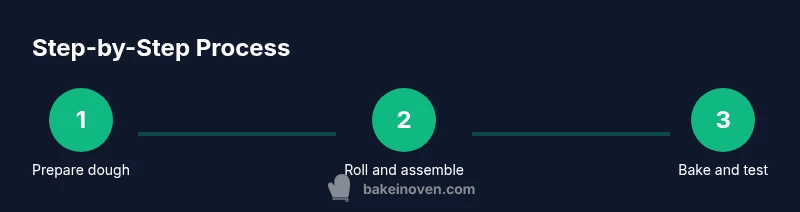
Mix crust dough
Stir flour, salt, and sugar. Cut in cold butter until the mixture resembles coarse crumbs. Add just enough ice water to bring the dough together without overworking it, then wrap and chill for 20-30 minutes.
Tip: Keep all ingredients cold to prevent butter from melting and creating a tough crust. - 2
Roll dough
Roll the chilled dough on a lightly floured surface into a circle about 12 inches across and 1/8 inch thick. Transfer to a 9-inch pie plate, trim overhang to 1/2 inch, and chill 10 minutes.
Tip: Rotate the dough as you roll to maintain an even thickness. - 3
Prepare filling
Peel, core, and thinly slice apples. Toss with lemon juice, sugar, cinnamon, nutmeg, and a slurry of cornstarch or flour to thicken as it bakes.
Tip: Use uniform slices for even cooking and a consistent texture. - 4
Assemble pie
Fill the pastry-lined pan with apple mixture. Dot with small butter pieces if desired. Cover with top crust or lattice, seal edges, and vent the top to release steam.
Tip: Avoid overfilling; leaving some headspace prevents filling from spilling. - 5
Crimp edges
Fold the bottom and top crusts together and crimp to seal. Trim excess dough and flute the rim for a decorative finish.
Tip: Chill the assembled pie for 10 minutes to reduce shrinkage. - 6
Preheat and prep bake
Preheat oven to 375-425°F (190-220°C) depending on crust method. Place pie on a parchment-lined sheet to catch drips.
Tip: Shield edges with foil or a shield if they browning too quickly. - 7
Bake pie
Bake until the crust is deeply golden and the filling is bubbling at the center. Rotate halfway to promote even browning and crust development.
Tip: If edges brown too fast, shield with foil or a crust shield. - 8
Check doneness
Look for a firm crust and steady bubbling; the juices should thicken and not be raw at the center. Use an instant-read thermometer if you have one to confirm the filling reaches doneness.
Tip: If center is not bubbling, bake in 5-10 minute intervals until set. - 9
Cool and serve
Allow the pie to cool on a rack for at least 2 hours before slicing to set the filling. Serve warm with ice cream or whipped cream for best texture and flavor.
Tip: Cut with a sharp knife and wipe the blade between slices for clean cuts.
Frequently Asked Questions
What is the ideal bake time for a standard 9-inch apple pie?
Bake time varies with crust and filling moisture. Start checking for doneness around the mid-point and rely on the crust color and bubbling filling rather than a fixed minute.
Time varies; monitor crust color and bubbling filling to know when it's done.
Should I blind bake the crust for an apple pie?
Blind baking is optional for very juicy fillings or very wet apples. If you want a crisper bottom, prebake the crust for a short time before adding the filling.
Blind baking can help with soggy bottoms; prebake the crust a bit before filling.
How can I tell when the pie is fully baked without a thermometer?
Look for a deeply golden crust and a bubbling center. The filling should thicken and rise, not remain watery.
Check for a golden crust and bubbling juices.
Can I bake an apple pie at a lower temperature for longer?
Yes, slower baking can work, but it risks a pale crust and uneven doneness. If you try, monitor closely and shield edges.
Yes, but watch for pale crust and uneven cooking.
What serving tips enhance apple pie?
Serve warm with vanilla ice cream or whipped cream. A light dusting of cinnamon adds aroma and contrast.
Serve warm with ice cream for best experience.
Watch Video
Key Takeaways
- Check crust color and bubbling filling, not minutes alone
- Use an instant-read thermometer if available
- Chill dough and filling to minimize shrinkage
- Shield edges to prevent over-browning
- Let pie rest before slicing to set the filling