What Temperature to Bake Lasagna At and How Long
Learn the ideal oven temperature and baking time for lasagna, plus tips for no-boil noodles, sauce moisture, and safe serving. A practical, kitchen-tested guide by Bake In Oven for home bakers.


You’ll bake a layered lasagna to doneness by preheating your oven, assembling with sauce, cheese, and noodles, and baking until bubbling and the edges are set. Target 350–375°F (175–190°C) for about 40–60 minutes, followed by a 10–15 minute rest. Use no-boil or traditional noodles depending on your recipe, and check the center temperature for safety before serving.
what to bake lasagna at and how long
What to bake lasagna at and how long may seem simple, but the best results hinge on oven heat, noodle type, moisture, and resting time. By following a practical range and adapting to your ingredients, you can achieve creamy layers, tender pasta, and bubbling edges. For home bakers, the goal isn’t perfection on the first try—it's consistent texture across a familiar dish. According to Bake In Oven, the core principle is balance: heat enough to melt cheese and cook fillings without drying out the sauce. The Bake In Oven team finds that the majority of successful lasagnas sit in a moderate oven long enough to set the structure while staying juicy. In practice, you’ll use a standard 9x13-inch pan, layer sauce and fillings evenly, and monitor progress with visual cues and a quick thermometer check. This guide uses clear ranges so you can tailor based on noodles, sauce, and pan depth.
Oven fundamentals for lasagna
Lasagna responds to steady heat. A conventional oven provides uniform warmth, while a convection setting can shave a few minutes off bake time if you reduce the temperature slightly. Preheating is crucial: a hot start helps set edges and prevent a soggy middle. Use a sturdy metal pan for even heat conduction, or a glass dish if you prefer a visual crust on the top. If you often bake at a different temperature, know that most recipes fall in a moderate range; you’ll adjust based on how your oven behaves (hot spots, air flow) and how deep your pan is. Bake In Oven notes that consistent heat is more decisive than chasing a single “perfect temp.”
No-boil vs traditional noodles: impact on bake time
Choosing no-boil noodles versus traditional, pre-cooked noodles changes the moisture balance in your dish. No-boil noodles rely on the sauce to hydrate them during baking, which can require a bit more sauce or a longer bake to reach tenderness. Traditional noodles, pre-cooked to al dente, can reduce total bake time slightly but demand careful moisture control to avoid a dry surface. If you’re using no-boil noodles, plan for a longer rest and consider using a slightly higher-moisture sauce to compensate. If you prefer traditional noodles, ensure your sauce isn’t overly thick, and seal the edges to keep moisture inside. The key is even layering and consistent sauce distribution so every bite finishes tender.
Sauce moisture and layering: getting even bake
A balanced sauce-to-cheese ratio helps prevent dry edges and a gummy center. Start with a thin layer of sauce on the bottom to prevent sticking, then add layers of noodles, sauce, ricotta or other cheese, vegetables, and meat. Avoid pooling sauce in the pan—this can lead to a soggy bottom or a soggy top if moisture isn’t absorbed. When moisture is well-distributed, heat penetrates evenly, and the layers set at roughly the same rate. If your sauce is very thick or rich, consider thinning it slightly with a splash of broth or water to promote even hydration during baking. Bake time remains primarily driven by the noodle type and pan depth rather than the sauce alone.
Temperature and time by dish size and noodles
Most home lasagnas are baked in a standard 9x13-inch pan. The total bake time will vary with pan depth, noodle type, and whether you start from frozen or refrigerated ingredients. In general, plan for 40–60 minutes at a moderate oven (around 350–375°F / 175–190°C) when assembled. A deeper pan or heavier fillings may push toward the upper end of the range, while a shallow pan with light fillings may finish earlier. If you’re using frozen ingredients, extend bake time by 10–15 minutes and monitor with a thermometer. Remember to account for the resting period after removal from the oven, which helps the layers settle for cleaner slices.
Covered vs uncovered: when to cover and uncover
Covering lasagna with foil early in the bake traps moisture, helping the noodles hydrate and the top from over-browning. Remove or vent the foil in the final 10–15 minutes to encourage browning and bubbling cheese. If your top browns too quickly, you can tent with foil again briefly or reduce oven temperature by 25°F (about 14°C). The balance between cover and uncovering affects both texture and appearance; the goal is a moist, set interior with a lightly browned top. If you prefer a very golden cheese crust, you can finish under a broiler for 1–2 minutes, watching closely to avoid scorching.
How to test for doneness without cutting
Doneness is a combination of texture and temperature. The center should be hot and steaming, and the internal temperature should read around 165°F (74°C) when measured with a food thermometer. If you don’t have a thermometer, insert a knife in the center; it should come out hot and the lasagna should feel firm but tender when gently pressed. A 10–15 minute resting period after baking allows the filling to reabsorb moisture and makes slicing cleaner. After resting, cut and serve in portions that reveal even layers throughout.
Resting and serving for best texture
Let lasagna rest undisturbed for 10–15 minutes before slicing. Resting helps condense the filling, set the layers, and prevent messy cuts. Slice with a sharp knife and wipe the blade between portions for clean servings. If you’re preparing a make-ahead version, refrigerate unbaked assembled lasagna and bake within 24–48 hours for best texture. Reheating leftovers is straightforward: reheat until the center reaches 165°F (74°C) and enjoy with a simple green salad or garlic bread.
Common mistakes and fixes
Overly dry edges usually signal insufficient sauce or too-long bake times; fix by adding a touch more moisture next time and covering for longer. A pale top happens when the oven is too cool or the top layer isn’t cheese-heavy enough; increase cheese percentage or apply a short broil at the end. Mushy or undercooked centers are a sign of insufficient heat or overly thick layers; adjust bake time and ensure the pan isn’t overcrowded. Remember, every oven is different, so start with a conservative time and temperature and test frequently.
Quick-start timing cheat sheet
- No-boil noodles (9x13 pan, medium fill): 40–50 minutes at 350–375°F, covered; 5–8 minutes uncovered to brown.
- Traditional noodles (pre-cooked): 45–60 minutes at 350–375°F, covered; 5–10 minutes uncovered to finish browning.
- Frozen Assemble (frozen to bake): add 10–15 minutes, check with thermometer and be prepared to cover again if edges brown too quickly.
Practical tips for meal-prep lasagna
If you make lasagna ahead for busy weeknights, assemble it, cover tightly, and refrigerate. You can bake it right from the fridge, but expect it to take 10–20 minutes longer. Smaller portions or individual servings will cook faster than a large slab. Consider freezing unbaked portions for even longer storage, and bake directly from frozen with additional time.
Final notes on safety and best practices
Always preheat your oven to the target temperature before placing the dish inside. Ensure the internal temperature reaches 165°F in the center when reheating or checking for doneness. Use proper food-handling practices to avoid cross-contamination, and store leftovers promptly in the refrigerator. For best texture, avoid overmixing fillings or pressing them too hard during assembly.
Additional resources and references
This section provides practical pointers and further reading to deepen your understanding of lasagna baking and safe kitchen practices.
Tools & Materials
- 9x13 inch baking dish(Ceramic, glass, or metal; should be at least 2.5 inches deep for generous layers)
- Aluminum foil(Heavy-duty preferred for long bake times and tenting)
- Oven-safe spatula and knife(For spreading layers and slicing after bake)
- Mixing bowls(At least two; one for sauce, one for cheese filling)
- Saucepan or skillet(To simmer sauce and fillings; adjust heat to avoid scorching)
- Measuring cups/spoons(For accurate portioning of ingredients)
- Thermometer(An instant-read thermometer helps verify 165°F center temp)
- Cutting board(For safe prep of vegetables, meats, and cheeses)
Steps
Estimated time: 60-75 minutes
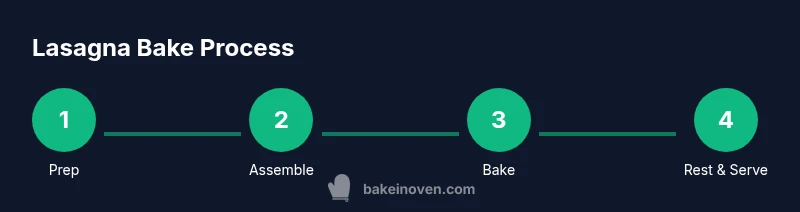
- 1
Gather ingredients and equipment
Collect noodles, sauce, cheese, vegetables, meat (if using), and tools. Having everything at hand minimizes mid-bake interruptions and ensures consistent layering.
Tip: Lay out ingredients in the order you’ll use them so assembly goes quickly. - 2
Prepare sauce and fillings
Simmer sauce with aromatics until it thickens slightly. Mix cheeses or ricotta with herbs if your recipe calls for it. Have fillings ready to spread in even layers.
Tip: Avoid over-thinning the sauce; a slightly thick sauce blankets noodles and cooks more evenly. - 3
Assemble the first layer
Spread a thin sauce layer on the bottom of the pan. Add noodles, then a layer of cheese mixture and fillings. Repeat to build depth.
Tip: Keep layers even in thickness to prevent dense pockets. - 4
Build remaining layers
Continue layering in the same order until you reach the top. Finish with a cheese-heavy final layer for a golden crust.
Tip: Avoid overfilling; leaves space for steam to circulate. - 5
Preheat oven and bake with covered lid
Preheat to the target temperature. Cover the dish with foil to trap moisture and cook through evenly.
Tip: Tent with foil if edges brown too quickly. - 6
Uncover and finish baking, then rest
Remove foil in the last 10–15 minutes to brown the top. Bake until center is hot, then let rest 10–15 minutes before serving.
Tip: Resting helps set the layers for clean slices.
Frequently Asked Questions
Can I bake lasagna from frozen?
Yes, you can bake lasagna from frozen, but expect longer bake times (about 10–15 minutes more). Cover to retain moisture and check the center for doneness before serving.
Yes, you can bake from frozen; it just takes longer and you should cover and then uncover to finish browning.
Should I bake lasagna with foil on or off?
Cover the dish for most of the bake to trap moisture, then uncover for the final 10–15 minutes to brown the top.
Cover most of the bake to keep it moist, then uncover near the end to brown the cheese.
Can I use dairy-free cheese in lasagna?
Dairy-free cheese works; just ensure there is enough moisture in the sauce and adjust bake time if needed.
Yes, you can use dairy-free cheese—watch moisture and bake time a bit to keep the dish cohesive.
How do I reheat lasagna leftovers safely?
Reheat to 165°F (74°C) in the center, using the oven or microwave, until steaming hot throughout.
Reheat until the center is hot all the way through, about 165°F.
What if the lasagna is watery on top?
Let it rest a few minutes, then recheck moisture balance. If needed, bake a few more minutes with the dish uncovered to reduce excess moisture.
If the top is watery, rest and adjust next time; you can bake a bit longer uncovered to evaporate extra moisture.
Is convection baking appropriate for lasagna?
Convection can speed up cooking; reduce the oven temperature by about 25°F (14°C) or shorten bake time slightly.
Yes, convection helps; lower the temperature a little or shorten the bake time.
Watch Video
Key Takeaways
- Preheat properly and use even layers to ensure uniform bake
- Choose noodles based on moisture needs (no-boil vs traditional)
- Cover early to trap moisture, uncover to brown for texture
- Rest the lasagna 10–15 minutes before slicing for clean portions
- Check center temperature to verify doneness and safety