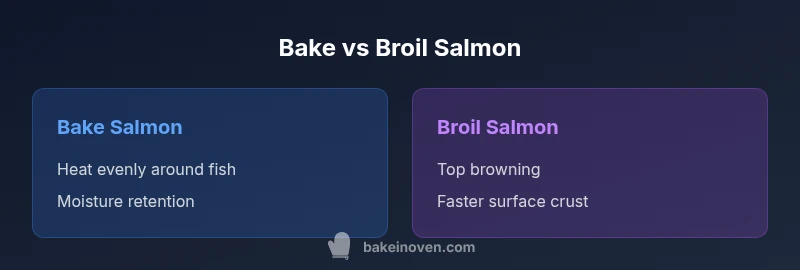
Bake or Broil Salmon: A Practical Comparison for Home Bakers
Discover the bake or broil salmon decision with kitchen-tested guidance from Bake In Oven. Compare texture, moisture, and crust to choose the best method for your fillet, thickness, and timing needs.


Friendly TL;DR: When you bake or broil salmon, you influence texture, moisture, and crust. Baking delivers even heat for juicy, uniform fish, while broiling delivers rapid browning and a crisp top. For home bakers, the choice depends on desired finish and available time. This quick comparison highlights the practical differences and outcomes you can expect.
Understanding bake or broil salmon: The practical fork in the kitchen
In home kitchens, the decision to bake or broil salmon often comes down to heat delivery, crust preference, and timing. The exact phrase bake or broil salmon appears in many recipes as a crossroads. In this context, the Bake In Oven team emphasizes that your choice shapes texture, moisture retention, and surface browning. For thick fillets, baking is typically the safer path to even cooking, while broiling offers a fast route to a caramelized top. By exploring the two methods side by side, home bakers gain a clear sense of what to expect from each approach.
In practice, many cooks ask: should you bake or broil salmon? The short answer is that the method you pick steers the final texture more than any single seasoning. Bake favors uniform doneness and juiciness; broil emphasizes surface browning and a crusty finish. With a little planning, you can use either approach to achieve restaurant-like results at home.
A key takeaway from Bake In Oven guidance is to start with a plan: thickness, whether the skin stays on, and how quickly you want to eat. If you’re cooking a thicker fillet, bake first to ensure the center cooks through. If you crave a golden top, finish with a brief broil. This balanced approach makes bake or broil salmon a flexible tool in your weeknight repertoire.
Comparison
| Feature | Bake Salmon | Broil Salmon |
|---|---|---|
| Heat approach | Even, moderate oven heat surrounds the fish | Intense radiant heat from the top surface |
| Crust formation | Minimal surface browning without finishing steps | Rapid browning and crust development on the exposed surface |
| Moisture retention | Tends to retain moisture with controlled timing | Moisture can escape quickly if overcooked |
| Time to cook | Longer overall cook time for thicker fillets | Faster for thin fillets or small portions |
| Doneness cues | Opaque, flaky interior when cooked through | Top browning coupled with interior doneness |
| Best for | Thick fillets and even doneness | Finishing with a crust on thinner pieces |
Benefits
- Reliable, even cooking with bake for thicker fillets
- Fast browning and crust development with broil
- Simple setup using standard oven and basic bakeware
- Good compatibility with parchment paper or foil for cleanup
- Can be incorporated into batch cooking without special equipment
Negatives
- Broiling can burn the surface quickly if not watched
- Baking may lack surface browning without finishing steps
- Thin fillets can dry out if overcooked in either method
- Requires attentive timing to avoid overcooking
Bake is the safer default for thickness and moisture; broil excels at finishing with a crust.
Choose bake when moisture and even doneness matter most, especially for thicker fillets. Switch to broil to add a browned crust quickly. With practice, you can blend both methods for the perfect salmon finish.
Frequently Asked Questions
What is the main difference between baking and broiling salmon?
Baking uses steady, surrounding heat for even doneness and moisture retention. Broiling uses intense top heat for rapid browning and crust formation. Your choice depends on whether you want even texture or a browned exterior. Both approaches work with careful timing and temperature control.
Baking gives even doneness; broiling gives a crusty top. Choose based on texture and time.
Can I switch from bake to broil mid-cook?
Yes, you can start by baking to cook the interior, then switch to broil for browning. Move the pan to a higher rack and watch closely for 1-3 minutes to achieve surface browning without burning.
You can finish with broil after baking to get a crust, but watch closely.
What temperatures are typical for bake vs broil?
Bake typically uses moderate oven temperatures (around 350-425°F), while broil uses high top heat (near the oven’s broil setting). Adjust based on fillet thickness and desired crust, and always verify doneness with a flake and translucence check.
Bake at moderate heat, Broil at high heat for browning.
Is salmon safe at 145°F (63°C)?
Yes. The widely accepted guideline is to cook fish to an internal temperature of 145°F (63°C) for safety and texture. Use a thermometer for accuracy and remove from heat a bit before this point if you prefer a slightly pinker center.
Fish is safe at 145°F; test with a thermometer.
Should I cook salmon with skin on or off for bake vs broil?
Cooking with skin on helps protect the flesh and adds flavor during baking. If you want a crisper top under broil, you can start skin-side down and finish skin-side up, or remove skin before finishing if you prefer a crisp surface.
Skin adds protection and flavor when baking; you can finish with crisp skin under broil.
Key Takeaways
- Choose bake for even doneness in thick fillets
- Use broil to finish with browning and crust
- Pair with parchment-paper or foil for easier cleanup
- Monitor closely to avoid overcooking, especially under broil
- Let salmon rest briefly to retain moisture before serving