Bake vs Convection Bake: A Practical Home-Baking Guide
Compare bake vs convect bake to optimize texture, time, and energy for home bakers. A practical Bake In Oven guide with tips, tables, and science. Insights.


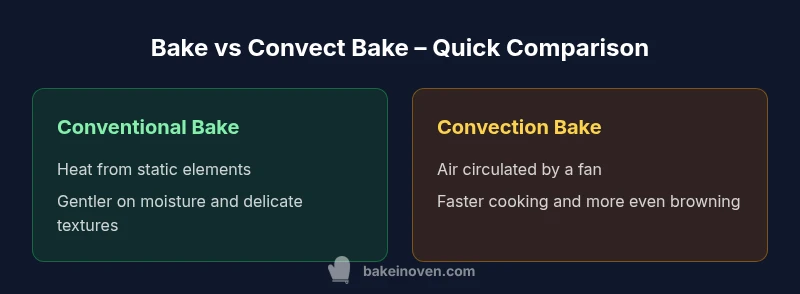
Summary: When deciding between bake vs convect bake, convection baking delivers faster cooking and more even browning by circulating hot air, while standard bake relies on radiant heat from stationary elements. Use convection for sheet-pan meals, cookies, and crusty pastries, and reserve traditional bake for delicate cakes and moisture-rich dishes.
Introduction to bake vs convect bake
For many home bakers, deciding between bake vs convect bake is a practical question that shapes texture, timing, and even energy use. The phrase bake vs convect bake captures a fundamental choice: should heat come from still air and radiant elements, or should hot air be circulated by a fan for faster, more even cooking? This article, written for home bakers and cooks, unpacks the science, the everyday realities, and the best-use cases for each approach. According to Bake In Oven, the decision isn't universal; it depends on the dish, the oven, and the texture you aim for. By understanding the strengths and limitations of each method, you can tailor your approach rather than rely on a one-size-fits-all rule. Over the years, we have tested hundreds of recipes—from loaves and pastries to casseroles and sheet-pan dinners—and the patterns become clear: convection shines when you want speed and crisp edges, while conventional baking helps preserve moisture and delicate crumb. Readers should view bake vs convect bake as a toolkit choice: pick the tool that yields the texture you want, then adjust accordingly. In the pages that follow, we provide a practical framework you can apply in any kitchen.
Comparison
| Feature | Conventional Bake | Convection Bake |
|---|---|---|
| Heat Source | Static radiant heat from elements | Air circulated by a fan around the food |
| Temperature Adjustments | Keep recipe temps or reduce slightly per guidance | Often kept the same or slightly lowered per recipe guidance |
| Cooking Time | Per recipe standard | Typically shorter when using convection |
| Texture Outcomes | Moist crumb and even rise with still air | Crispier crusts and even browning from airflow |
| Best For | Delicate cakes, custards, moisture-sensitive dishes | Roasted vegetables, cookies, sheet-pan meals, pastries |
| Ease of Use | Simple, fewer adjustments for many recipes | Requires planning and small adjustments for best results |
Benefits
- Faster cooking times with convection
- More even browning and crust formation
- Better for roasting vegetables and crisp pastries
- Can improve energy efficiency when used strategically
Negatives
- Not ideal for delicate cakes and moisture-sensitive desserts
- Requires recipe adjustments and careful monitoring
- Can over-brown or dry foods if misused
Convection bake is a powerful ally for speed and browning; conventional bake remains essential for delicate textures.
Convection is ideal when you want quick, even browning and faster sheet-pan results. Conventional bake preserves moisture and tenderness, which is critical for delicate cakes and custards. Use both as tools in a kitchen toolbox to match texture, timing, and outcomes.
Frequently Asked Questions
What is the main difference between bake and convection bake?
Conventional bake relies on static heat from elements, offering gentler, moister results. Convection bake uses a fan to circulate hot air, speeding cooking and promoting even browning. The choice affects texture and timing depending on the dish.
Conventional bake uses still air; convection adds a fan. Choose based on whether you want tenderness or speed and browning.
Can I use convection bake for all recipes?
Not every recipe benefits from convection. Delicate cakes, custards, and some moisture-rich dishes may suffer from dryness or uneven texture if convection is used inappropriately.
Convection isn’t ideal for every recipe—delicate items often do better with still air.
Do I need to adjust time when using convection bake?
Yes. Convection often requires shorter cooking times or lower temperatures. Start with modest adjustments and monitor doneness to avoid overcooking.
Yes, reduce time or temperature and watch closely as you bake.
Is convection bake better for bread?
Convection can help crust formation on some breads, but it may dry the crumb if not managed carefully. It’s best for breads with robust crusts and quicker bake times, while softer breads may benefit from conventional bake.
Convection can aid crust, but monitor crumb; use conventional for very soft crumb bread.
How do I know if my oven has convection mode?
Look for a fan icon or the word convection on the control panel. Some ovens label it as a convection bake setting or a fan-assisted mode.
Check the control panel for a convection label or a fan icon to identify the mode.
Are there energy savings with convection baking?
Convection can shorten cooking times, which can save energy, but preheating and batch size also influence overall consumption.
Yes, there can be energy savings from faster cooking, depending on use.
Key Takeaways
- Identify dishes that benefit from airflow and faster browning
- Always test and adjust temperatures when switching modes
- Use convection for cookies, roasted vegetables, and crusty pastries
- Reserve conventional bake for tender cakes and moisture-rich desserts