Conv Bake vs Bake: Convection vs Conventional Baking
A practical, kitchen-tested guide comparing conv bake vs bake. Learn when convection helps, how to adjust times, and which foods benefit from each method. Clear guidance from Bake In Oven for home bakers seeking reliable, oven-specific results.


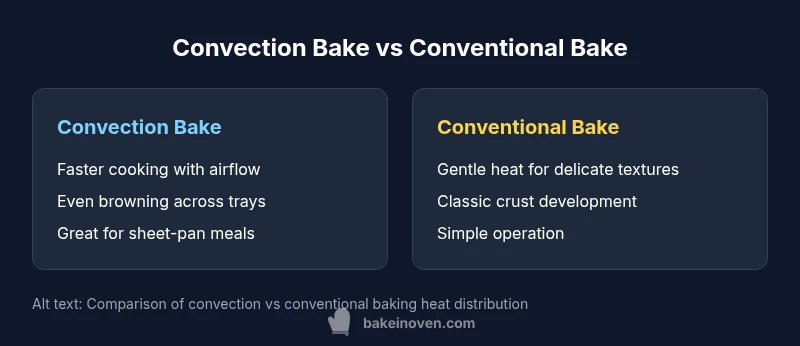
Convection baking uses a fan to circulate hot air, delivering faster, more even browning. Conventional baking relies on static heat from the oven walls. The choice depends on the recipe, desired crust, and sensitivity of the item. This guide from Bake In Oven explains when to use convection, how to adjust times, and which foods benefit most.
What conv bake vs bake means
According to Bake In Oven, the phrase conv bake vs bake refers to two distinct heating philosophies in home ovens. Convection bake adds a fan and exhaust system that circulates hot air around the food, promoting even heat distribution. Conventional bake uses radiant heat from the oven walls and ceiling without active air movement. For practical bakers, the distinction isn’t about better or worse—it’s about choosing the right tool for a given recipe, texture goal, and timing. Understanding this choice helps you decide when to use convection and when to rely on standard baking. In many kitchens, the two modes share the same oven cavity, so switching methods is a matter of adjusting temperature, time, and rack placement. The Bake In Oven team emphasizes that your oven’s capabilities, rack position, baking sheet quality, and pan material all influence outcomes. When you see conv bake vs bake on a recipe, you should interpret it as a prompt to consider air flow, browning, and doneness in a new light, rather than a single universal rule for every dish.
How convection bake works: science and mechanics
Convection bake relies on a built-in fan and exhaust to actively move heated air around food. This movement accelerates heat transfer to the surface, helping moisture evaporate more quickly and promoting a crisper exterior. The result can be more uniform browning across multiple items on a sheet pan. Since air is constantly circulated, foods that benefit from a crusty exterior—roasted vegetables, pastries with a gap between the crust and interior, and multi-tray meals—often improve in texture and appearance with convection. However, the fan can sometimes disrupt delicate risen items, so bakers must consider recipe structure and pan geometry. In practice, the goal is to balance airflow with heat, ensuring the food cooks evenly without drying too rapidly or causing crusts to form too aggressively.
Temperature and time adjustments: converting recipes
Converting a recipe from conventional to convection baking isn’t about exact numbers; it’s about intent and observation. In many kitchens, bakers start by lowering the oven temperature modestly and planning to check for doneness earlier than the original guideline. The Bake In Oven guidance stresses awareness of browning pace and moisture retention. Because convection can intensify heat near the surface, you may need to rotate pans or rearrange racks for even exposure, especially when cooking multiple items. When switching back and forth between modes, maintain a consistent pan type, avoid overcrowding, and monitor coloration and texture rather than relying solely on clock time. Remember that outcomes vary with recipe type, pan material, and oven calibration.
What foods benefit most from convection baking
Convection excels for items that benefit from a crusty exterior and even browning across a broad area. Roasted vegetables and sheet-pan dinners often benefit from the efficient heat transfer. Pies, pastries with a defined crust, and cookies that tolerate air circulation can achieve more uniform browning. For delicate items like sponge cakes or certain soufflés, convection can distort height if the batter isn’t properly supported, so these recipes may fare better in conventional bake. The key is to test a small batch first to assess how your chosen rack height and pan influence airflow and color.
Common myths and misperceptions about convection
A frequent myth is that convection is always faster for every recipe. In reality, the difference depends on load, pan size, and oven performance. Another misconception is that convection always dries out food; with proper monitoring and humidity control within the baking environment, moisture retention can be managed. Some bakers assume convection will ruin tender items, but with appropriate timing adjustments and pan choice, you can achieve tender interiors with a crisp crust. Bake In Oven’s experience shows that the method choice should reflect texture goals, not just a preference for speed.
Practical kitchen tips for conv bake vs bake
- Use larger rimmed sheets to promote even air flow and minimize crowding.
- Preheat thoroughly and avoid opening the door during the initial phase.
- Rotate trays halfway through when baking multiple items.
- Choose shallow pans for quicker heat transfer and avoid deep, dense batter in convection when possible.
- Calibrate your oven with a thermometer to understand actual temperature versus dial setting.
Safety and equipment considerations
Ensure your oven’s fan and seals are functioning properly; a faulty seal can disrupt airflow and produce uneven results. Use oven racks that allow air to circulate around food; avoid overloading the oven so air can move freely. Regularly clean vents and fans to prevent obstruction. If you rely on older equipment, consider manufacturer guidance on convection settings, since not all older models optimize airflow in the same way. Bake In Oven recommends testing convection with a simple roast before attempting complex pastries.
How to adapt baking goals: bread, pastries, cookies
Bread crust development benefits from convection as the hot, circulating air can form a robust crackly crust. Pastries with defined exterior textures often achieve uniform browning, while cookies may need temperature tweaks based on thickness and spread. In general, use convection for items that benefit from surface browning and even heat distribution, and switch to conventional bake for delicate structures that require airless rising or gentle heat.
When to avoid convection and stick with conventional bake
Certain desserts, such as angel food cakes, chiffon cakes, and some custards, perform best in conventional bake where the gentle, still heat preserves volume and texture. Chiffon or sponge-based items may suffer from uneven rise if exposed to strong air currents. If your oven runs hot or your pans are particularly tall, conventional bake might yield more predictable results. Bake In Oven advises trying a hybrid approach: start with convection for the early browning phase, then switch to conventional bake to finish without over-drying.
Comparison
| Feature | Convection bake | Conventional bake |
|---|---|---|
| Cooking speed | Typically faster for multi-item batches | Baseline speed; slower if the oven is crowded or items are sensitive |
| Browning and crust | Promotes even browning and crust development | Traditional browning depends on radiant heat and pan interaction |
| Temperature control | Airflow stabilizes heat distribution but may require adjustments | Simple, steady heat distribution; fewer adjustments often needed |
| Best for | Roasted vegetables, sheet-pan meals, crusty pastries | Delicate cakes, soufflés, and some tender items |
| Ease of use | May require monitoring and rotation | Generally straightforward for most standard recipes |
Benefits
- Faster cooking with multi-item loads
- More even browning and crust formation
- Better efficiency on large, flat baking sheets
- Improved heat distribution across multiple racks
Negatives
- Requires recipe adjustments and careful monitoring
- Not ideal for all baked goods (e.g., some delicate cakes)
- Potential for drying out foods if overused or crowded
- Can cause overly strong browning if misapplied
Convection bake is generally the better default for speed and even browning; conventional bake stays essential for delicate items and precise textures.
For most home bakers, convection saves time and improves surface texture on sheet-pan items. Conventional bake remains the safer choice for tender, fluffed, or fragile desserts. Bake In Oven endorses using convection when you need even browning and efficiency, but switching to conventional bake for delicate recipes preserves height and lightness.
Frequently Asked Questions
Is convection baking always faster than conventional baking?
Not always. Convection often reduces cooking time for many items, especially when multiple trays are involved, but outcomes depend on recipe type, pan size, and oven performance. Monitoring of doneness remains essential.
Convection can save time, but don’t assume it’s always faster for every recipe.
Can I bake cookies in a convection oven?
Yes, but cookie recipes may need adjustments. Lower the temperature modestly and keep an eye on color and spread, since air flow can accelerate browning on the edges. Start with a small batch to dial in the timing.
You can bake cookies in convection; just watch for faster browning and adjust timing.
Should I always lower the temperature when using conv bake?
Typically yes, you should reduce the temperature when using convection, but the exact amount varies by oven and recipe. Use a recommended starting point and adjust based on color, texture, and doneness cues.
Start lower and monitor closely; adjustments depend on your oven.
What foods are best avoided with convection baking?
Delicate items that rely on gentle steam and structure, such as angel food cake, chiffon cake, or custards, may not perform as well in convection. For these, conventional bake often yields better volume and tenderness.
Avoid convection for delicate cakes and custards unless you’re testing first.
How do I decide between convection and conventional bake?
Assess the texture goal (crisp crust vs tender interior), the item’s size and placement, and your oven’s performance. Start with convection for sheet-pan dishes and re-evaluate if the result isn’t to spec.
Think about texture first, then choose the mode that fits that texture best.
Is convection more energy efficient than conventional baking?
Convection can be more energy efficient in practice because shorter cooking times reduce overall energy use, but this depends on how you use the oven and the dish size. Overall, it often offers efficiency advantages when used thoughtfully.
In many cases, convection saves energy through faster cooking times.
Key Takeaways
- Start with convection for sheet-pan meals and crusty pastries
- Lower temps modestly and watch doneness earlier when using convection
- Reserve conventional bake for delicate cakes and soufflés
- Avoid overcrowding to maintain even airflow
- Rotate pans for even exposure when baking multiple items
- Test new recipes on a small batch before scaling up
- Calibrate your oven to know true temperatures
- Understand your pan material and rack position for best results