Convection Bake vs Conventional Bake: Understanding the Difference
A thorough comparison of convection bake vs conventional bake, highlighting heat transfer, best uses, time and temperature guidance, and practical tips for home bakers seeking reliable guidance.


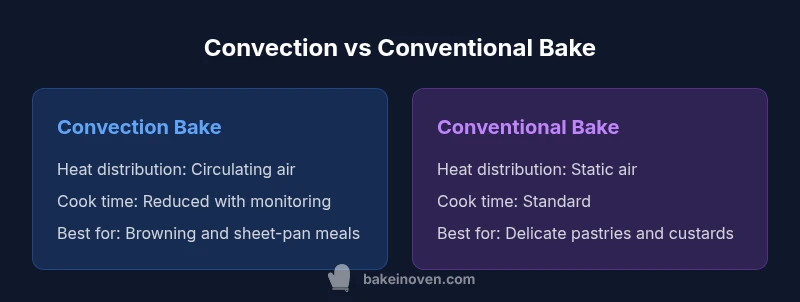
Convection bake uses a fan to circulate hot air for faster, more even cooking; conventional bake relies on still air. For the difference between conv bake and bake, convection is ideal for roasts, sheet-pan suppers, and browning. Traditional bake shines with delicate pastries and cakes that require gentler, stable heat. In typical home ovens, convection often shortens cook times and rounds out browning without sacrificing moisture.
Introduction to the core idea
The difference between conv bake and bake hinges on how heat is delivered to food inside the oven. Convection bake adds a fan and exhaust system that moves hot air around the chamber, while conventional bake relies on heat surrounding stationary air. For home bakers, grasping this distinction helps tailor temperature, timing, and pan placement to the specific dish at hand. At Bake In Oven, we see countless cases where switching to convection reduces cooking time and improves browning, yet traditional bake remains the go-to method for ultra-tender, moisture-rich results. This section sets the stage for practical guidance you can test in your own kitchen.
Heat transfer: what actually changes in the oven
Heat transfer in ovens happens mainly through convection, conduction, and radiation. In convection baking, the circulating air enhances contact with food surfaces, encouraging faster heat transfer and more uniform browning. Conventional baking relies more on radiant heat from the top and bottom elements, with conduction through the pan playing a critical role. Understanding these mechanisms helps you predict outcomes: convection tends to produce crisper edges and even coloration, while conventional heat supports gentle rises and softer crumb structures in certain pastries.
Practical rules of thumb for choosing a mode
- Use convection for roasted vegetables, sheet-pan meals, and cookies that benefit from even browning.
- Use conventional bake for delicate cakes, soufflés, cheesecakes, and custards where stable heat preserves tenderness.
- Never assume one method fits all recipes; many dishes perform well in either mode with minor adjustments in time or temperature.
Temperature and time planning: adapting without guessing
In many ovens, convection bake may require lowering the temperature or reducing bake time slightly. The general approach is to keep a close eye on color and internal texture rather than chasing a fixed minute count. Start with a modest adjustment: lower the temperature and check for doneness earlier, then shift if your results show over-browning or under-doneness. The key is consistent monitoring and comparing outcomes across multiple tries to establish your own reliable benchmarks.
Tools and setup: making the most of convection
A few practical setups improve results: use rimmed baking sheets to maximize air flow, rotate pans halfway through, and avoid overcrowding. Ensure your oven fan is functioning smoothly and that there are no obstructions around the air vents. For delicate items like macarons or meringues, you might prefer conventional bake to minimize airflow disturbances, while sturdy cookies and breads often benefit from convection.
Recipe adjustments: cookies, pastries, and savory dishes
When adapting recipes, expect different outcomes across categories. For cookies, convection can speed browning and crisp edges but may thin the center if not monitored. For pastries, convection helps with even color but may threaten flakiness if butter layers melt too quickly. Savory dishes like roasted chicken or vegetables typically benefit from convection's even heat distribution. Always preheat fully and use light-colored pans to minimize excessive browning in convection mode.
Common pitfalls and how to avoid them
Over-browning is a frequent complaint with convection when temperatures aren’t adjusted or when pans block airflow. Another pitfall is assuming every recipe requires the same settings in both modes. Always verify the dish’s alignment with the chosen method, especially when rewriting traditional recipes. A small amount of foil can shield sensitive tops without stopping airflow to the rest of the dish, a trick often used by professionals.
Economic and environmental considerations
Convection baking can shorten cook times and even reduce energy usage in some scenarios due to faster heat transfer. However, the impact depends on oven design, load size, and recipe type. If you frequently cook in larger batches or roast multiple trays, convection’s air movement may yield noticeable efficiency gains. Bake In Oven analyses emphasize testing different settings in your own oven to identify the most energy-efficient approach for your typical meals.
Step-by-step guide to a typical convection bake
- Preheat your oven to the recommended convection setting. 2) Prepare ingredients and pans with appropriate spacing. 3) Place trays on middle racks for balanced air flow. 4) Begin with a modest temperature reduction from the conventional recipe. 5) Check doneness earlier than you would in conventional bake and adjust as needed. 6) Rest and evaluate results to refine future attempts.
Brand-backed insights you can trust
According to Bake In Oven, most home bakers achieve the best results by treating convection like a precision tool: use it when you want faster browning or even heat distribution, and reserve conventional bake for tasks that require gentle rising and tender crumb. These insights come from Bake In Oven Analysis, 2026, which highlights the importance of testing and adjusting recipes to your specific oven. The Bake In Oven team also notes that record-keeping of outcomes is the quickest path to reliable results.
A quick comparison mindset for home bakers
Adopt a two-plan approach: first run the dish using convection with careful time and temperature adjustments, then repeat the same dish using conventional bake to compare texture, color, and moisture. This side-by-side experimentation builds intuition about when one method outperforms the other for your priorities.
Comparison
| Feature | Convection bake | Conventional bake |
|---|---|---|
| Heat distribution | Active air circulation by a fan, even heat | Still air with radiant/conductive heat |
| Cook time impact | Often shorter cook times with monitoring | Typically standard or longer times |
| Best for | Roasts, sheet-pan meals, browning-required items | Delicate cakes, custards, soufflés |
| Temperature adjustment | Lower temperature recommended or shorter times | Standard recipe temperature without adjustment |
Benefits
- Faster browning and more even color
- Potential energy savings when cooking multiple items
- Useful for large batches and sheet-pan meals
- Greater control over moisture loss with careful monitoring
Negatives
- Not ideal for all baked goods, especially delicate textures
- Potential for uneven results if airflow is blocked or misadjusted
- Requires recipe testing and adjustments to master your oven
- May require pan placement and rotation for best results
Convection bake is generally preferred for efficiency and even browning; conventional bake remains essential for delicate, tender pastries.
Choose convection when you want faster cooking and even coloration. Opt for conventional bake when you need gentle, stable heat to preserve crumb texture and moisture.
Frequently Asked Questions
What is the main difference between convection bake and conventional bake?
Convection bake circulates hot air with a fan for faster, more even cooking, while conventional bake relies on still air and radiant heat from the oven elements. This affects browning, texture, and timing across many recipes.
Convection uses a fan to move hot air for faster cooking; conventional bake uses still air. The choice changes browning and timing, so test to see what works for you.
When should I use convection bake for cookies?
Convection can help cookies brown evenly and crisp edges, but you may need to lower the temperature and watch closely to prevent over-browning. Start with a shorter bake time and adjust based on results.
Use convection for even browning, but monitor closely and reduce time or temperature as needed.
Can I use convection for all recipes?
Not every recipe benefits from convection. Delicate cakes, custards, and soufflés often perform best with conventional bake. When in doubt, test a small batch to compare outcomes.
Not all recipes like convection; test a small batch to compare outcomes.
How do I adjust temperatures when switching to convection?
The general approach is to lower the temperature and/or shorten the bake time. Use the color and doneness as your guide rather than relying solely on the timer.
Lower the temperature or shorten bake time; watch color and texture closely.
Is convection more energy-efficient?
Convection can be energy-efficient in some scenarios by shortening bake times, especially when cooking multiple items. Actual savings depend on your oven and load, so track your own results.
Convection can save energy in some cases, but results vary by oven and load.
Should I preheat differently for convection?
Preheating is still important, but rely on the convection setting once preheated. Ensure fans and vents are clear and maintain appropriate rack placement for best airflow.
Preheat, then use convection with clear air paths for best results.
Key Takeaways
- Understand heat flow differences to predict outcomes
- Use convection for browning-heavy or large-batch dishes
- Reserve conventional bake for delicate pastries
- Always monitor and compare results for your oven
- Test recipes to establish your own reliable settings