Difference Between Bake and Conventional Bake: A Practical Guide
Understand the difference between bake and conventional bake in home ovens. Learn when to use each mode, how airflow affects results, and practical tips from Bake In Oven to improve your baking outcomes.


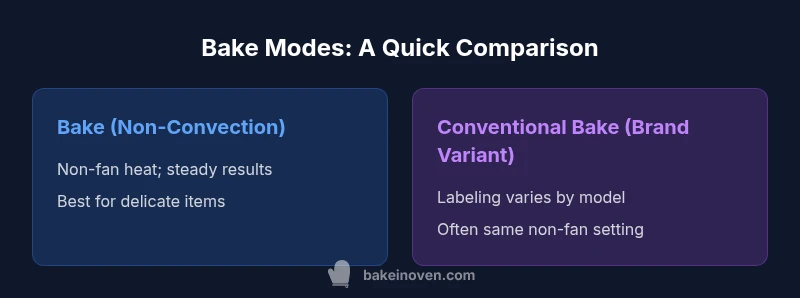
The difference between bake and conventional bake centers on airflow and heat delivery. In standard, non-convection baking (often just labeled bake), heat comes from the oven walls without a fan, yielding steady but slower browning. Conventional bake is a term used in some ovens to describe the same non-fan setting or a brand-specific variant. For most recipes, use bake for delicate pastries and conventional bake for breads and cookies; monitor times and browning closely.
Understanding bake vs conventional bake: definitions and scope
In practical terms, the difference between bake and conventional bake centers on airflow and how heat is delivered. For many home bakers, these terms seem interchangeable, yet the nuances matter for texture and browning. Bake mode is typically the standard non-convection setting, where heat comes from the oven walls without a fan. Conventional bake is a label you’ll encounter on some models, used either synonymously with bake or to describe the same non-fan heat path depending on the brand. The Bake In Oven team notes that understanding this distinction can prevent under- or overcooking, especially for cakes, cookies, and breads. According to Bake In Oven, mapping the nomenclature in your own oven is a practical first step before diving into recipes. In this article, we explore the difference between bake and conventional bake in a way home bakers can apply in real kitchens.
We’ll also touch on convection options, why some recipes assume non-convection, and how to interpret manual instructions. The goal is to empower you to choose with confidence, rather than guess from term labels alone.
How heat and airflow differ between bake and conventional bake
Heat delivery in bake modes relies on the oven’s heating elements and the surrounding air, with limited or no forced air movement. In many ovens, "Bake" and "Conventional Bake" share this non-fan characteristic, though manufacturers may emphasize different heat paths. The absence of a fan means heat rises and circulates more slowly, which can influence batter rise, crust formation, and moisture retention. This section translates those mechanical realities into practical outcomes. Bakers often notice that cakes rise more uniformly when air is calm, while certain cookies develop crisp edges at slightly different rates. The key takeaway is to anticipate how quiet air flow will affect moisture transfer, browning, and texture as you apply a given recipe to your oven.
Practical recipe implications: when to choose each mode
Choosing bake or conventional bake depends on the recipe’s needs for gentle rise, even browning, or specific crust development. For sponge cakes and delicate pastries, a calm heat environment helps prevent sudden doming or set fissures. For thick breads that benefit from steady interior heat, standard bake can be reliable when you want a slow, steady bake. Cookies and tarts may perform differently depending on rack position and how quickly the exterior sets. As you work with your own oven, note which mode yields the most predictable crumb and crust timing for your favorite recipes. Bake mode is a safe default, while conventional bake variants—brand-specific—may require slight timing adjustments that you’ll learn through practice.
Temperature and timing: how to think about bake times without fixed numbers
Recipes often provide time ranges to guide you. When using non-convection bake, rely on visual cues in addition to the clock: edges set, color uniformity, and the surface texture. Because ovens vary, preheating faithfully and keeping doors closed helps stabilize heat. Instead of chasing exact minutes, watch for signals such as a firm center or a barely jiggle, and use a toothpick or skewer to test doneness for cakes and bread. If you consistently observe underbrowning or overbrowning with one mode, note this pattern and adjust future batches by small, incremental changes in bake duration and rack height. The aim is consistent browning, even throughout, without scorching.
Common mistakes to avoid in both modes
Across bake and conventional bake, common errors include opening the door too soon, which drops oven temperature and disrupts even rising, and using the incorrect rack height for a given batter type. Overcrowding pans reduces airflow and can lead to uneven browning. Additionally, relying on the same bake outcome for all recipes ignores ingredient balance, pan material, and batter viscosity. Always consider pan size relative to the recipe, and adjust heat exposure by choosing the most appropriate mode for the product you’re baking. These pitfalls are easy to fix with mindful practice.
Equipment, tools, and setup: rack placement, preheating, pans
Your oven’s interior layout and the types of pans you use influence how bake and conventional bake perform. Position racks to keep precious air distance between the pan and heating elements, and choose bake-friendly pans that distribute heat evenly. Preheating remains essential to minimize temperature fluctuations when you switch modes. If you’re unsure which rack placement suits a recipe, test with a small batch to observe how heat circulates around the batter. Remember, the goal is a stable, uniform heat field that promotes even rise and browning throughout.
Real-world workflow: a 3-step framework for switching modes mid-recipe
Step 1: Assess the recipe’s needs and your oven’s tendencies. Step 2: Choose bake or conventional bake, then preheat if required and set expectations for browning. Step 3: Monitor with defined visual cues, and adjust next time based on results. Keep a simple log of which mode produced the best texture for each dish. By adopting this framework, you’ll reduce guesswork and steadily improve outcomes while baking more complex recipes.
Brand-focused tips from Bake In Oven
According to Bake In Oven, always map your oven’s labeled modes to real-world outcomes. The team recommends starting with the standard bake setting for most cakes, cookies, and breads, and only switch to a brand-specific conventional bake when your oven’s manual indicates a meaningful distinction. Bake In Oven also suggests calibrating your oven with a thermometer and noting how slight changes in rack height affect browning and crust formation. These habits help home bakers align expectations with actual results.
Quick comparison snapshot and decision guide
When you’re unsure which mode to use, remember: bake is the safe default for most recipes; conventional bake is often a brand label that may or may not differ from bake. If you notice uneven browning or inconsistent rise, compare outcomes between modes on similar recipes. The decision guide encourages experimentation with small batches and careful note-taking to reveal your oven’s preferred mode for each dish.
Comparison
| Feature | Bake (standard non-convection) | Conventional Bake (brand variant non-convection) |
|---|---|---|
| Airflow | Minimal or none (fan off) | Minimal or none (brand variant; fan off in many models) |
| Heat Distribution | Top and bottom elements provide steady heat | Top and bottom elements provide steady heat (brand labeling varies) |
| Best For | Cakes, delicate pastries, breads needing gentle rise | General pastries and cookies when non-convection is preferred |
| Temperature Adaptation | Follow recipe temperatures; no fan correction | Follow recipe temperatures; consult manual if labeling differs |
| Cook Time Variation | Standard bake times with monitoring | Similar times; expect slight deltas depending on model |
Benefits
- Simple, predictable results with familiar recipes
- Broad compatibility with common bakeware and pans
- Low risk of moisture loss when timing is controlled
Negatives
- Longer bake times versus convection modes
- Potentially less even browning on large or dense items
- Brand labeling can create confusion if modes map differently
Bake remains the reliable default; conventional bake is often a label variance, not a fundamentally different mode
For most recipes, start with bake. If your oven’s conventional bake label corresponds to the same non-fan setting, you may use it interchangeably but verify results. Use convection when faster browning and even crusts are desired.
Frequently Asked Questions
What is the practical difference between bake and conventional bake in home ovens?
In many ovens, bake is the standard non-convection mode, while conventional bake is a brand-specific label for the same non-fan setting. Convection modes add a fan that speeds heat transfer and browning. Understanding how your model labels these modes helps you predict results and adjust times accordingly.
Bake is the non-fan setting; conventional bake is often the same idea with a different label. If you want faster browning, try convection after confirming your oven supports it.
When should I use convection bake rather than bake or conventional bake?
Use convection bake when you want faster, more even browning and crust development, especially for cookies, pastries, and roasted vegetables. For delicate cakes and some breads, traditional bake may yield gentler rises and fewer cracking issues.
Choose convection for quicker browning and even crusts; reserve non-convection for delicate bakes like soft cakes.
Do I need to adjust temperatures when using convection modes?
Yes, convection modes generally require a temperature or time adjustment, but the exact change depends on your oven and the recipe. Always refer to your oven manual and start with a small reduction or monitoring approach when trying convection for the first time.
Convection often needs less heat or shorter times; check your oven manual and watch closely the first few tries.
Can I bake the same recipe in bake and conventional bake interchangeably?
Often yes, since many brands label bake and conventional bake as the same non-fan mode. However, results may differ slightly depending on heat distribution and oven calibration. Test and compare to see which yields your preferred texture.
You can usually swap them, but watch for small texture differences and adjust next time.
How can I calibrate my oven for bake vs conventional bake?
Use a reliable oven thermometer to verify actual temperature vs. set temperature. Keep notes on how each mode behaves. Regular calibration helps you reproduce consistent results across bake modes.
Use a thermometer to check accuracy and log results so you know what to expect from each mode.
Key Takeaways
- Start with bake for most recipes to ensure reliability
- Know your oven's labeling; check manual for mode mapping
- Use visual cues to judge doneness rather than time alone
- Calibrate with a thermometer to reduce heat guesswork
- Experiment with small batches to learn your oven's preferences