Whats the difference between conventional bake and regular bake: An analytical comparison
Explore the nuanced distinction between conventional bake and regular bake. This analytical guide clarifies terminology, heat delivery, and practical implications for everyday baking.


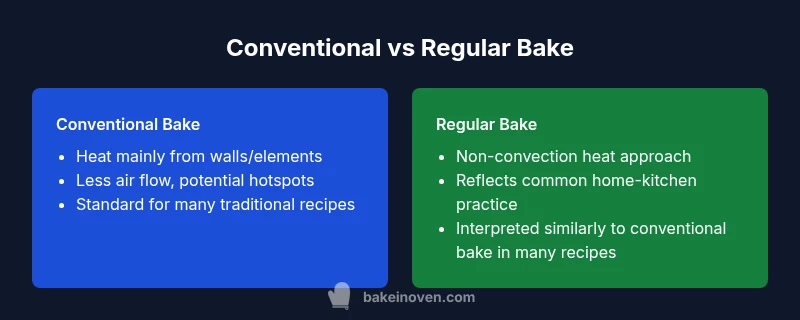
What many home bakers call a “regular bake” is often just a non-convection, conventional bake using radiant heat from the oven walls. The term “conventional bake” more formally describes this standard dry-heat method, while some recipes use “regular bake” interchangeably. In practice, the outcomes hinge on your oven’s accuracy, rack position, and the recipe’s intent. Bake In Oven’s analysis shows that when convection is not used, heat distribution relies on natural air movement, making timing more sensitive to rack height and pan type. For most everyday bakes, the two terms describe the same basic approach, but awareness of subtle differences helps you predict browning, moisture retention, and texture.
whats the difference between conventional bake and regular bake
The exact wording matters less than the practical implications for home bakers. In many kitchens, what is labeled as a conventional bake is the non-convection, standard dry-heat method that relies on radiant heat from the oven walls. The phrase “regular bake” is used by some home cooks and recipe writers to describe the same process without fan-assisted heat. According to Bake In Oven, the distinction is often semantic, but the nuance surfaces when you consider heat distribution, browning, and moisture loss. Knowing this helps you interpret recipes more accurately and decide when a method swap is appropriate. The key question is whether your oven’s heating elements are attempting to distribute heat evenly without a fan or if you need enhanced air circulation for certain baked goods.
From a practical perspective, the terms matter most when you are troubleshooting. If your pan is browning too quickly or the center remains undercooked, you may be dealing with heat hotspots or an oven that runs hot or cold. In those moments, the difference between conventional and regular bake becomes a matter of calibration rather than a linguistic distinction.
Historical context and terminology trends
Terminology in baking has evolved with oven technology. Traditional, non-convection ovens used in most households relied on radiant heat and natural convection from the warm air rising. Early recipes often described this as the standard bake method. As convection ovens gained popularity, manufacturers and culinary writers began distinguishing between non-convection (conventional) and convection baking. The phrase “regular bake” popped up in home-kitchen contexts to emphasize the method without using technical terms. Bake In Oven notes that many cooks still default to their mental model of a simple bake, which can blur when a recipe explicitly calls for convection or air-flow adjustments. Understanding the historical usage helps you make educated substitutions and adjust times accordingly.
Heat delivery and outcomes: Conventional vs Regular Bake
Conventional bake delivers heat primarily through radiant elements with ambient air movement. Without a fan, hot air tends to stratify, which can lead to uneven browning if you place a pan too high or too low. Regular bake typically follows the same non-convection path, but some recipes use the term to indicate a familiar, home-kitchen approach that assumes modest air circulation. The Bake In Oven team emphasizes that outcomes hinge on pan geometry, rack position, and oven calibration. For delicate items like soufflés or custards, subtle temperature control and even heat distribution matter more than the label attached to the bake mode.
Recipe interpretation: how to tell which method your recipe implies
To interpret a recipe correctly, check the temperature guidance, bake time, and any notes about browning or moisture. If a recipe states a temperature with no fan symbol or convection note, it is likely intended for conventional/regular bake. If it mentions a convection setting (often labeled “convection bake” or includes a fan symbol), you should use the convection method. If you’re unsure, a practical rule is to start with the conventional method and observe the crust and center, then adjust as needed. Keeping a baking diary helps you refine the assumptions you make when encountering ambiguous terms.
Practical scenarios: cookies, breads, casseroles
Cookies: Conventional bake yields a reliable, uniform spread when you maintain even heat and avoid overcrowding. Bread: Traditional loaves can brown nicely under non-convection heat, but loaf structure benefits from careful heat distribution to avoid a pale bottom. Casseroles: Non-convection baking can preserve moisture but may require longer bake times or tenting to prevent top scorching. In each scenario, understanding whether the oven is truly non-convection matters for predicting browning and texture.
How to adjust times and temperatures when swapping methods
When swapping between conventional and convection, you typically reduce temperatures by 20–25°F (about 10–15°C) for convection and extend times slightly for non-convection. If a recipe provides a precise bake time for conventional heat, monitor for changes in color and internal temperature rather than relying solely on the clock. Pan material and thickness can amplify these adjustments: dark, heavy pans heat differently than light-colored, thin ones. Calibrating your oven with an independent thermometer helps you account for any drift over time.
Common myths and misconceptions
Myth: Convection is always superior for every bake. Truth: Some recipes benefit from gentle, non-convection heat to maintain moisture and prevent over-browning. Myth: Regular bake can’t brown effectively. Truth: Proper heat management and pan positioning can yield crisp, golden crusts without a fan. Myth: You should always follow the label on your oven. Truth: Oven performance varies by model, altitude, and rack placement, so adjustments are often necessary for consistent results.
Best practices and quick-start guidelines
- Know your oven: get it calibrated and verify interior temperatures with a reliable thermometer.
- Start with conventional/regular bake unless the recipe specifies convection.
- Use the right pan and rack height to promote even browning.
- If converting a recipe to convection, drop the temperature and reduce time cautiously while watching color and texture.
- Keep notes in a baking journal to track how your appliance and pan choices influence outcomes.
Troubleshooting and adjustments if results are off
If browning is uneven, rotate pans or adjust rack positions between batches. If moisture seems too high, consider a longer bake with a slightly raised rack to encourage evaporation. If crusts are too dark before the center firms, reduce temperature further or tent with foil to protect the top. Consistency comes from a repeatable routine: preheat properly, verify with a thermometer, and document deviations and how you corrected them.
When to choose each method for best results
Choose conventional/regular bake for classic, reliable outcomes with familiar textures and browning patterns. Opt for convection when you want faster, more even browning and a crisper crust on high-moisture items like roasted vegetables or pastries that benefit from air flow. The right choice depends on the recipe’s intent, your oven’s performance, and how comfortable you are with adjusting time and temperature. Bake In Oven recommends starting with how the recipe intends the bake to end and then adjusting to your specific oven.
Comparison
| Feature | Conventional bake | Regular bake | ||
|---|---|---|---|---|
| Heat source | Radiant heat from oven walls/elements | Radiant heat from oven walls/elements | ||
| Heat distribution | Less air circulation; relies on natural convection | Same non-convection behavior; typically no fan | values | |
| Typical use-cases | Standard baking without fan assistance | Standard baking without fan assistance | ||
| Best for texture | Even browning without excessive crust | Even browning without excessive crust | ||
| Energy usage | Depends on oven, usually moderate | Depends on oven, usually moderate | ||
| Best for recipes | Cakes, cookies, casseroles relying on dry heat | Cakes, cookies, casseroles relying on dry heat |
Benefits
- Low equipment requirements for traditional recipes
- Predictable outcomes with familiar textures
- Broad compatibility with most ovens and pans
- No need to manage fan-induced air flow for delicate bakes
Negatives
- Potential for uneven browning without air flow
- Longer bake times for some items
- Limited control over crust formation in moisture-rich foods
Conventional bake remains the reliable default for most home bakers
Conventional bake is best when you want predictable results using standard equipment. Regular bake, as a label, often points to the same non-convection method, with outcomes driven by oven calibration and rack positioning. For many recipes, either term describes the same approach; the key is understanding your oven and monitoring color, texture, and internal temperature.
Frequently Asked Questions
What is the main difference between conventional bake and regular bake?
In practice, many bakers use 'conventional bake' and 'regular bake' to describe non-convection baking with radiant heat. The terms are often used interchangeably, so the real difference lies in how your oven distributes heat. Understanding your oven's behavior helps you anticipate browning and moisture loss.
Conventional and regular bake usually mean non-convection baking. The difference is mostly in terminology; watch how your oven browns and adjust accordingly.
Do convection ovens use a 'regular bake' setting?
Convection ovens often have a separate convection bake setting. When a recipe specifies regular bake, it typically means non-convection heat. If you are unsure, start with conventional methods and monitor progress closely.
Convection is a separate option; regular bake usually means non-convection heat. Start with conventional heat and watch closely.
When should I choose conventional bake over convection?
Choose conventional bake when you want even texture without aggressive air movement—especially for delicate pastries, custards, and recipes that rely on steady heat. Convection is better for achieving quick browning and crisper crusts when moisture is not the top priority.
Go conventional for delicate textures; convection for crisper, faster browning.
Can I substitute one method for the other in a recipe?
Substituting may require temperature and time adjustments. If you switch from conventional to convection, lower the temperature by about 20–25°F (10–15°C) and check earlier for doneness. Conversely, when moving from convection to conventional, increase time slightly and monitor color and internal temperature.
If you swap methods, lower convection temperature and watch closely; adjust time as needed.
Are there foods that perform better with one method?
Yes. Pastry creams and delicate cakes often fare well with non-convection heat to preserve moisture, while roasted vegetables and pies with bulkier crusts often benefit from convection to improve browning and crust texture.
Some recipes prefer conventional heat for softness; convection helps browning and crusts.
What are common signs that conventional bake is not working well for a recipe?
Common signs include uneven browning, a pale bottom, or a center that remains undercooked. If you notice hot spots, rotate pans or reposition racks, and recheck temperatures with a thermometer to ensure accuracy.
Look for uneven browning or undercooked centers; adjust rack position and verify oven temp.
Key Takeaways
- Identify the intended bake method by recipe notes and oven type
- Calibrate your oven for accurate temperatures
- Rotate pans to counteract heat hotspots
- Swap methods only with mindful time/temperature adjustments
- Keep notes to improve future results