What is convection bake vs bake? A practical comparison for home bakers
Compare convection bake and conventional baking to understand heat flow, timing, and best uses. Learn how to choose between faster, browner results and delicate, steady rises for home baking success.


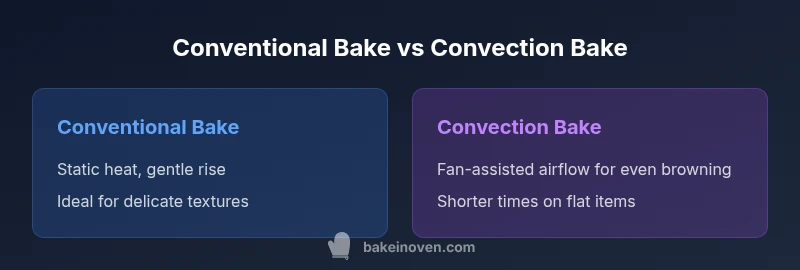
Convection bake uses a fan and exhaust to circulate hot air, speeding cooking and promoting even browning. Traditional bake relies on radiant heat from oven elements with little air movement. The core difference is air movement: convection shortens times and enhances browning, while conventional baking offers gentler, steadier heat for delicate textures. Use convection for sheet-pan meals and roasts; choose conventional for cakes and soufflés. See the full chart for details.
What is convection bake vs bake? A clear definition
Convection bake deliberately moves hot air around the oven cavity with a fan and an exhaust system. This circulation accelerates heat transfer to the food surface, creating faster browning and more uniform results. Conventional baking relies on still air heated by the oven's elements, so heat transfer happens mainly through radiant heat and natural convection inside the closed oven. The practical takeaway is simple: convection air movement affects how quickly items heat and brown, while conventional baking leans on steady heat for controlled rise and texture. When you ask what is convection bake vs bake, you’re comparing two heating philosophies that ultimately shape texture, crust, and even moisture retention in your baked goods.
How heat moves inside an oven: conduction, convection, and radiation
Heat in any oven travels by three mechanisms. Conduction transfers heat through pans and dough; radiation warms from the oven walls and top/bottom elements; convection uses a fan to push hot air across the food surface. In a convection bake, the air movement elevates the heat transfer coefficient, pushing surfaces toward browning and crispness faster than a conventional bake. This is why convection excels for sheet-pan cookies, roasted vegetables, and thin-crust pizzas. In contrast, conventional baking relies on slower, more uniform heat that favors even rise and gentle moisture retention, which is advantageous for cakes and delicate pastries.
When to favor convection and when to avoid it
Choosing between convection and conventional baking depends on the goal. Convection shines for foods that benefit from rapid browning and even surface texture: cookies, roasted vegetables, crispy edges on pastries, and most flat, wide items. If you’re seeking a tall, soft crumb with a delicate rise—think chiffon cakes, soufflés, and some yeast breads—conventional baking reduces the risk of uneven results. In this section, we stay objective: convection offers speed and evenness, while conventional bake preserves tenderness and height in certain recipes.
How to adjust recipes for convection without guesswork
A practical approach to using convection is to start by relying on the recipe’s temperature and time as a baseline, then observe and adjust. In many cases, you will want to lower the oven temperature or shorten the bake time when moving from conventional to convection, and you should avoid overcrowding the rack to ensure proper airflow. For delicate items, consider using a lower fan setting if available or switching to conventional mode mid-bake. These adjustments help mitigate over-browning and uneven leavening while still leveraging convection benefits.
Real-world baking scenarios: 4 common cases
- Cookies and pastries on a sheet pan: convection helps cookies bake evenly and crisp edges. 2) Roasted vegetables and proteins: convection promotes even browning and a faster cook. 3) Cakes and delicate batters: conventional bake supports stable rise and uniform crumb. 4) Thin breads and flatbreads: convection can shorten bake time and enhance crust color. In each case, observe the food closely and use a timer as a guide rather than a fixed rule.
Practical steps to build intuition with your oven
- Start with a small test batch when trying convection for a new recipe.
- Use the center rack for even airflow; avoid stacking food.
- Ensure lids are off and pans are uncovered to maximize air exposure.
- Keep notes on bake times and crust color to guide future attempts. Over a few batches, you’ll build a reliable sense of when to switch modes and how to adjust temperatures.
Myths and realities about convection baking
Common myths say convection always browns faster or dries foods. The truth is nuance: convection increases heat transfer efficiency, which can speed browning and moisture loss if not managed. Proper guidance—using appropriate rack positions, avoiding overcrowding, and tuning time and temperature—lets you exploit convection without sacrificing crumb or moisture. Bake In Oven’s practical guidance emphasizes testing and adjusting to your specific oven.
Comparative summary: what matters most for outcomes
If your priority is speed and consistent surface browning on flat items, convection is your friend. If you need tall, tender crumb and gentle rise, conventional baking remains the safer choice. The best approach is to understand your oven’s quirks, then choose the mode that aligns with texture, moisture, and crust goals for each recipe.
Comparison
| Feature | Conventional Bake | Convection Bake |
|---|---|---|
| Heat source and circulation | Static radiant heat with limited air movement | Forced air circulation via a fan and exhaust |
| Temperature adjustment | Follow recipe temps as written | Often lower temperature or shorter time (per recipe guidance) |
| Cooking times | Standard times (may be longer for some items) | Typically shorter due to faster heat transfer |
| Best for | Delicate cakes, soufflés, and items needing steady rise | Cookies, sheet-pan meals, and crispy surfaces |
| Pan and rack considerations | Open pans and glass dishes common; space matters for even heat | Aeration favored by metal racks; avoid crowding |
Benefits
- Faster cooking and more even browning for many items
- Better surface texture on sheet-pan items and cookies
- Can reduce overall oven time and energy use
- Improves browning and crust formation when used correctly
Negatives
- Tall cakes and delicate batters may rise unevenly
- Not all recipes benefit; airflow can disrupt fragile textures
- Requires adjustments to temperatures and times
- Overcrowding or obstructed airflow can negate benefits
Convection bake generally offers faster, more even browning, but conventional baking remains superior for delicate textures
Choose convection for flat, wide items and roasting; favor conventional baking for cakes and delicate pastries. Start with modest adjustments and test in small batches.
Frequently Asked Questions
What is convection bake vs bake?
Convection bake uses a fan to circulate hot air, speeding cooking and improving browning. Conventional bake relies on still air heated by elements. The choice depends on desired texture and color, with convection favored for cookies and roasts and conventional ideal for delicate cakes.
Convection bake moves hot air with a fan for faster cooking and browner edges. Conventional bake uses still air for a gentler bake. Choose convection for browning, conventional for delicate textures.
Can I convert conventional recipes to convection without changing times?
Yes, you can convert many conventional recipes to convection by lowering the temperature and watching the bake time closely. Start with a small reduction and use sensory cues like color and doneness rather than relying solely on the clock.
Yes—lower the temperature and monitor doneness closely when converting to convection.
Do all ovens have convection?
Most modern ovens include a convection setting, but some older models do not. If your oven lacks a convection option, you can simulate it by using a baking stone and rotating the pan for air exposure, though results won’t be identical.
Most modern ovens have convection, but not all older models do.
Which is best for baking cookies?
Convection is often ideal for cookies due to even heat and browning. Space cookies evenly on sheets and avoid overcrowding to maximize airflow and consistency.
Convection usually gives cookies even browning; space them well.
Will convection bake dry out bread?
Convection can dry crusts if mismanaged. To minimize dryness, keep oven humidity balanced, avoid overbaking, and consider finishing some loaves with conventional mode if you need a softer crumb.
Convection can dry bread if overbaked; manage timing and humidity.
Should I use convection for tall cakes?
Tall, delicate cakes often benefit from conventional baking to ensure an even rise and uniform crumb. If you try convection, monitor closely and consider using mid-bake mode or lower fan speed.
Conventional is usually better for tall cakes; if using convection, watch closely.
Key Takeaways
- Understand how heat moves: convection adds air movement
- Tailor mode choice to texture and bake goal
- Adjust temperature and time when switching modes
- Test new recipes with small batches first