Is Bake or Convection Bake Better? A Practical Guide for Home Bakers
Discover whether bake or convection bake is better for home ovens. Analytical guidance, adjustments, and recipes to optimize texture, browning, and cooking times.


According to Bake In Oven, convection baking typically delivers faster cooking and more even browning by circulating air, while traditional bake remains gentler on delicate batters. For cookies, roasted vegetables, and casseroles, convection often wins on speed and crust. For cakes, custards, and tender breads, traditional bake can yield softer textures. Use convection with careful temperature and time adjustments when appropriate.
Is Bake vs Convection Bake: The Core Difference
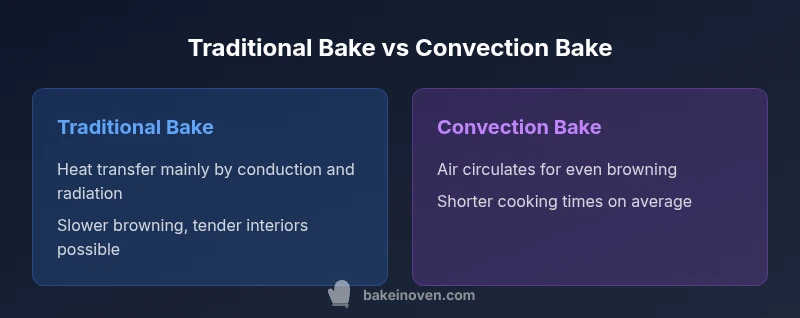
In home ovens, the terms bake and convection bake describe two distinct heat-delivery philosophies. A standard bake mode relies on radiant heat from elements and walls to cook food, with heat diffusing outward. Convection bake adds a fan (and usually an exhaust) that circulates hot air around the food. That circulation accelerates heat transfer, promotes more even browning, and can shorten overall cook times. If you’re asking is bake or convection bake better, the answer hinges on texture goals, the type of dish, and your oven’s quirks. The Bake In Oven team notes that convection shines for sheet-pan meals and items that crave crisp edges, while traditional bake tends to be more forgiving for ultra-tender interiors. Understanding these physics helps you predict outcomes before you even preheat.
Is Bake vs Convection Bake: The Core Difference
In home ovens, the terms bake and convection bake describe two distinct heat-delivery philosophies. A standard bake mode relies on radiant heat from elements and walls to cook food, with heat diffusing outward. Convection bake adds a fan (and usually an exhaust) that circulates hot air around the food. That circulation accelerates heat transfer, promotes more even browning, and can shorten overall cook times. If you’re asking is bake or convection bake better, the answer hinges on texture goals, the type of dish, and your oven’s quirks. The Bake In Oven team notes that convection shines for sheet-pan meals and items that crave crisp edges, while traditional bake tends to be more forgiving for ultra-tender interiors. Understanding these physics helps you predict outcomes before you even preheat.
Comparison
| Feature | Traditional bake | Convection bake |
|---|---|---|
| Heat transfer | Radiant heat with natural air circulation; no fan | Forced air circulation with a fan for faster heat transfer |
| Browning and crust | Slower browning; crust forms through conduction and moisture loss | Quicker, more uniform browning and crisper edges |
| Best for | Delicate cakes, custards, meringues, soft breads | Cookies, roasted vegetables, casseroles, sheet-pan meals |
| Timing | Often longer bake times depending on recipe | Tends to shorten overall cooking time |
| Temperature adjustments | Usually minimal changes; follow recipe guidance | Typically lower temperature recommended; monitor early |
| Energy use | Depends on oven and recipe | Can save time, potentially energy due to shorter cycles |
| Equipment | Standard oven mode suffices | Requires working convection fan; not all ovens perform equally |
Benefits
- Faster cooking times for many dishes
- More even browning and crust development
- Better air circulation helps with sheet-pan efficiency
- Can reduce overall cooking time in multi-dish batches
- Potential energy savings from shorter cycles
Negatives
- Not ideal for ultra-delicate or tall cakes
- Some recipes rely on gentle heat and may dry out
- Requires recipe adjustments and observation to avoid over-browning
Convection bake is the versatile default for many home bakers; traditional bake remains essential for delicate textures.
Choose convection when speed and even browning matter most. Opt for traditional bake for tender interiors and recipes designed without a fan.
Frequently Asked Questions
Can I convert any recipe to convection bake?
Most recipes can be adapted to convection bake by lowering the oven temperature by about 25°F (15°C) and checking a bit earlier than the original time. Use a thermometer for doneness and avoid overcrowding the pan. If your oven runs unevenly, rotate pans midway.
Most recipes can be adapted to convection by lowering the temperature and watching doneness earlier; rotate pans for even browning.
Is convection better for cookies?
Convection helps cookies spread evenly and brown more consistently, but thin doughs can over-brow. Start with a slightly cooler temperature and shorter bake time, and monitor the first batch closely.
Convection usually helps cookies brown evenly, but watch thickness and short bake times to avoid over-browning.
Should I always use convection for roasts?
Convection is great for roasts to achieve even browning and a shorter cook time. Use a meat thermometer to avoid overcooking, especially for large, thick cuts where interior doneness matters.
Convection roasts are great for even browning; use a thermometer to avoid overcooking.
What foods should avoid convection?
Delicate custards, soufflés, and some airy breads may suffer from excessive air movement. For fragile batters, stick with traditional bake and off-temperature convection only if tested.
Avoid convection for delicate custards or airy soufflés unless you’ve tested a trusted recipe.
Does convection bake consume more energy?
Convection can reduce total cooking time, which may lower energy use overall for a given dish. Fan operation does draw some extra power, but shorter cycles often compensate.
Convection can save time, potentially reducing energy use, though the fan adds modest power draw.
Key Takeaways
- Start with convection for most sheet-pan meals.
- Use traditional bake for cakes, custards, and delicate batters.
- Always adjust temperature and monitor time when switching methods.
- Preheat and check early to prevent overbrowning or undercooking.
- Know your oven’s quirks and compensate accordingly.