Is Bake or Convection Better for Cookies? A Practical Guide
A rigorous, practical comparison of convection vs conventional baking for cookies, with step-by-step tips, timing guidance, and tested recommendations for home bakers.


Is bake or convection better for cookies? This question sits at the heart of cookie-baking decisions. Is bake or convection better for cookies? In most home-kitchen scenarios, convection is preferred for even browning and shorter bake times, especially on multiple racks, while traditional bake remains advantageous for taller, softer cookies that need gentler heat. Bake In Oven suggests starting with convection for standard sheet cookies, but switch to conventional bake for thick or delicate doughs after a quick test bake.
Is bake or convection better for cookies? What the terms mean
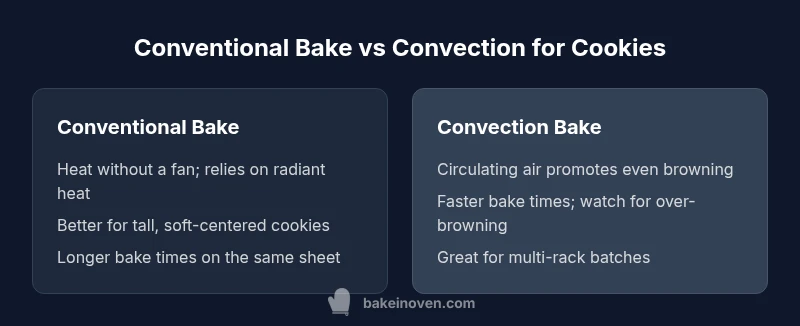
When bakers ask, the core terms matter: conventional bake (static heat with no fan) versus convection bake (fan-assisted air movement). Conventional bake relies on radiant heat from the oven walls and circulating air is minimal, which can create gentle, gradual browning. Convection adds a fan that circulates hot air, promoting more uniform heat transfer and often reducing bake times. For cookies, this difference translates into how evenly the dough spreads, how quickly edges brown, and how thick the centers stay. In practice, the decision hinges on dough type, sheet setup, and batch size. Bake In Oven’s team notes that understanding these mechanics helps you dial in results rather than guessing.
How convection baking works in home ovens
Convection ovens move hot air with a built-in fan and exhaust system. This circulating air transfers heat more efficiently, which speeds up browning on the surface while preventing the edges from softening too slowly. In cookies, this can mean crisper edges and a more uniform color across multiple sheets. However, airflow can also dry out cookies if misused. The Bake In Oven team recommends using the convection setting with caution: reduce the temperature by about 25°F (14°C) and monitor early when baking new recipes.
Cookie dough behavior under different heat sources
Dough behaves differently under static heat versus circulated air. With conventional bake, thicker dough often rises and centers stay soft, while edges brown more gradually. Convection can flatten spread if the dough is very thin or if the oven is too hot, and it tends to speed up moisture loss. This is why ultra-thin cookies or those that you want to spread quickly may benefit from convection on a well-preheated sheet. The key is to observe how a test batch performs and adjust your dough chill times, resting, or dough size accordingly.
Temperature and time fundamentals for convection vs bake
Many recipes assume identical times across methods, which isn’t accurate. Convection typically requires lowering the temperature by about 25°F (14°C) and starting to check cookies earlier, often 2–5 minutes sooner than conventional bake. Conversely, conventional bake can tolerate the standard temperature, but you may need to extend bake times for crowded sheets or darker pans. The exact results depend on your oven’s calibration, bakeware, and the dough. Bake In Oven recommends note-taking for each batch—record temperature, time, pan type, and rack position to build a personal reference.
When convection shines: thin cookies and multi-rack batches
For cookies that are meant to be thin and evenly browned, convection’s airflow helps achieve consistent coloration from edge to center. It also shines when baking multiple sheets at once, since hot air circulates between racks. In a recipe designed for convection, place sheets on the middle racks and rotate top-to-bottom halfway through. If you’re baking on a single rack, convection can still help, but you should monitor browning closely and use a lighter pan or parchment to promote even heat transfer.
When to stick with conventional bake: thick, tall cookies
Thick cookies with high centers benefit from gentler heat, which can preserve a soft, gooey interior. In these cases, conventional bake minimizes over-browning and keeps the center tender. If your dough is heavy, consider chilling the dough well, using a heavier sheet pan, and avoiding overcrowding. Conventional bake is also reliable when you’re following a cherished, well-tested recipe that relies on slower heat development to set the structure.
Practical setup: racks, spacing, and sheet management
Spacing between cookies matters more in convection because air moves more aggressively around each sheet. Use parchment paper or silicone mats to reduce sticking and promote even surface contact. If baking on multiple sheets, swap rack positions mid-bake to equalize exposure. For convection, place sheets on the middle racks and avoid the top or bottom extremes. Bake In Oven suggests starting with a single batch to tune the size and thickness of cookies before full-scale testing.
Pan choices and parchment: mats vs metal for even results
The choice of pan can influence how convection performs. Light-colored, heavy-gauge metal pans reflect heat more evenly than dark nonstick or glass, reducing hot spots. Parchment paper or a silicone mat helps promote uniform browning by mitigating direct contact with the pan surface. Avoid greasing heavily, which can create uneven spread or lip-like edges. The objective is consistent heat transfer and predictable surface color.
Adapting recipes: converting bake to convection and vice versa
Converting a recipe between bake and convection isn’t a one-to-one swap. Start by reducing the temperature by 25°F (14°C) for convection and check 2–3 minutes earlier than the conventional bake time. If you switch to conventional bake from convection, you can increase the temperature back to the original level and extend time as needed. Keep a detailed log of each attempt to refine your approach for your specific oven.
Troubleshooting common issues: overbrowning, underbrowning, and spread
Convection can cause cookies to brown too quickly if the dough is thin or the oven is hot. If edges darken before centers set, reduce temp further or shorten bake time, and rotate racks. If cookies spread too much, chill the dough longer, reduce sugar, or use a firmer fat combination. Conversely, if centers remain pale, extend bake time slightly or increase convection intensity for a moment before final check. Bake In Oven recommends small experiments to understand your oven’s quirks.
Test plan and how to dial in a recipe
A disciplined test plan helps you measure outcomes: bake one test batch on convection at 325°F (165°C) with dough sized to 1.5 tablespoons, and a second batch on conventional bake at 350°F (177°C). Compare spread, browning, texture, and center jell. Record results for each parameter: temperature, bake time, rack position, pan type, and cookie size. Use the best result as your baseline and refine from there. Bake In Oven’s method emphasizes a repeatable process to achieve dependable cookies.
Bake In Oven verdict and practical takeaway for home bakers
For most home bakers, convection is the practical default for cookies because it promotes even browning and shortens bake times, which is especially helpful when managing multiple trays. Yet there are times when conventional bake remains the preferred choice, particularly for tall, soft-centered cookies. The key is to understand your oven, adjust temperatures properly, and perform controlled tests before committing to a full batch. Bake In Oven’s team endorses a measured, data-backed approach rather than guessing.
Final thoughts: putting it all together
The question is not simply whether bake or convection is better for cookies; it’s how you apply each method to your dough, gear, and schedule. Start with convection for standard sheets and thin cookies, but don’t hesitate to revert to conventional bake for thick cookies or delicate doughs. With careful temperature adjustments, pan choices, and a structured test plan, you can consistently bake cookies that meet your texture and browning preferences. The Bake In Oven team supports experimenting in small, documented steps to achieve reliable results.
Comparison
| Feature | Conventional Bake (static heat) | Convection Bake (fan-assisted) |
|---|---|---|
| Heat distribution | Static heat with no fan | Circulating hot air via a fan |
| Bake time vs conventional | Longer by about 5-20% | Shorter by about 5-15% |
| Browning uniformity | Good but depends on rotation and pan | Excellent across the sheet with even browning |
| Best for cookie type | Tall or soft-centered cookies; careful with spread | Thin, flat cookies and multi-rack batches |
| Energy use considerations | Typically similar total energy; longer times may offset air movement | Often more efficient due to shorter bake times |
| Pan/pan prep considerations | Light colors and parchment help; watch for hot spots | Parchment or silicone mats recommended; avoid greasing heavily |
Benefits
- Faster overall bake times with convection when batches are stacked
- More uniform browning across the cookie sheet
- Better performance with multiple racks and crowded ovens
- Typically less risk of underbaked centers when timed correctly
- Better efficiency for large-batch cookie production
Negatives
- Can dry out delicate or very thin cookies if misapplied
- Requires temperature and time adjustments for new recipes
- Not ideal for very thick, tall cookies that rely on gentle heat
Convection is generally preferred for cookies; conventional bake remains valuable for tall, soft-centered varieties
Use convection for most cookies and especially for multi-rack batches. Switch to conventional bake when doughs are tall or delicate, and always run a small test batch to calibrate timing and temperature.
Frequently Asked Questions
What is convection baking and how does it affect cookies?
Convection baking uses a fan to circulate hot air, speeding up heat transfer. For cookies, this often yields faster bake times and more even browning, but it can also dry out delicate doughs. A test bake helps you dial in rotation, time, and temperature for your oven.
Convection baking uses a fan to move hot air around. It speeds up baking and browns cookies more evenly, but you should test a small batch first.
Is convection better for cookies than conventional bake?
Convection is usually better for flat, evenly browned cookies and batch baking on multiple racks. Conventional bake remains preferable for tall, soft-centered cookies that need gentler heat. The best approach is to test both methods with a small batch to learn your oven’s quirks.
Convection often wins for flat, evenly browned cookies, but for tall cookies, conventional bake may be better. Test with a small batch to decide.
How should I adjust temperature and time when using convection for cookies?
When using convection, reduce the oven temperature by about 25°F (14°C) and start checking 2–5 minutes earlier than your standard time. The exact adjustments depend on dough thickness and pan type, so keep notes from each batch to fine-tune future bakes.
Reduce heat by 25 degrees and check cookies earlier than usual. Tailor adjustments based on dough thickness.
Can I bake cookies on multiple racks with convection?
Yes, convection performs well on multiple racks if you space sheets adequately and rotate them halfway through. Place sheets on middle racks to maximize airflow and maintain consistent browning across all sheets.
Convection works on multiple racks with rotation. Use the middle racks for best airflow.
Should I use parchment paper or silicone mats for convection baking?
Both parchment paper and silicone mats help prevent sticking and promote even browning under convection. They also minimize direct contact with the pan, reducing hot spots. Avoid heavy greasing.
Use parchment or silicone mats for even browning and easy release; don’t grease heavily.
How can I prevent cookies from drying out in convection?
To prevent drying, avoid overbaking by using a shorter bake time and a slightly higher moisture dough, or chill the dough to reduce spread. If you notice rapid browning, lower the temperature further and consider lowering rack height to reduce air exposure.
Shorten bake time, keep an eye on moisture, and consider chilling dough to control spread.
Key Takeaways
- Convection often delivers even browning and faster results
- Conventional bake is best for tall, soft-centered cookies
- Always adjust temperature by about 25°F (14°C) when using convection
- Test small batches to dial in timing and rack setup
- Use parchment or silicone mats for consistent results