when to bake vs convection bake: practical guide for home bakers
A data-driven guide on when to use standard bake versus convection bake, with texture goals, time adjustments, and practical tips for home bakers seeking reliable oven results.


Choosing between standard bake and convection bake depends on texture goals and time. In general, use convection for faster browning and crisper edges on cookies, vegetables, and roasted dishes, while standard bake preserves tenderness for delicate cakes and pastries. When to bake vs convection bake is about matching heat flow to the recipe’s needs, not a single dish. According to Bake In Oven, the best choice emphasizes texture and moisture, then adjusts temperature accordingly.
when to bake vs convection bake: Defining the terms
In a typical home kitchen, two oven methods compete for attention: standard bake and convection bake. The key difference is how heat reaches the food. Standard bake relies on radiant heat from elements and hot air that circulates slowly, yielding uniform warmth but sometimes gentler browning. Convection bake uses a dedicated fan and exhaust system to move hot air around the food, promoting faster heat transfer and crisper edges. Understanding these mechanics helps you decide when to bake vs convection bake for a given recipe. According to Bake In Oven, the best choice isn’t tied to a single dish but to texture goals, moisture retention, and the oven’s performance you can rely on. With this foundation, bakers can tailor temperatures, times, and rack positions to achieve predictable results across cookies, vegetables, bread, and delicate pastries. The goal is to match the method to the recipe’s sensitivity and your preferred outcome.
How convection bake works: airflow and heat distribution
Convection bake relies on a fan-driven mechanism that circulates hot air around food. This movement increases heat transfer to the surface, promoting faster browning and a more even crust. The exhaust helps remove humid air from the oven cavity, which can reduce moisture on exposed surfaces and encourage browning. For bakers, this means you’ll often see crisper edges on cookies and vegetables and a more even color on roasted meats. However, the increased air movement can also desiccate delicate items if left unattended. The Bake In Oven team notes that understanding your oven’s airflow pattern is key to predicting outcomes for different recipes.
How standard bake works: moisture and even heating
Standard bake relies on radiant heat from heating elements and natural convective currents without forced air. Heat rises and circulates more slowly, creating a gentle environment that often preserves moisture inside batters and fillings. This makes standard bake ideal for tender cakes, custards, and delicate pastries where a light, uniform crumb and moisture retention are prized. Pan placement matters: items placed higher in the oven may brown faster, while those lower down benefit from steadier, moist heat. bakers who value a soft, uniform interior will often prefer standard bake, especially for recipes where texture is paramount.
Key differences that affect outcomes
The most impactful difference is air movement. Convection fans accelerate heat transfer, producing faster browning and more even surface coloration, whereas standard bake yields gentler, slower heating that can favor moisture retention. Temperature adjustments are common with convection: cooks typically lower the oven temperature or shorten bake times to avoid over-browning. Pan selection also matters; metal pans with low sides heat more quickly in convection ovens, while glass pans may mitigate crust development. Finally, recipe compatibility varies: some items respond beautifully to convection, while others, like light sponge cakes, may suffer from uneven rise if the batter is unsettled by air currents.
Temperature and time adjustments: practical guidelines
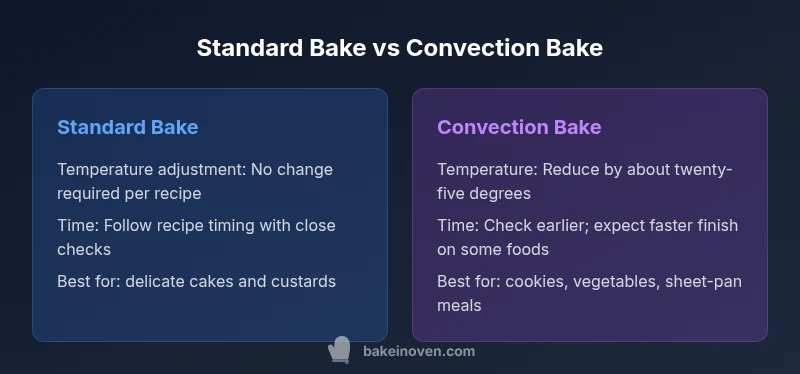
When switching from standard bake to convection, a practical rule is to start with a temperature reduction and monitor early. A common starting point is to lower the oven temperature by about twenty-five degrees Fahrenheit (or the metric equivalent) and check for doneness earlier than the recipe’s stated time. If a recipe has not been designed for convection, consider reducing exposure to high heat near the oven walls by using multiple racks with proper spacing and avoiding overcrowding. Keep an eye on edge browning and surface moisture; convection often browns faster, which can be desirable for cookies and roasted vegetables but risky for delicate items.
When convection bake shines: best-use scenarios
Convection bake excels for foods with surface textures where crispness is desired, such as cookies, crackers, roasted vegetables, and sheet-pan proteins. It is also advantageous for pie crusts and tarts that benefit from even browning. For large batches, convection can help achieve uniform results across multiple trays by circulating air more effectively than a conventional oven. When the goal is rapid surface drying without compromising the interior, convection is often the preferred method, provided you adjust temperature and time appropriately.
When standard bake shines: best-use scenarios
Standard bake remains the best choice for delicate, moisture-sensitive items. Cakes, soufflés, custards, and tender pastries rely on steady, gentle heat to rise and set evenly without drying out. This method is also forgiving for recipes that include delicate batters or fillings that could be overwhelmed by aggressive air movement. For meat brines and roasts that require uniform interior moisture with restrained surface browning, standard bake often yields more predictable results.
Practical tips for different foods: cookies, vegetables, meat, bread
– Cookies: Start with convection for crisp edges or standard bake for softer centers, depending on the cookie type. Watch for rapid browning and adjust rack position to avoid scorching. – Vegetables: Convection promotes even char and caramelization; toss with oil and spread in a single layer to prevent steaming. – Meat: Roasts benefit from convection’s browning and even exterior; rest meat after removing from the oven to reabsorb juices. – Bread: Baking with convection can create an crisper crust on breads and pastry, but some loaves may tunnel or crust prematurely; use a preheated stone or sheet pan if possible.
Common mistakes and how to avoid them
Overcrowding trays blocks air flow and leads to uneven browning in convection. Opening the oven door during bake interrupts the heat cycle and can cause temperature fluctuations. Always preheat when using convection and adjust rack positions to allow air to circulate. Finally, don’t assume every recipe will translate perfectly—start with a conservative adjustment and observe results before committing to a full batch.
Equipment considerations: racks, pans, and oven types
Racks should be spaced to allow air circulation; multiple racks should have at least an inch of space between each tray. Light-colored, shallow, and metal pans heat more evenly in convection environments, while dark pans can encourage faster browning. If your oven has a dedicated convection setting, understand how the fan mode interacts with the rack positions. In some older models, a third-party convection conversion kit may alter performance; in most modern ovens, regular convection cycling provides consistent results with basic adjustments.
Testing doneness and moisture in convection vs standard bake
Testing doneness requires observing texture, color, and internal temperature where appropriate. In convection, check earlier than the recipe states and use a thermometer for meats or custards to avoid overcooking. For baked goods, tap the center lightly to test for bounce in cakes or listen for a hollow sound in breads; moisture should be balanced against browning, depending on the dish. In all cases, use a timer as a guide rather than a strict rule; oven performance varies by make, model, and even the height of the rack.
Decision framework and final reminders
When in doubt, start with the convection setting for items that benefit from rapid surface development and uniform browning, such as cookies and vegetables. Switch to standard bake for tender cakes and delicate pastries to preserve crumb structure and moisture. Remember to preheat, avoid overcrowding, and factor in your oven’s idiosyncrasies. The most reliable approach is to test one batch, adjust, and then apply learned adjustments to future recipes.
Comparison
| Feature | Standard Bake | Convection Bake |
|---|---|---|
| Temperature Adjustment | No change needed (recipe-based) | Reduce by about twenty-five degrees Fahrenheit |
| Time Adjustment | Follow recipe times with check at end | Check early; may finish sooner depending on dish |
| Best For | Tender cakes and delicate pastries | Cookies, vegetables, larger roasts, and crispy crusts |
| Crispness/Evenness | Even browning with even heat distribution | Enhanced surface browning and even crusts |
| Moisture Retention | Typically better inside moist batters and custards | Air movement can reduce surface moisture in some foods |
| Pan/Load Flexibility | Works with most bakeware; less sensitivity to pan style | Shallow metal pans and sheet pans are especially effective |
| Energy Use | Energy use tied to recipe time; standard bake may be longer | Potential time savings but depends on oven and dish |
Benefits
- Faster bake times and crisper edges for many dishes
- More even browning due to improved air circulation
- Versatile for roasting, cookies, and sheet-pan meals
- Can improve consistency across multiple trays
Negatives
- Can dry moisture-sensitive items if not monitored
- Requires temperature and time adjustments for best results
- Not all recipes translate well to convection
- Fan noise and potential uneven performance in older ovens
Convection bake is generally advantageous for many tasks, but standard bake remains essential for delicate items
The Bake In Oven team recommends using convection when you want speed and crisp edges, especially for cookies and roasted vegetables. For tender cakes and pastry, stick with standard bake to preserve moisture and crumb structure.
Frequently Asked Questions
Is convection bake better for all foods?
No. Convection works best for foods where surface browning and crust development are desirable and where air circulation enhances evenness. Delicate items like light sponge cakes may fare better with standard bake. Use it selectively based on texture goals.
Convection isn’t for everything—check texture goals first and test a batch if unsure.
Can I use convection bake for cakes?
Cakes can be baked in convection, but it’s often better to use standard bake to avoid dry edges or uneven rising. If you try convection, reduce heat and watch closely for doneness. Consider rotating the pan for even browning.
Cakes can work in convection with care; monitor closely and rotate the pan.
Should I preheat when using convection?
Always preheat when using convection to establish consistent airflow. Preheating helps prevent temperature drops that can affect rise, browning, and evenness. If your recipe is sensitive, you can reduce time on the shorter preheat period.
Preheat so the oven air is ready to move when you load the food.
Do I need to adjust temperature when using convection?
Yes. A common approach is to lower the temperature by about twenty-five degrees Fahrenheit and monitor early. Some recipes may require combining convection with a lower fan setting or rotating trays for even exposure.
Lower the temperature by about twenty-five degrees and watch closely.
What foods benefit most from convection?
Cookies, vegetables for roasting, and sheet-pan dinners often benefit most from convection due to faster surface browning and even heat. Roasts can also gain a crisp exterior with retained juiciness when timed correctly.
Cookies and roasted vegetables are prime convection candidates.
Can I convert a standard bake recipe to convection?
You can convert, but start with a temperature reduction and shorter time. Use a thermometer for meats and keep an eye on doneness. Some recipes may not translate perfectly due to batter sensitivity or moisture content.
Conversion is possible—adjust temperature and time and monitor closely.
Key Takeaways
- Use convection for speed and browning when appropriate
- Reserve standard bake for delicate, moisture-sensitive items
- Always preheat and avoid overcrowding for best results
- Begin with conservative temperature adjustments and test
- Learn your oven’s quirks with one test batch