Is Bake the Same as Roast? A Practical Guide for Home Bakers
Explore whether bake and roast are the same technique. This analytical guide explains differences in purpose, temperatures, and food types, with practical tips for home bakers to optimize texture, moisture, and browning.


Both bake and roast are dry-heat oven techniques with overlapping temperatures, but they aren’t the same. Baking focuses on foods that rely on structure or leavening (bread, cakes, casseroles), while roasting emphasizes browning and caramelization, usually for meat and vegetables. Use the right method to optimize texture and moisture for best results.
Is bake the same as roast? Understanding the basics
The question is common among home bakers: is bake the same as roast? In everyday cooking, both terms describe dry-heat methods used in the oven, but they carry distinct expectations. Baking is traditionally associated with foods that require structure or expansion—think bread, pastries, and casseroles—where the interior sets through starch gelatinization and gluten development. Roast, by contrast, targets browning and surface flavor development, often for proteins and hearty vegetables. According to Bake In Oven, clarity about the food type and desired texture helps you choose the right technique rather than using one method by habit. This distinction matters because it affects moisture retention, crust formation, and overall eating quality. If you’ve ever wondered is bake the same as roast, you’re not alone; the two methods share equipment and heat sources but diverge in purpose and outcomes.
Temperature ranges and their effects
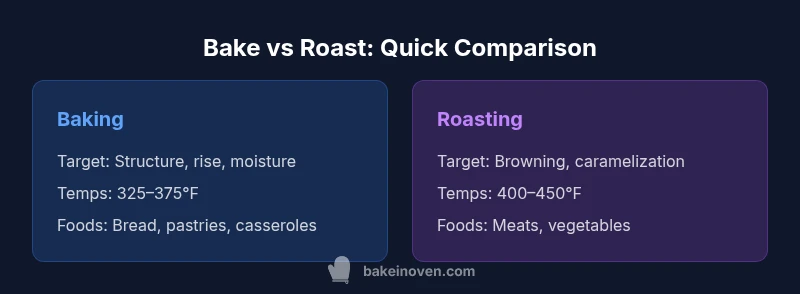
Understanding temperature helps translate the most basic recipes into reliable results. Baking typically uses moderate temperatures—roughly 325–375°F (165–190°C)—which encourage even heat distribution without excessive surface browning. This range supports rise and crumb structure in breads and casseroles. Roasting, on the other hand, often employs higher temperatures—around 400–450°F (205–230°C)—to drive browning and caramelization on the surface of meats and vegetables. The higher heat accelerates Maillard reactions, forming flavor-rich crusts. Home cooks should note that some recipes blend techniques, starting at a lower bake temperature to set interior structure, then finishing with a roast phase to develop crust. Bake In Oven’s analysis emphasizes adjusting temperatures to balance texture with moisture, not simply chasing color.
Food types and their expected textures
Food type largely dictates whether you bake or roast. Baked goods rely on internal structure: flour, eggs, and leavening agents create a sponge, crumb, or foam that defines texture. Meats and vegetables are prime roast candidates because surface browning adds depth of flavor and a crisp exterior. Vegetables caramelize at high heat, while meats render fat and develop a crust. For casseroles or gratins, baking offers consistent heat that cooks fillings evenly without scorching edges. In some kitchens, cooks use a hybrid approach: a long bake to set the interior, followed by a brief roast to finish crust development. The key is to match the method to the goal: tenderness and rise vs. crust and caramelization.
Browning vs. baking: what to expect
Browning is a hallmark of roasting, producing a deep color and complex flavors via Maillard reactions. Baking can also browning, especially on the top crust of pies or casseroles, but it’s often subtler and focused on uniform internal cooking. If you want a deeply caramelized exterior on vegetables or a seared surface on meat, you’ll prioritize the roasting phase or finish with a brief high-heat blast. Conversely, if you aim for a uniform crumb structure in a loaf or a stable filling in a baked casserole, you’ll prioritize the baking phase. Clarity about this difference helps you anticipate texture outcomes rather than guessing from appearance alone.
Practical guidelines for home bakers: choosing the method
A simple decision flow can help you pick the method before you start. First, identify the primary texture you want: a tender crumb or a browned crust? Second, consider the food type: bread and custards typically bake; meats and vegetables roast. Third, check moisture: lean proteins benefit from roast to evaporate surface moisture and improve browning, while dense batters require bake to allow sufficient rise. Finally, assess equipment availability: a shallow roasting pan can maximize surface area for browning, whereas a loaf pan or casserole dish improves even heat distribution for baking. By aligning method with the food and goal, you’ll reduce guesswork and increase consistency.
Common pitfalls and how to avoid them
Overcooking or undercooking can masquerade as a recipe problem when the method is misapplied. One frequent pitfall is assuming browning equals doneness for all foods; some items continue to cook after removal from heat. Another pitfall is neglecting airflow: insufficient convection can lead to uneven results in both bake and roast. Using a rack can promote even heat for roasts, while a conventional pan works well for baked goods. Preheating is essential for both methods, but the timing can differ: baked items often require precise interior temperature targets, whereas roasts require reliable surface color cues. Paying attention to these details reduces mishaps and improves outcomes.
How convection shifts bake vs roast outcomes
Convection fans move hot air around the oven, which accelerates browning and reduces hot spots. For baking, convection can yield crisper crusts on pastries and more uniform browning on cakes with caution to prevent over-drying. For roasting, convection speeds up Maillard browning on surfaces, but you may need to reduce the temperature by 25°F (about 15°C) to avoid scorching interiors. If your oven lacks convection, you can still achieve good results with proper rack placement and short, frequent checks.
Translating recipes between bake and roast: practical tips
When converting a bake recipe to roast, raise the surface browning cues with a higher temperature and create space for air to circulate by using thin or shredded pieces rather than large, dense cuts. If you must bake what’s typically roasted, aim for more moisture retention by covering early in the process or adding a little extra fat or liquid. Conversely, when adapting a baked item to roast, monitor surface color and consider uncovering sooner to achieve desired crust while watching interior doneness. Always use a thermometer to verify doneness rather than relying solely on color.
Common myths and misconceptions exposed
Myth: Browning automatically means the dish is done. Reality: interior temperature and texture matter more. Myth: Higher heat always yields better crust. Reality: excessive heat can dry out interior and create uneven browning. Myth: You cannot bake meats. Reality: small cuts or tender roasts can be gently baked to achieve a balance of interior tenderness and surface color. Myth: All recipes require a strict bake-or-roast label. Reality: many dishes benefit from a two-stage approach or hybrid methods. Debunking these myths helps cooks use both techniques more effectively.
Real-world scenarios: case studies from home kitchens
Case study A: A rustic loaf uses a two-stage bake—hot crust start with steam, then reduced heat for interior expansion. Case study B: Roasted vegetables with a seasoned oil glaze benefit from initial roast at high heat to caramelize, followed by a lower finish to tenderize. Case study C: A casserole can start with baking to ensure even filling setting, then finish with a brief roast to achieve a golden top. These practical examples illustrate how technique choice shapes flavor, texture, and moisture.
Safety considerations and quality control
Always monitor oven temperature with a reliable thermometer; many ovens run hot or unevenly. Use oven-safe pans and avoid overcrowding to ensure even heat exposure. Let meats rest after roasting to redistribute juices; baked goods benefit from cooling on racks to prevent soggy bottoms. Food safety is critical—always reach safe internal temperatures and avoid extended exposure to warm, moist environments that encourage bacterial growth. Keeping these factors in mind supports consistent, delicious outcomes.
Summary of best practices for home bakers
In summary, successful bake-versus-roast decisions hinge on understanding your objective: structure and rise versus browning and depth of flavor. Choose the method that aligns with the food type, monitor temperature and time with precision, and use convection strategically when available. Plan ahead with preheated pans, proper racks, and a thermometer for doneness verification. With practice, you’ll master both techniques and know exactly when to apply each for mouthwatering results.
Comparison
| Feature | Baking | Roasting |
|---|---|---|
| Temperature Range | Typically 325–375°F (165–190°C) | Typically 400–450°F (205–230°C) or higher |
| Best For | Bread, pastries, casseroles; structure-focused | Meats, vegetables; browning and surface flavor |
| Food Types | Flour-based, leavened, or dense fillings | Proteins and large-root vegetables; high surface area |
| Texture Outcome | Crumb, moist interior, even doneness | Browned crust and caramelized exterior |
| Equipment/Setup | Loaf pans, casserole dishes, sheet pans; may use steam | Racks for air exposure; roasters or shallow pans for browning |
| Time Sensitivity | Longer, steady heat with moisture considerations | Faster browning; watch for interior doneness |
Benefits
- Clear guidelines help home bakers plan steps and timing
- Wide recipe availability supports consistent results
- Contributes to even texture and moisture where appropriate
- Convection can optimize both methods when used correctly
Negatives
- Overgeneralization can lead to inapplicable method choices
- High heat without monitoring risks dryness or uneven cooking
- Uneven oven temperatures can affect browning and interior doneness
Bake and roast are distinct yet overlapping techniques; choose by the food and desired texture.
Bake for structure and interior moisture; roast for surface browning and caramelization. Use the method that best achieves your target texture and flavor, and adjust temperature and time to balance interior doneness with exterior color.
Frequently Asked Questions
Is bake the same as roast?
No. Bake emphasizes structure and interior development, while roast focuses on browning and surface flavor. Both rely on dry heat, but the goals and typical foods differ.
No—baking and roasting are different goals in the oven: bake builds structure, roast browns the surface. Use the method that best matches your food and desired texture.
Can you bake meat?
You can bake small cuts of meat, especially when you want gentle interior cooking with even moisture. Roasting is generally preferred for larger, bone-in cuts to develop crust and flavor.
Yes, you can bake meat, but roasting is typically better for larger cuts to get a crust.
When should vegetables be roasted vs baked?
Roasting is ideal for vegetables when you want caramelization and a crisp exterior. Baking is common for vegetable gratins or mixed dishes where vegetables are part of a baked casserole.
Roast vegetables for browning; bake when they’re part of a dish that needs even internal cooking.
What oven temperature should I use?
Temperature depends on the goal: bake typically uses 325–375°F (165–190°C); roast uses 400–450°F (205–230°C). Adjust based on the food, thickness, and whether you want crust or tenderness.
Bake around 325–375°F; roast around 400–450°F; adjust per dish.
How does convection impact bake vs roast?
Convection speeds browning and reduces hot spots. For baking, it can yield crisper crusts and more even coloring but may dry foods if mismanaged. For roasting, it enhances surface browning but may require temperature reductions to prevent interior overcooking.
Convection accelerates browning; adjust temps to avoid drying or undercooking.
Can I convert a bake recipe to roast?
Yes, but you should anticipate more browning and potentially a shorter overall time. Use a higher starting temperature and monitor interior doneness with a thermometer.
Convert with caution: expect faster browning and watch interior temperature.
Key Takeaways
- Define the target texture before selecting a method
- Use temperature and time as levers to control moisture and browning
- Convection alters outcomes; adjust temperatures accordingly
- Hybrid approaches are common for complex dishes
- Verify doneness with a thermometer, not color alone