Convection Bake vs Roast: Understanding the Difference
Explore the practical differences between convection bake and convection roast, how airflow affects browning and moisture, and actionable tips to apply the right setting for your recipes.


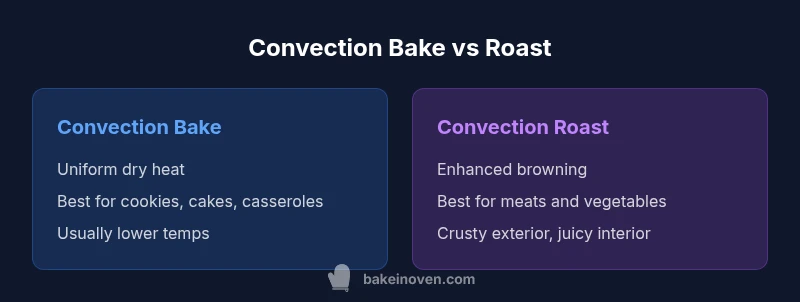
Convection bake and convection roast both use a fan-assisted oven to circulate hot air, but they target different outcomes. Bake mode emphasizes even, dry heat for pastries and casseroles, while roast mode amplifies browning and crust formation on meats and vegetables. Understanding these differences helps you choose the right setting for texture, moisture, and time.
What convection bake vs convection roast mean in practical terms
According to Bake In Oven, convection bake and convection roast are two fan-assisted oven modes that optimize heat transfer by circulating hot air around the food. Bake mode focuses on steady, even heat ideal for pastries, casseroles, and delicate batters where a uniform crumb and consistent moisture are important. Roast mode, by contrast, prioritizes aggressive browning and crust formation, making it better suited for meats, poultry, and vegetables where a flavorful exterior matters as much as the interior texture. The practical takeaway is simple: choose bake for gentle, even cooking and roast for crusty, browned surfaces. The Bake In Oven team notes that recognizing when to switch modes can save time and improve repeatability in your kitchen.
How convection ovens achieve these results: airflow, fan speed, and heating elements
Convection ovens circulate hot air with a rear or built-in fan, often assisted by multiple heating elements. The moving air conducts heat more rapidly away from the surface of the food, which reduces the risk of hot spots and promotes even cooking. In convection bake, the emphasis is on steady airflow with moderate fan speed to dry out surfaces evenly without excessive browning. In convection roast, increased airflow and higher perceived heat promote faster Maillard browning on the exterior while keeping the interior moist when timed correctly. Understanding this mechanism helps you adjust temperatures and durations to achieve your target texture.
The science behind browning and moisture with convection
Browning is driven by the Maillard reaction, which accelerates when heat is intense and moisture on the surface is managed. Convection moves moisture away from the surface, allowing sugars and amino acids to react more quickly, creating that desirable crust. For baked goods, this translates to crisp edges and a well-developed crust without compromising the crumb inside. For meats, rapid surface drying forms a crust that can trap juices inside if monitored properly. The balance between surface moisture and interior temperature is what convection techniques optimize, and small adjustments in time and temperature can yield noticeably different results.
Use cases: when to bake vs roast in convection mode
Convection bake is ideal for:
- Cookies, puff pastries, croissants, and muffins that benefit from quick surface drying and even browning
- Casseroles and gratins where an evenly heated top layer matters
- Dishes that require a uniform crust without excessive surface darkening
Convection roast is ideal for:
- Whole birds, large roasts, and thick cuts of meat needing a browned exterior
- Roasted vegetables that develop a deep, caramelized crust
- Dishes where a crusty exterior enhances flavor while interior remains juicy
Many home cooks switch between modes within the same meal plan, using bake for the starches and sides and roast for the protein. This approach takes advantage of each mode’s strengths.
Temperature and time guidelines for converting standard recipes
When using convection, a common rule of thumb is to reduce the temperature by about 25-50°F (15-30°C) from standard bake or roast temperatures. Time adjustments vary by dish size and density; expect shorter overall cook times due to improved heat transfer, but monitor carefully near the end of cooking. Start by checking doneness earlier than the original recipe, using internal temperature for meats or a toothpick/crack test for baked goods. If you’re unsure, perform a quick test bake or roast on a small item first to calibrate your oven’s airflow and browning potential.
Preheating and equipment setup: rack placement, pans, and airflow
Preheating is usually recommended, especially when browning is a goal. Position racks to maximize air circulation: avoid stacking foods and ensure there is space around pans for air to flow. For bake items like cookies or sheet pan meals, use shallow, open pans to promote surface contact with the hot air. For roasts, a rack set inside a sturdy roasting pan helps air circulate underneath the meat, creating even browning on all sides. If you’re using dark or nonstick bakeware, reduce heat slightly to prevent over-browning.
Common pitfalls and how to avoid them
- Over-browning: shorten time or lower temperature and rotate pans halfway through.
- Uneven browning: rotate racks or swap pan positions during cooking.
- Dry surfaces on delicate items: consider lowering airflow by using a vented setting or covering with parchment briefly to protect moisture.
- Inconsistent results: always preheat, level pans, and avoid overcrowding to maintain consistent airflow.
- Recipe reliance: not all baked goods respond the same to convection; test and adjust gradually.
Texture and moisture outcomes: browning, crust, and juiciness
Convection tends to promote crusty surfaces and even browning, which is ideal for roasts and many baked goods requiring a crisp exterior. However, excessive airflow can dry delicate items if not monitored. For meats, the crust forms early, trapping juices if the internal temperature is watched closely. For pastries, careful timing can yield a flaky crumb with a uniform color across the surface. The key is to adjust heat and time to cooperate with the dish’s inherent moisture content and density.
Step-by-step practical guide for a bake and a roast using convection
- Preheat the oven to the convection target temperature. 2) Prepare your ingredients and arrange on a shallow, open tray or roasting pan with a rack for air contact. 3) Place the tray in the center of the oven to maximize even airflow. 4) Start with a conservative time estimate and check doneness early with a thermometer or visual cues. 5) If browning is uneven, rotate the tray 180 degrees or swap rack positions. 6) Allow a brief rest period for meats to redistribute juices before carving or serving. 7) Clean pans and allow the oven to re-stabilize before a subsequent bake or roast.
Myths vs realities: debunking common convection kitchen myths
Myth: Convection always cooks faster. Reality: It often reduces total time but depends on dish size and airflow. Myth: You must lower temperatures by a fixed amount. Reality: Some ovens require more fine-tuning; use a test bake to calibrate. Myth: Convection is only for meats. Reality: It benefits most baked goods, including pastries and even casseroles. Myth: Preheating is optional. Reality: Preheating improves browning and repeatability.
Real-world recipes that showcase convection bake vs roast
If you’re baking cookies, convection bake can yield uniform spread and color with less density in centers. For a roast chicken, convection roast produces a crisp skin and juicy interior when the internal temperature alignment is monitored. Vegetables like carrots and Brussels sprouts roast beautifully when a rack allows air to pass around each piece, promoting even caramelization. In practice, keep a log of outcomes to build your personal convection playbook and determine which mode best suits your preferred textures.
Decision framework: choosing the right mode for your dish
To decide between convection bake and convection roast, consider the ingredient type, target texture, and moisture needs. If you want moist interiors with a crisp exterior, use roast but monitor internal temperature to stop short of overcooking. If you seek even browning without drastic surface changes, bake is safer. For complex meals with multiple components, plan which elements benefit from each mode and sequence your steps to take advantage of airflow across the oven cavity.
Comparison
| Feature | Convection Bake | Convection Roast |
|---|---|---|
| Texture outcomes | Even, dry heat ideal for pastries, casseroles, and sensitive batters | Browns and crisps the exterior while keeping interiors juicy when timed correctly |
| Best for | Cookies, cakes, casseroles, and flatbreads needing uniform crumb | Meats, poultry, root vegetables, and dense roasts requiring crust and depth of flavor |
| Temperature adjustment | Typically 25-50°F lower than standard bake temperatures | Often similar reductions, but monitor for crust formation and avoid over-browning |
| Cook time impact | Can reduce overall time for some items due to efficient heat transfer | Can shorten or stabilize time for proper browning; watch toward the end |
| Pan/rack setup | Shallow, open pans; ensure space around foods for airflow | Rack inside a roasting pan to elevate meat and promote airflow below and around |
| Moisture management | Surface dries faster; suitable for crusts and crisp edges | Outer crust forms quickly, interior juices can be preserved with timing |
| Preheating | Usually recommended for best browning and consistency | Helpful, especially when aiming for a crust; plan accordingly |
| Energy use | Similar energy usage, but potential time savings due to airflow | Potentially higher efficiency through reduced cooking duration |
Benefits
- Faster cooking with even heat distribution
- Better browning and crust formation
- More consistent results across multiple items
- Versatile for baked goods and roasts
- Can reduce overall energy use with shorter times
Negatives
- Requires recipe adjustments and careful monitoring
- Not all foods benefit; risk of drying delicate items
- Airflow can cause uneven results if overcrowded or misused
- Some ovens require calibration for optimal performance
Convection bake and convection roast are complementary modes; choose based on food type and desired texture.
Use convection bake for baked goods and delicate dishes to maximize evenness. Use convection roast for meats and vegetables when you want a crust and robust browning, while keeping interior moist with careful timing.
Frequently Asked Questions
What is convection bake vs convection roast?
Convection bake uses a fan to circulate hot air for even, dry heat, ideal for pastries and casseroles. Convection roast emphasizes browning and crust formation for meats and vegetables. The choice depends on desired texture and moisture balance.
Convection bake dries surfaces evenly for baked goods; convection roast browns surfaces for meats. Pick based on texture you want.
Do I need to preheat a convection oven for bake or roast?
Preheating helps achieve consistent browning and texture, especially for crust development. Some quick-start methods exist, but for predictable results, preheat to your target temperature.
Preheat for best browning and consistency; it helps the air circulate as expected.
Can I bake and roast with the same temperature in convection mode?
You can often use a similar temperature, but you should reduce by about 25°F (15°C) and watch for doneness, as different foods respond differently to convection.
Yes, but start lower and check doneness early.
Which foods should I avoid using convection bake?
Delicate custards, light sponge cakes, and very moist batters can over-brown or dry out under strong air flow. Consider conventional bake for those items or adjust time and temperature carefully.
Delicate cakes and custards may not fare well with full convection.
How do I convert standard bake times to convection?
Start by reducing the temperature by about 25°F (15°C) and check doneness earlier than the recipe suggests. Times vary with dish size and density, so perform a quick test run when possible.
Lower the temperature and start checking earlier.
Is convection the same as air fry?
Air fry is a form of high-airflow cooking, often with smaller, more compact appliances. Convection ovens use a built-in fan and heat source to circulate air inside a larger oven, designed for a wider range of foods.
Air fry is a high-airflow method; convection is broader and built into standard ovens.
Key Takeaways
- Know which foods benefit from convection baking vs roasting
- Always adjust temperature and time for convection cooking
- Preheat and use open pans with space for airflow
- Monitor doneness early to avoid overcooking
- Rotate pans and align rack position for even browning