Turkey Bake Time Chart: Perfect Oven Temps for Juicy Turkey
Discover a science-backed turkey bake time chart with safe temps, resting guidance, and practical oven tips to ensure juicy, evenly cooked turkey every time.


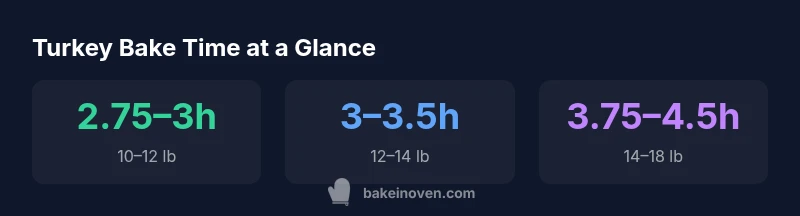
Using a turkey bake time chart helps you land juicy, safe poultry. At 325°F (165°C), follow weight-based estimates and finish with a 165°F internal temp. For a 10–12 lb turkey, expect roughly 2.75–3 hours; 12–14 lb about 3–3.5 hours; 14–18 lb can reach 3.75–4.5 hours. Rest 15–20 minutes before carving. Start checking early to avoid overcooking.
Why a Turkey Bake Time Chart Matters
A turkey bake time chart isn’t a rigid countdown; it’s a practical planning tool that translates weight into expected cook times while accounting for what happens inside your oven. The Bake In Oven team has found that even small deviations in oven performance, pan size, or turkey shape can shift finish times by 15–30 minutes. A chart helps you stage the process: when to prep, when to start checking, and when to pull the turkey from the oven to rest. Most important, the chart anchors the final doneness to a safe internal temperature of 165°F (74°C), which is essential for food safety. Resting the turkey after removal lets carryover heat finish the job without drying the meat. Finally, a chart provides a reference point for gravy: the pan drippings collected during the final phase are typically richest when the breast meat has just reached the target temperature. In practice, use the chart as a guide for timing, then verify with a thermometer and adjust for your unique oven and turkey size. With a reliable chart in hand, home cooks gain confidence and consistency, reducing last‑minute scrambling in the kitchen.
How to Read a Turkey Bake Time Chart
Charts usually present columns such as weight range, estimated bake time, and notes about whether the turkey is stuffed, pan size, and whether convection is used. The key is to map your bird weight to the expected range and to plan a window rather than a fixed minute. For example, a 12–14 lb turkey may show 3–3.5 hours at 325°F when unstuffed; add extra minutes if the bird is stuffed or the oven runs cooler. Always rely on the thermometer rather than the clock to confirm doneness. The chart also indicates resting time; the moment you pull the turkey is not the moment you serve. Carryover cooking can raise the temperature several degrees in the final minutes, so the thermometer should reach 165°F in the thickest part before you remove it from heat. If you are using a convection setting, reduce the time by about 10–15 minutes and check earlier. When using a chart, keep a log of outcomes to refine future cook times for your oven and turkey size. The goal is repeatable success, not perfection on the first try.
Step-By-Step: Create Your Own Chart
First, weigh the turkey accurately and choose an appropriate pan size. Preheat the oven to 325°F (165°C) and prepare the roasting setup (rack position, dry pat-drying, seasonings). Then, estimate the pre-rest cook time using a standard weight-based reference. Insert a reliable thermometer into the thickest part of the thigh without touching bone. Start checking around the lower end of the estimated window. When the thermometer reads 165°F, remove the turkey and let it rest. Record the actual time and resting outcome to adjust the chart for your kitchen. If you encounter convection cooking, run a small test with a known weight to calibrate the time before cooking a larger bird. Finally, update your chart seasonally for variations in turkey size or oven performance. For best results, maintain a consistent method: same pan, same rack height, and the same preheating routine every time.
Safety and Quality: Temperature, Rest, and Handling
Safety begins with proper thawing and handling; do not rush the process. Thaw in the fridge, not on the counter, and avoid cross-contamination by using separate utensils and cutting boards. The recommended final temperature for the thickest breast or thigh is 165°F (74°C). Carryover heat can push the temperature higher after removal, so plan to pull the bird a few degrees before the thermometer hits 165°F and allow 15–20 minutes of resting. Resting not only yields juicier meat but also stabilizes the juices for easier carving and a more presentable slice. When selecting a pan and rack, ensure the pan can accommodate any juices for pan gravy. If you brine or dry-brine, follow your brining protocol and be mindful of salt balance in your final dish. Always wash hands and surfaces after handling raw poultry; sanitize knives and countertops to prevent contamination.
Common Scenarios: Stuffed vs Unstuffed, Whole vs Parts
Stuffed birds require longer cooking times and careful temperature measurement; stuffing should reach 165°F to be safe, but this extends the overall cooking window and increases the risk of overcooking the breast. For best results, cook stuffing separately or use a preheated loaf inside the cavity and test the stuffing’s temperature separately. Unstuffed, whole birds tend to cook more evenly and predictably, which is why weight-based charts are most reliable for them. If you plan to roast turkey parts (breasts or thighs), use smaller, uniform pieces for consistent heat penetration. Keeping the breast meat away from overcooking is especially important because it dries quickly. The chart remains helpful for parts; simply adapt the weight-based window to your specific cut size and bone-in or bone-out configuration.
Practical Tips: Prepping, Pan Choice, and Juiciness
Pat the turkey dry, salt generously, and consider a quick dry brine if time allows. Patting dry improves browning and reduces steaming inside the cavity. Choose a roasting pan that fits the bird with room for air to circulate; a rack helps elevate the bird for even heat. Avoid overcrowding by using a large enough pan so drippings can collect for gravy. If you want crisp skin, finish under a hot broiler for a minute or two, watching carefully. Basting is optional; it can add surface moisture but won't change doneness and can extend the cook time if you open the oven frequently. A thermometer remains the most reliable guide; set it in the thickest part of the thigh, away from bone. If you brine, rinse lightly and pat dry before applying seasonings to avoid sweating during roasting.
Case Studies: 10–12 lb and 16 lb Turkeys
Consider two common cases. A 10–12 lb unstuffed turkey roasted at 325°F typically lands in the 2.75–3 hour window; after removal, rest 15–20 minutes before carving. A 16 lb turkey may fall toward the upper end of the range, around 4 hours, with a longer resting period. In both cases, verify doneness with a meat thermometer, checking the thickest part of the thigh and breast. If your oven tends to heat unevenly, plan extra minutes and rotate the pan halfway through cooking. Across the board, the safest approach is to rely on internal temperature rather than the clock, and to record outcomes to refine your personal chart for future holiday roasts.
Bake time chart by turkey weight
| Weight (lb) | Estimated bake time | Notes |
|---|---|---|
| 10–12 | 2.75–3 hours | Unstuffed; verify 165°F |
| 12–14 | 3–3.5 hours | Unstuffed; rest before carving |
| 14–18 | 3.75–4.5 hours | Unstuffed; check early |
Frequently Asked Questions
What is the safe internal temperature for turkey?
The safe internal temperature for turkey is 165°F (74°C) when measured in the thickest part of the breast or thigh with a calibrated instant-read thermometer. Letting the bird rest after removal helps carryover heat finish the job without drying the meat.
Aim for 165 degrees in the thickest part and rest the turkey before carving.
Should I baste my turkey during cooking?
Basting is optional and won’t make the turkey safer or more cooked. It can add surface moisture and flavor, but it may slightly extend cook time if you open the oven frequently. Rely on the thermometer to judge doneness instead.
Basting isn’t required for safety; use a thermometer and baste only if you enjoy the extra flavor over the extra fuss.
Is stuffing the turkey breast-safe at 165°F?
Stuffing inside the turkey can raise cooking time and may introduce safety concerns if the stuffing doesn’t reach 165°F. It’s safer to cook stuffing separately or use a preheated loaf as a cavity filler, then test the stuffing’s temperature independently.
Stuffing in the turkey isn’t recommended for safety; cook stuffing separately and test separately.
Can I reuse pan drippings for gravy?
Yes. Pan drippings add rich flavor. Deglaze the pan, simmer with stock, and thicken to make gravy. Heat the mixture to safe temperatures before serving.
Drippings are great for gravy—deglaze, simmer, and thicken; make sure it’s hot before serving.
How do I adapt bake times for a convection oven?
Convection can cook faster; reduce time by about 10–15 minutes and monitor earlier with a thermometer, especially for larger birds. Start checking closer to the lower end of the chart window.
If you use convection, check earlier and reduce time a bit; thermometer is your best guide.
“Timely bake times reduce guesswork and deliver juicier turkeys. Accurate, weight-based charts guide home bakers toward consistent results.”
Key Takeaways
- Follow weight-based timings with thermometer confirmation
- Unstuffed birds cook more evenly
- Allow 15–20 minutes resting time
- Calibrate your oven for best results
- Always use a safe, accurate thermometer